
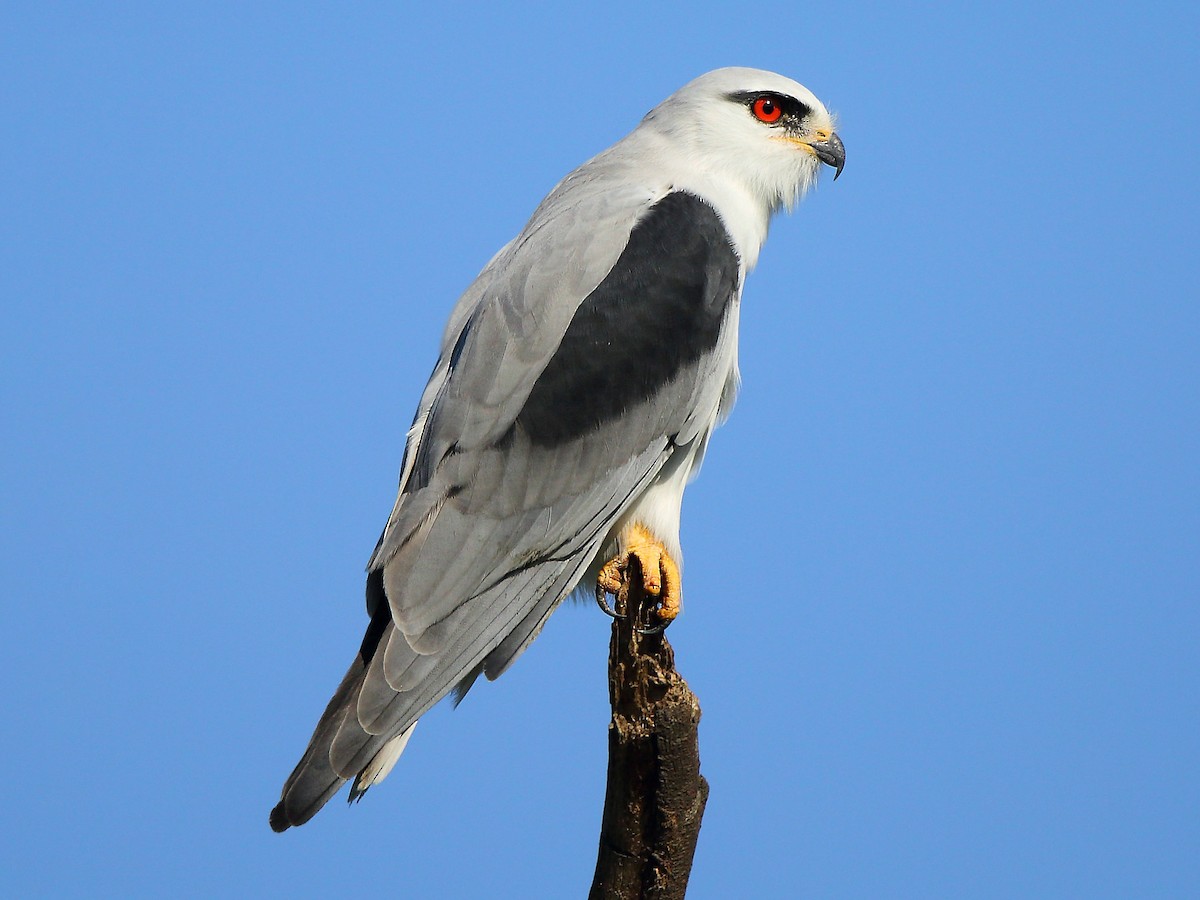
How to identify the Black-shouldered Kite
Elanus caeruleus
Spotted a bird? Identify it instantly with the Birdby app
Open the appTo correctly identify the Black-shouldered Kite (Elanus caeruleus), check each of these features. Birds can be tricky: habit, habitat, and call often confirm a sighting that a single photo cannot.
Size at a glance
- Length
- 30-37 cm
- Wingspan
- 75-95 cm
- Weight
- 190-340 g
Physical features to check
- 1
Plumage
Overall feather coloration and pattern.
Adults are predominantly white on the underparts and head, with pale grey upperparts. The most distinctive feature is the prominent black patch on the 'shoulders' (carpal joint) of the wings, visible both at rest and in flight. The primary feathers are black, contrasting sharply with the white underwing coverts. The tail is short and square, white with a grey tip.
- 2
Beak shape
Shape and color of the bill: a key field mark.
Small, sharply hooked, black beak with a yellow cere.
- 3
Eye color
Iris color and any distinctive eye markings.
Striking ruby-red eyes, surrounded by a black patch (lores).
- 4
Leg color
Leg and foot color.
Bright yellow legs and feet with black talons.
- 5
Distinguishing features
Standout features that separate this species.
Black shoulder patches, red eyes, white underparts, pale grey upperparts, and a characteristic hovering flight.
- 6
Juvenile appearance
How young birds differ from adults.
Juveniles have a brownish wash on the head and breast, with rufous-brown mottling on the upperparts and wing coverts. The black shoulder patches are less defined, and the eyes are brownish-orange, gradually turning red with age. The tail often has a dark subterminal band.
- 7
Seasonal changes
Plumage variation between breeding and non-breeding seasons.
No significant seasonal plumage changes. Plumage remains consistent year-round for adults.
- 8
Sexual dimorphism
How males and females differ.
Males and females are generally similar in plumage and size, though females may be slightly larger and heavier on average.
Key field marks
- Plumage. Look for the striking contrast of pure white underparts and head against pale grey upperparts. The most definitive mark is the prominent black patch on the 'shoulders' (carpal joint) of the wings.
- Eyes. The intense ruby-red eyes are a key identifier, especially in adults, contrasting with the black lores.
- Flight Style. Observe its characteristic hovering (kiting) flight, often stationary in the air with rapid wing beats, scanning the ground. This behavior is highly diagnostic.
- Perching Posture. When perched, it often sits upright on an exposed branch or power line, with its short tail and black shoulder patches clearly visible.
- Juvenile Plumage. In juveniles, look for the brownish wash on the head and breast, rufous mottling on the back, and brownish-orange eyes. The black shoulder patches are still present but may be less distinct.
Explore the Black-shouldered Kite
Identify birds anywhere
Free on iOS, Android, and Web. Photo & sound identification, full species database, and your personal life list.