
Spotted a bird? Identify it instantly with the Birdby app
Open the appAbout
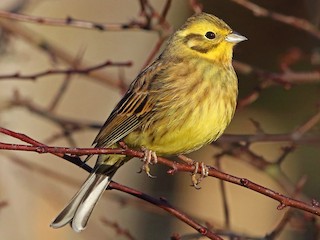
The Yellowhammer is a medium-sized passerine bird in the bunting family Emberizidae. It is a distinctive and often conspicuous bird of open countryside, known for the bright yellow plumage of the male and its characteristic 'a little bit of bread and no cheese' song. It is a widespread species across much of Europe and Asia, typically found in agricultural areas, heathland, and open woodlands.
Size & lifespan
- Length
- 16-17.5 cm
- Wingspan
- 23-29.5 cm
- Weight
- 20-36 g
- Lifespan
- 2-3 years (up to 10 years recorded)
- Diet
- Omnivore
Physical characteristics
- Plumage
- Adult males are strikingly bright yellow on the head and underparts, with a streaked rufous-brown back, rump, and flanks. The breast often shows some rufous streaking. The outer tail feathers are white, prominent in flight. Females are duller, with less yellow and more streaking, particularly on the head and breast. Juveniles resemble females but are even duller and more heavily streaked.
- Beak shape
- Conical, stout, and relatively small, adapted for seed eating. Dark grey to blackish.
- Eye color
- Dark brown
- Leg color
- Pinkish-brown to pale brown
- Distinguishing features
- Bright yellow head and underparts (male), rufous rump, white outer tail feathers, and streaked brown back. The male's bright yellow face with a dark eye-stripe and moustachial stripe is particularly distinctive.
- Juvenile appearance
- Juveniles are heavily streaked brown overall, with only faint yellowish tinges, particularly on the face and underparts. They lack the strong yellow of adult males and are generally duller than adult females.
- Seasonal changes
- Plumage remains largely consistent throughout the year, though the yellow may appear slightly brighter in breeding plumage due to wear of feather tips. No significant non-breeding plumage changes.
- Sexual dimorphism
- Pronounced. Males are much brighter yellow, especially on the head and underparts, with more defined streaking. Females are duller, with more extensive streaking on the head and breast, and less intense yellow.
How to identify
- 1
Plumage (Male)
Look for the bright yellow head and underparts, contrasting with a streaked rufous-brown back and rump. White outer tail feathers are visible in flight.
- 2
Plumage (Female/Juvenile)
Females are duller, with less yellow and more streaking on the head and breast. Juveniles are even duller and more heavily streaked overall.
- 3
Song
Listen for the distinctive 'a little bit of bread and no cheese' song, a series of short notes followed by a drawn-out final note, often delivered from a prominent perch.
- 4
Habitat
Check open agricultural land, hedgerows, heathland, and open woodlands. They are often seen perched on wires, fences, or bushes.
- 5
Behavior
Observe their ground-feeding habits, often scratching among leaf litter or stubble for seeds. Their undulating flight pattern is also characteristic.
Habitat & range
- Biomes
- Temperate grasslands, shrublands, open woodlands, agricultural land, heathland, moorland.
- Geographic range
- Widespread across most of Europe and western Asia, from Ireland and Portugal east to western Siberia and Kazakhstan. Introduced to New Zealand.
- Elevation range
- Typically found from sea level up to 1,000 meters, occasionally higher in some mountainous regions.
- Preferred environments
- Prefers open, cultivated land with hedgerows, scattered bushes, and small trees. Also found in heathland, moorland edges, and open woodland clearings. Requires a mix of open ground for foraging and dense cover for nesting and roosting.
Behavior
- Activity time
- Diurnal.
- Feeding habits
- Primarily ground feeders, foraging for seeds, particularly cereal grains, and insects. They will also take berries and other plant matter. They often feed in flocks outside the breeding season.
- Social behavior
- During the breeding season, they are territorial and typically seen in pairs. Outside of breeding, they form flocks, sometimes large, often mixing with other finch and bunting species, especially at winter feeding sites.
- Flight pattern
- Undulating flight, typical of many finches and buntings, with rapid wing beats followed by a short glide. Often flies low over fields or between hedgerows.
- Migration pattern
- Mostly resident or short-distance migrants in western and central Europe. Northern and eastern populations are more migratory, moving south and west for the winter. They are partial migrants.
- Territoriality
- Males establish and defend breeding territories through song and display. Territories are typically centered around suitable nesting and foraging areas.
Song & calls
- Song
- A distinctive, rhythmic song often described as 'a little bit of bread and no cheese' or 'sisi-sisi-sisi-sii-sii-sii-siiiiii'. It consists of a series of short, rapid notes followed by one or more drawn-out, often buzzing, final notes. Sung from a prominent perch.
- Call
- Common calls include a sharp 'tzick' or 'chip', often given in flight or when alarmed. Also a softer 'tsip' or 'tseep'.
- When they vocalize
- Males sing frequently from early spring through late summer, primarily during the breeding season to attract mates and defend territory. Calls are given year-round.
Breeding & reproduction
- Breeding season
- April to August, typically producing 2-3 broods per season.
- Nesting habits
- Nests are typically built on or very close to the ground, often well-concealed at the base of a bush, in dense grass, or within a hedgerow. The nest is a cup-shaped structure made of grass, moss, and roots, lined with finer materials like hair or fine grass.
- Clutch size
- 3-5 eggs
- Egg description
- 3-5 eggs, typically pale purplish-white to greyish-white, heavily streaked and spotted with dark purplish-brown or black, often concentrated at the broad end.
- Incubation period
- 12-14 days, primarily by the female.
- Fledging period
- 11-13 days after hatching. Young are fed by both parents.
- Parental care
- Both parents participate in feeding the nestlings and fledglings. The female primarily incubates, but the male often brings food to her on the nest.
Where to find
Agricultural Land
Look in fields with hedgerows, especially those growing cereal crops. They often perch on fences or power lines bordering fields.
Heathland and Moorland Edges
Found in areas with scattered gorse, heather, and small trees, providing both cover and open foraging areas.
Open Woodlands and Clearings
Can be found in the edges of deciduous or mixed woodlands, particularly where there are clearings or rides.
Gardens (Winter)
In harsh winters, they may visit gardens with bird feeders, especially if seeds (like sunflower hearts or millet) are offered on the ground.
Field tips
- Listen for the song. The male's song is very distinctive and often the first indication of a Yellowhammer's presence. Listen for it from prominent perches.
- Scan prominent perches. Males frequently sing from the tops of bushes, hedgerows, fences, or power lines, making them relatively easy to spot.
- Look on the ground. Yellowhammers are primarily ground feeders. Scan the edges of fields, under hedgerows, and in stubble for foraging birds.
- Visit in the morning. They are most active and vocal in the early morning, especially during the breeding season.
- Be patient. While often conspicuous, they can also be shy. Find a good vantage point and wait quietly.
Similar species
Corn Bunting
Emberiza calandra
The Corn Bunting is larger, plumper, and lacks any yellow plumage. It is uniformly streaky brown, with a heavier bill. Its song is a jangling, metallic 'squeaky gate' sound, very different from the Yellowhammer's.
Cirl Bunting
Emberiza cirlus
The Cirl Bunting male has a distinctive olive-green head with black eye-stripe and moustachial stripe, and a yellow throat. It has a grey rump (Yellowhammer has rufous). Females are harder to distinguish but generally have less yellow and a more olive-grey tone than Yellowhammer females. The song is a rapid, monotonous trill.
Reed Bunting
Emberiza schoeniclus
Male Reed Buntings have a black head and throat with a prominent white moustachial stripe and white collar. Females are streaky brown with a buffy supercilium. They lack the extensive yellow of the Yellowhammer and prefer wetland habitats.
Quick facts
- Distinctive Song:
- Often described as 'a little bit of bread and no cheese'.
- Male Plumage:
- Bright yellow head and underparts.
- Habitat Preference:
- Open countryside with hedgerows and scattered trees.
- Diet:
- Seeds (especially cereals) and insects.
- Nesting:
- Ground or low in dense vegetation.
Fun facts
- The Yellowhammer's song is one of the most easily recognizable bird songs in the European countryside and has inspired folk songs and poems.
- Despite its bright plumage, the Yellowhammer can be surprisingly well-camouflaged when perched in dense vegetation or foraging on the ground.
- In some parts of its range, particularly in the UK, Yellowhammer populations have experienced significant declines due to changes in agricultural practices, though conservation efforts are underway.
- The species was introduced to New Zealand in the late 19th century and has established a thriving population there.
Scientific classification
- Kingdom
- Animalia
- Phylum
- Chordata
- Class
- Aves
- Order
- Passeriformes
- Family
- Emberizidae
- Genus
- Emberiza
- Species
- Emberiza citrinella
Explore the Yellowhammer
Identify birds anywhere
Free on iOS, Android, and Web. Photo & sound identification, full species database, and your personal life list.