
How to identify the Yellowhammer
Emberiza citrinella
Spotted a bird? Identify it instantly with the Birdby app
Open the appTo correctly identify the Yellowhammer (Emberiza citrinella), check each of these features. Birds can be tricky: habit, habitat, and call often confirm a sighting that a single photo cannot.
Size at a glance
- Length
- 16-17.5 cm
- Wingspan
- 23-29.5 cm
- Weight
- 20-36 g
Physical features to check
- 1
Plumage
Overall feather coloration and pattern.
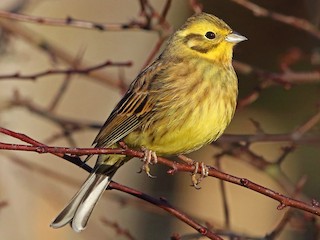
Adult males are strikingly bright yellow on the head and underparts, with a streaked rufous-brown back, rump, and flanks. The breast often shows some rufous streaking. The outer tail feathers are white, prominent in flight. Females are duller, with less yellow and more streaking, particularly on the head and breast. Juveniles resemble females but are even duller and more heavily streaked.
- 2
Beak shape
Shape and color of the bill: a key field mark.
Conical, stout, and relatively small, adapted for seed eating. Dark grey to blackish.
- 3
Eye color
Iris color and any distinctive eye markings.
Dark brown
- 4
Leg color
Leg and foot color.
Pinkish-brown to pale brown
- 5
Distinguishing features
Standout features that separate this species.
Bright yellow head and underparts (male), rufous rump, white outer tail feathers, and streaked brown back. The male's bright yellow face with a dark eye-stripe and moustachial stripe is particularly distinctive.
- 6
Juvenile appearance
How young birds differ from adults.
Juveniles are heavily streaked brown overall, with only faint yellowish tinges, particularly on the face and underparts. They lack the strong yellow of adult males and are generally duller than adult females.
- 7
Seasonal changes
Plumage variation between breeding and non-breeding seasons.
Plumage remains largely consistent throughout the year, though the yellow may appear slightly brighter in breeding plumage due to wear of feather tips. No significant non-breeding plumage changes.
- 8
Sexual dimorphism
How males and females differ.
Pronounced. Males are much brighter yellow, especially on the head and underparts, with more defined streaking. Females are duller, with more extensive streaking on the head and breast, and less intense yellow.
Key field marks
- Plumage (Male). Look for the bright yellow head and underparts, contrasting with a streaked rufous-brown back and rump. White outer tail feathers are visible in flight.
- Plumage (Female/Juvenile). Females are duller, with less yellow and more streaking on the head and breast. Juveniles are even duller and more heavily streaked overall.
- Song. Listen for the distinctive 'a little bit of bread and no cheese' song, a series of short notes followed by a drawn-out final note, often delivered from a prominent perch.
- Habitat. Check open agricultural land, hedgerows, heathland, and open woodlands. They are often seen perched on wires, fences, or bushes.
- Behavior. Observe their ground-feeding habits, often scratching among leaf litter or stubble for seeds. Their undulating flight pattern is also characteristic.
Explore the Yellowhammer
Identify birds anywhere
Free on iOS, Android, and Web. Photo & sound identification, full species database, and your personal life list.