
Spotted a bird? Identify it instantly with the Birdby app
Open the appAbout
The Asian Koel is a large, long-tailed cuckoo found across Asia. It is a brood parasite, laying its eggs in the nests of other birds, primarily crows. Known for its distinctive, loud calls, especially during the breeding season, it is often heard more than seen.
Size & lifespan
- Length
- 39-46 cm
- Wingspan
- Approximately 55-65 cm
- Weight
- 190-327 g
- Lifespan
- Approximately 5-8 years in the wild
- Diet
- Omnivore, primarily frugivorous, but also consumes insects, caterpillars, eggs, and nestlings of host birds.
Physical characteristics
- Plumage
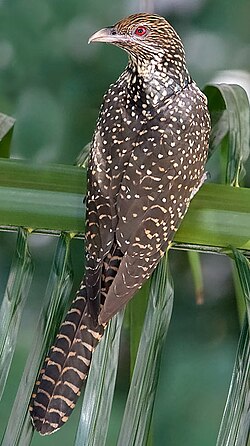
- Adult male is glossy bluish-black or greenish-black all over. Adult female is dark brown on the crown and upperparts, heavily spotted and barred with white or buff. The underparts are paler, buffy-white, also heavily barred with dark brown. Juveniles resemble females but are duller and have a blackish beak.
- Beak shape
- Stout, slightly decurved, and conical. Adult males have a pale greenish-yellow to yellowish-green beak, sometimes with a reddish tinge at the base. Females and juveniles have a blackish beak.
- Eye color
- Bright crimson red in adults, dark brown in juveniles.
- Leg color
- Greyish-black to dark grey
- Distinguishing features
- The striking red eyes of adults, the glossy black plumage of the male, and the heavily spotted and barred plumage of the female are key features. Its large size and long tail are also distinctive.
- Juvenile appearance
- Juveniles are duller than adult females, with a blackish beak and dark eyes. They have a similar spotted and barred pattern but are generally less contrasting.
- Seasonal changes
- No significant seasonal plumage changes in adults. Plumage remains consistent year-round.
- Sexual dimorphism
- Pronounced sexual dimorphism, with males being entirely glossy black and females being brown with extensive white/buff spotting and barring.
How to identify
- 1
Male Plumage
Look for a large, entirely glossy bluish-black bird with striking red eyes and a pale greenish-yellow bill. Its long tail is also noticeable.
- 2
Female Plumage
Identify by its dark brown upperparts heavily spotted and barred with white/buff, paler underparts with similar barring, red eyes, and a blackish bill. The overall impression is a heavily patterned bird.
- 3
Vocalization
Listen for the loud, repetitive, ascending 'ko-EL, ko-EL' call of the male, especially at dawn and dusk. The female's sharp 'kik-kik-kik' is also distinctive.
- 4
Behavior
Observe its arboreal habits, often moving stealthily through dense foliage. Its presence is often revealed by its calls or by the agitated behavior of host crows.
- 5
Habitat
Look in areas with fruit-bearing trees, especially figs, in gardens, parks, and woodlands, often near human habitation where host crows are common.
Habitat & range
- Biomes
- Tropical and subtropical forests, woodlands, groves, orchards, gardens, and urban parks.
- Geographic range
- Widespread across the Indian subcontinent, Southeast Asia, China, and extending to Australia (where it is known as the Eastern Koel, Eudynamys orientalis, often considered a separate species or subspecies group).
- Elevation range
- Sea level up to approximately 1,800 meters.
- Preferred environments
- Prefers areas with abundant fruit-bearing trees, especially figs, and the presence of host bird species (primarily crows) for brood parasitism. Often found in human-modified landscapes.
Behavior
- Activity time
- Diurnal, most active during early morning and late afternoon, especially vocal during these periods.
- Feeding habits
- Primarily arboreal, feeding on fruits, especially figs, berries, and other soft fruits. Also consumes insects, caterpillars, and occasionally eggs or nestlings of host birds. Forages stealthily among foliage.
- Social behavior
- Generally solitary or found in pairs during the breeding season. Not typically seen in large flocks.
- Flight pattern
- Strong, direct flight with rapid wing beats, often undulating. Can be quite agile when navigating through dense canopy.
- Migration pattern
- Many populations are migratory, particularly those in northern parts of their range (e.g., China, northern India), moving south for winter. Southern populations (e.g., peninsular India, Southeast Asia) are largely resident or undertake local movements. Australian populations are migratory, breeding in Australia and migrating to New Guinea and Indonesia for the non-breeding season.
- Territoriality
- Males are territorial during the breeding season, defending calling perches and areas where host nests are likely to be found. Calls are often used to establish and maintain territory.
Song & calls
- Song
- The male's song is a loud, repetitive, ascending 'ko-EL, ko-EL, ko-EL' or 'ku-OO, ku-OO, ku-OO' call, often increasing in tempo and volume. It can be heard for long distances, especially at dawn and dusk.
- Call
- Females have a distinct, sharp, high-pitched 'kik-kik-kik' or 'whik-whik-whik' call, often given when disturbed or interacting with males. Both sexes may give harsh alarm calls.
- When they vocalize
- Most vocal during the breeding season (spring and summer), particularly at dawn, dusk, and sometimes throughout the night, especially on moonlit nights.
Breeding & reproduction
- Breeding season
- Varies geographically, typically coinciding with the breeding season of its host species. In India, generally April to August; in Southeast Asia, March to July.
- Nesting habits
- Obligate brood parasite. Does not build its own nest. Females lay eggs in the nests of other bird species, primarily corvids (crows, magpies), but also sometimes bulbuls, babblers, and shrikes. The female typically removes one host egg before laying her own.
- Clutch size
- A female koel may lay multiple eggs in different host nests over a breeding season, usually one egg per host nest.
- Egg description
- Eggs are typically pale greenish-grey to olive-brown, often with reddish-brown spots or blotches, resembling the eggs of its host species (e.g., House Crow). They are relatively small for the size of the koel.
- Incubation period
- Approximately 12-14 days, similar to that of its crow hosts. Incubation is performed by the host parents.
- Fledging period
- Koel chicks fledge around 20-28 days after hatching, often staying in the host's territory and being fed by host parents for several weeks post-fledging.
- Parental care
- No parental care from the biological parents. The host parents incubate the egg, feed the chick, and raise it until independence. The koel chick often outcompetes or ejects host chicks/eggs.
Where to find
Urban Parks and Gardens
Common in well-wooded urban and suburban areas, especially where fruit trees are present and crows are abundant.
Orchards and Plantations
Areas with fruit-bearing trees are prime habitats due to their frugivorous diet.
Woodlands and Forest Edges
Found in open woodlands, secondary forests, and the edges of denser forests.
Field tips
- Listen for Calls. The Asian Koel is often heard before it is seen. Learn its distinctive calls, especially the male's 'ko-EL' song, and locate it by sound. They are most vocal during the breeding season.
- Look in Fruit Trees. Scan fruit-bearing trees, particularly fig trees, as these are a primary food source. They can be well-camouflaged among the leaves.
- Observe Host Birds. Pay attention to the behavior of crows. Agitated crows mobbing a bird might indicate the presence of a koel, as crows often harass koels due to their brood parasitic nature.
- Dawn and Dusk. These are the most active and vocal times for Asian Koels, making them easier to detect.
Similar species
Black-billed Koel
Eudynamys melanorhynchus
Found only in Sulawesi and nearby islands. Males are similar to Asian Koel but have a black bill. Females are also similar but often have finer barring and a black bill.
Pacific Koel (Eastern Koel)
Eudynamys orientalis
Often considered a separate species or a group of subspecies within E. scolopaceus. Found in Australia, New Guinea, and surrounding islands. Males are virtually identical to Asian Koel. Females tend to be more rufous-brown with less distinct barring than Asian Koel females. The primary distinction is geographic range and sometimes subtle vocal differences.
Common Cuckoo
Cuculus canorus
Smaller, greyish plumage (male), and a different call ('cuck-oo'). It has a more hawk-like appearance in flight and is not glossy black like the male Asian Koel. Females are also distinctly different, being barred grey and white, not spotted brown.
Quick facts
- Primary Diet:
- Fruits (frugivorous)
- Nesting Strategy:
- Obligate brood parasite
- Host Species:
- Mainly crows (Corvidae)
- Distinctive Feature:
- Loud, repetitive 'ko-EL' call
- Eye Color:
- Bright crimson red in adults
Fun facts
- The Asian Koel's scientific name 'Eudynamys' means 'true powerful one', referring to its loud voice.
- In many cultures, the call of the Asian Koel is associated with the arrival of spring or the monsoon season.
- Despite being a brood parasite, the koel chick does not always eject host eggs or chicks, sometimes growing up alongside them, though it usually outcompetes them for food.
- The female koel is known to observe host nests for suitable egg-laying opportunities, often waiting for the host to be absent.
Scientific classification
- Kingdom
- Animalia
- Phylum
- Chordata
- Class
- Aves
- Order
- Cuculiformes
- Family
- Cuculidae
- Genus
- Eudynamys
- Species
- Eudynamys scolopaceus
Explore the Asian Koel
Identify birds anywhere
Free on iOS, Android, and Web. Photo & sound identification, full species database, and your personal life list.