
How to identify the Asian Koel
Eudynamys scolopaceus
Spotted a bird? Identify it instantly with the Birdby app
Open the appTo correctly identify the Asian Koel (Eudynamys scolopaceus), check each of these features. Birds can be tricky: habit, habitat, and call often confirm a sighting that a single photo cannot.
Size at a glance
- Length
- 39-46 cm
- Wingspan
- Approximately 55-65 cm
- Weight
- 190-327 g
Physical features to check
- 1
Plumage
Overall feather coloration and pattern.
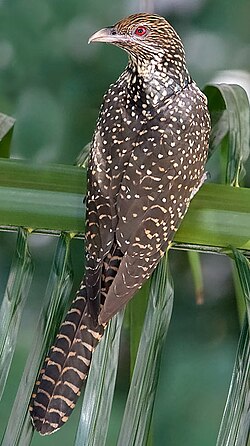
Adult male is glossy bluish-black or greenish-black all over. Adult female is dark brown on the crown and upperparts, heavily spotted and barred with white or buff. The underparts are paler, buffy-white, also heavily barred with dark brown. Juveniles resemble females but are duller and have a blackish beak.
- 2
Beak shape
Shape and color of the bill: a key field mark.
Stout, slightly decurved, and conical. Adult males have a pale greenish-yellow to yellowish-green beak, sometimes with a reddish tinge at the base. Females and juveniles have a blackish beak.
- 3
Eye color
Iris color and any distinctive eye markings.
Bright crimson red in adults, dark brown in juveniles.
- 4
Leg color
Leg and foot color.
Greyish-black to dark grey
- 5
Distinguishing features
Standout features that separate this species.
The striking red eyes of adults, the glossy black plumage of the male, and the heavily spotted and barred plumage of the female are key features. Its large size and long tail are also distinctive.
- 6
Juvenile appearance
How young birds differ from adults.
Juveniles are duller than adult females, with a blackish beak and dark eyes. They have a similar spotted and barred pattern but are generally less contrasting.
- 7
Seasonal changes
Plumage variation between breeding and non-breeding seasons.
No significant seasonal plumage changes in adults. Plumage remains consistent year-round.
- 8
Sexual dimorphism
How males and females differ.
Pronounced sexual dimorphism, with males being entirely glossy black and females being brown with extensive white/buff spotting and barring.
Key field marks
- Male Plumage. Look for a large, entirely glossy bluish-black bird with striking red eyes and a pale greenish-yellow bill. Its long tail is also noticeable.
- Female Plumage. Identify by its dark brown upperparts heavily spotted and barred with white/buff, paler underparts with similar barring, red eyes, and a blackish bill. The overall impression is a heavily patterned bird.
- Vocalization. Listen for the loud, repetitive, ascending 'ko-EL, ko-EL' call of the male, especially at dawn and dusk. The female's sharp 'kik-kik-kik' is also distinctive.
- Behavior. Observe its arboreal habits, often moving stealthily through dense foliage. Its presence is often revealed by its calls or by the agitated behavior of host crows.
- Habitat. Look in areas with fruit-bearing trees, especially figs, in gardens, parks, and woodlands, often near human habitation where host crows are common.
Explore the Asian Koel
Identify birds anywhere
Free on iOS, Android, and Web. Photo & sound identification, full species database, and your personal life list.