
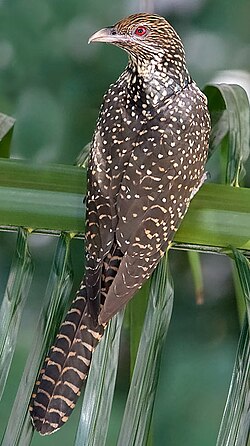
Where does the Asian Koel live?
Eudynamys scolopaceus
Spotted a bird? Identify it instantly with the Birdby app
Open the appThe Asian Koel lives in specific habitats and regions. Knowing where, and when, to look improves your chances of a successful sighting.
Biomes
Tropical and subtropical forests, woodlands, groves, orchards, gardens, and urban parks.
Geographic range
Widespread across the Indian subcontinent, Southeast Asia, China, and extending to Australia (where it is known as the Eastern Koel, Eudynamys orientalis, often considered a separate species or subspecies group).
Preferred environments
Prefers areas with abundant fruit-bearing trees, especially figs, and the presence of host bird species (primarily crows) for brood parasitism. Often found in human-modified landscapes.
Elevation range
Sea level up to approximately 1,800 meters.
Where to look
Urban Parks and Gardens
Common in well-wooded urban and suburban areas, especially where fruit trees are present and crows are abundant.
Orchards and Plantations
Areas with fruit-bearing trees are prime habitats due to their frugivorous diet.
Woodlands and Forest Edges
Found in open woodlands, secondary forests, and the edges of denser forests.
Field tips
- Listen for Calls. The Asian Koel is often heard before it is seen. Learn its distinctive calls, especially the male's 'ko-EL' song, and locate it by sound. They are most vocal during the breeding season.
- Look in Fruit Trees. Scan fruit-bearing trees, particularly fig trees, as these are a primary food source. They can be well-camouflaged among the leaves.
- Observe Host Birds. Pay attention to the behavior of crows. Agitated crows mobbing a bird might indicate the presence of a koel, as crows often harass koels due to their brood parasitic nature.
- Dawn and Dusk. These are the most active and vocal times for Asian Koels, making them easier to detect.
Migration
Many populations are migratory, particularly those in northern parts of their range (e.g., China, northern India), moving south for winter. Southern populations (e.g., peninsular India, Southeast Asia) are largely resident or undertake local movements. Australian populations are migratory, breeding in Australia and migrating to New Guinea and Indonesia for the non-breeding season.
Explore the Asian Koel
Identify birds anywhere
Free on iOS, Android, and Web. Photo & sound identification, full species database, and your personal life list.