
Spotted a bird? Identify it instantly with the Birdby app
Open the appAbout
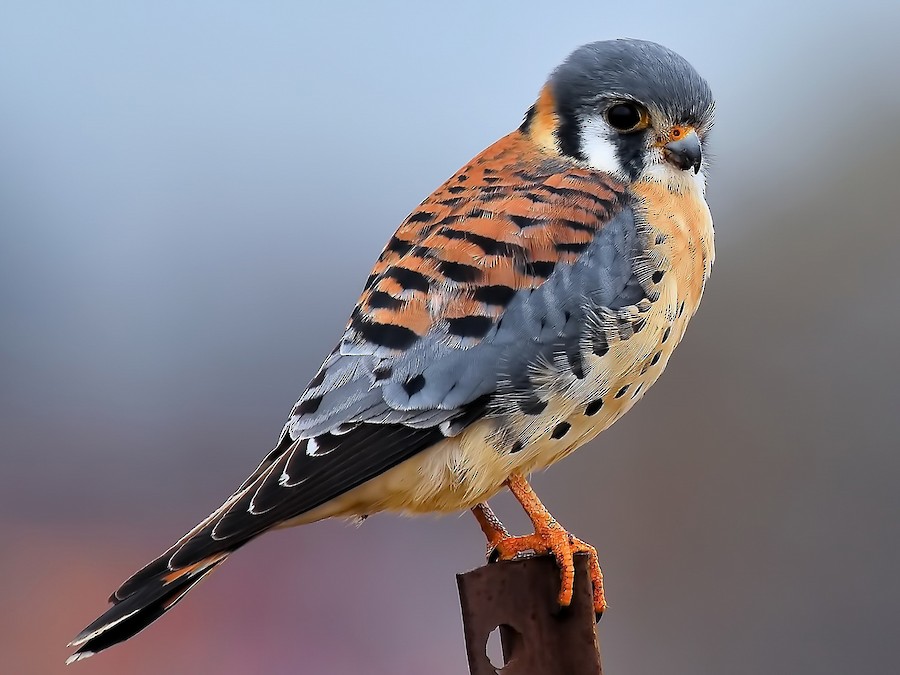
The American Kestrel is the smallest and most common falcon in North America. It is a colorful raptor, known for its distinctive facial markings, pointed wings, and characteristic hovering flight. Highly adaptable, it can be found in a wide range of open and semi-open habitats.
Size & lifespan
- Length
- 21-31 cm (8.3-12.2 in)
- Wingspan
- 51-61 cm (20-24 in)
- Weight
- 80-165 g (2.8-5.8 oz)
- Lifespan
- Typically 1-5 years in the wild, up to 11 years recorded
- Diet
- Carnivore (primarily insects, small mammals, small birds, and reptiles)
Physical characteristics
- Plumage
- Males have slate-blue wings, rufous back with black barring, and a rufous tail with a broad black subterminal band and white tip. Underparts are white to buff, often with light spotting on the flanks. Females have rufous wings and back, both barred with black, and a rufous tail with multiple narrow black bars. Underparts are streaked. Both sexes have two prominent black vertical stripes on each side of the face (malar stripes) and two black spots on the nape (ocelli).
- Beak shape
- Short, sharply hooked, dark gray to black with a yellow cere.
- Eye color
- Dark brown
- Leg color
- Yellow
- Distinguishing features
- Small size, colorful plumage (especially males), pointed wings, two black facial stripes, two black spots on the nape, and characteristic hovering flight.
- Juvenile appearance
- Juveniles resemble adult females, with rufous wings and back barred with black, and a barred rufous tail. Males begin to show blue-gray in their wings as they mature, but juvenile males are often indistinguishable from juvenile females in the field.
- Seasonal changes
- No significant seasonal plumage changes; plumage remains consistent year-round after molting into adult feathers.
- Sexual dimorphism
- Pronounced. Males have slate-blue wings and fewer black bars on the back and tail. Females have rufous wings and back with more extensive black barring, and a more heavily barred tail.
How to identify
- 1
Size and Shape
Look for a small, slender falcon with pointed wings and a relatively long tail. Often seen perched upright on wires or poles.
- 2
Plumage (Male)
Note the striking slate-blue wings, rufous back with black barring, and a rufous tail with a single broad black band near the tip. Underparts are pale with light spotting.
- 3
Plumage (Female)
Observe the rufous wings and back, both heavily barred with black, and a rufous tail with multiple narrow black bars. Underparts are streaked.
- 4
Head Markings
Crucial for identification: two prominent black vertical stripes on each side of the face (malar stripes) and two black spots on the nape (ocelli) are present in both sexes.
- 5
Flight Pattern
Watch for its characteristic hovering (kiting) flight, where it hangs motionless in the air on rapidly beating wings, scanning the ground below. Also has a direct, rapid flight.
- 6
Vocalizations
Listen for its distinctive, high-pitched 'klee-klee-klee' or 'killy-killy-killy' calls.
Habitat & range
- Biomes
- Grasslands, deserts, open woodlands, agricultural fields, urban and suburban areas.
- Geographic range
- Throughout the Americas, from Alaska and northern Canada south through the United States and Mexico, Central America, and into South America as far as Tierra del Fuego. Absent from dense forests and high arctic tundra.
- Elevation range
- Sea level up to 4,500 meters (14,800 feet) in some parts of its range, though typically found at lower to mid-elevations.
- Preferred environments
- Open country with scattered trees, snags, or utility poles for perching, and suitable cavities for nesting. Often found near human habitation.
Behavior
- Activity time
- Diurnal, most active during daylight hours.
- Feeding habits
- Primarily a sit-and-wait predator, perching on elevated spots to scan for prey. Also known for its distinctive hovering flight (kiting) while searching for prey. Dives swiftly to capture prey on the ground. Diet includes large insects (grasshoppers, crickets, beetles), small rodents (voles, mice), small birds, lizards, and snakes.
- Social behavior
- Generally solitary outside of the breeding season. During breeding, they form monogamous pairs. Not typically seen in large flocks.
- Flight pattern
- Direct and swift flight with rapid wing beats. Often hovers (kites) in place against the wind, with rapid wing beats, while scanning the ground for prey. Glides on pointed wings.
- Migration pattern
- Northern populations are migratory, moving south for the winter. Southern populations are resident year-round. Migration occurs during the day, often along coastlines or mountain ranges. Some individuals may move short distances even in resident populations.
- Territoriality
- Pairs defend a breeding territory, especially around the nest site. Non-breeding individuals may defend foraging areas.
Song & calls
- Song
- Does not have a complex song. Vocalizations are typically sharp, high-pitched calls.
- Call
- Most common call is a rapid series of 'klee-klee-klee' or 'killy-killy-killy' notes, often given when agitated, defending territory, or in flight. Also produces a softer 'whine' or 'chitter' during courtship or when communicating with young.
- When they vocalize
- Calls are given throughout the day, especially when disturbed, during territorial disputes, or when interacting with mates or young.
Breeding & reproduction
- Breeding season
- Varies geographically, typically from March to August in North America, peaking in April-May.
- Nesting habits
- Cavity nesters. They do not build their own nests but utilize existing cavities in trees (often old woodpecker holes), rock crevices, or artificial nest boxes. They may also use cavities in buildings or utility poles.
- Clutch size
- 3-7 eggs (most commonly 4-5)
- Egg description
- Typically 3-7 eggs, usually 4-5. Eggs are creamy white to pale buff, heavily spotted and blotched with shades of brown, reddish-brown, or purple, often concentrated at the larger end. Average size is about 35 x 29 mm.
- Incubation period
- 29-32 days, primarily by the female, though the male may assist.
- Fledging period
- 28-31 days after hatching. Young remain dependent on parents for several weeks after fledging.
- Parental care
- Both parents participate in raising the young. The female primarily incubates and broods, while the male provides most of the food during incubation and early brooding. Both parents hunt and feed the young after they hatch and fledge.
Where to find
Open Countryside
Look in agricultural fields, pastures, and grasslands where prey is abundant and perches are available.
Roadsides
Often seen perched on telephone wires, utility poles, or fence posts along roadsides, especially in rural and suburban areas.
Urban/Suburban Areas
Can be found in parks, golf courses, and even city centers if suitable nesting cavities (e.g., in buildings) and foraging areas are present.
Woodland Edges
Found at the edges of open woodlands, where trees provide nesting sites and open areas offer hunting grounds.
Field tips
- Scan Perches. Actively scan utility wires, fence posts, and dead snags in open areas. Kestrels often perch conspicuously.
- Look for Hovering. Watch for small raptors hovering in place over fields or open ground, a key hunting technique for kestrels.
- Listen for Calls. Their distinctive 'klee-klee-klee' call can often alert you to their presence before you see them.
- Check Nest Boxes. In areas with active nest box programs for kestrels, check boxes during the breeding season.
- Observe Behavior. Look for sudden dives from perches or hovering positions, indicating a hunting attempt.
Similar species
Merlin
Falco columbarius
Merlins are slightly larger, stockier, and lack the prominent facial stripes and nape spots of the American Kestrel. Merlins have a darker, more uniform plumage (especially males are slate-gray all over), and their flight is more powerful and direct, with less hovering. Their tail is typically banded with white, but not rufous.
Sharp-shinned Hawk
Accipiter striatus
Sharp-shinned Hawks are accipiters, characterized by short, rounded wings and a long tail, contrasting with the kestrel's pointed wings and shorter tail. Their flight pattern is a distinctive flap-flap-glide, and they rarely hover. Plumage is typically blue-gray above and rufous-barred white below in adults, lacking the kestrel's facial markings.
Eurasian Kestrel
Falco tinnunculus
Found in Eurasia and Africa, not typically overlapping with the American Kestrel. While similar in size and behavior (including hovering), the Eurasian Kestrel male has a plain rufous back (unbarred) and a gray head, lacking the American Kestrel's distinct facial stripes and nape spots. Females are more similar but still lack the American Kestrel's specific facial pattern.
Quick facts
- Smallest Falcon:
- The smallest falcon in North America.
- Hovering Hunter:
- Known for its distinctive hovering (kiting) flight while hunting.
- Cavity Nester:
- Does not build its own nest, relying on existing cavities.
- Sexual Dimorphism:
- Males and females have distinctly different plumage patterns.
- Diet Versatility:
- Feeds on a wide range of prey, from large insects to small birds and mammals.
Fun facts
- American Kestrels can see ultraviolet light, which helps them detect the urine trails of voles and other prey, as these trails reflect UV light.
- Despite their small size, they are fierce predators and can sometimes take prey larger than themselves.
- They are one of the few raptors that readily use artificial nest boxes, making them a popular species for conservation efforts.
- The 'kestrel' name comes from the Old French 'crecelle', meaning 'rattle', referring to their chattering call.
- Their scientific name, Falco sparverius, means 'sparrow hawk', reflecting their small size and historical classification, though they are true falcons.
Scientific classification
- Kingdom
- Animalia
- Phylum
- Chordata
- Class
- Aves
- Order
- Falconiformes
- Family
- Falconidae
- Genus
- Falco
- Species
- Falco sparverius
Explore the American Kestrel
Identify birds anywhere
Free on iOS, Android, and Web. Photo & sound identification, full species database, and your personal life list.