
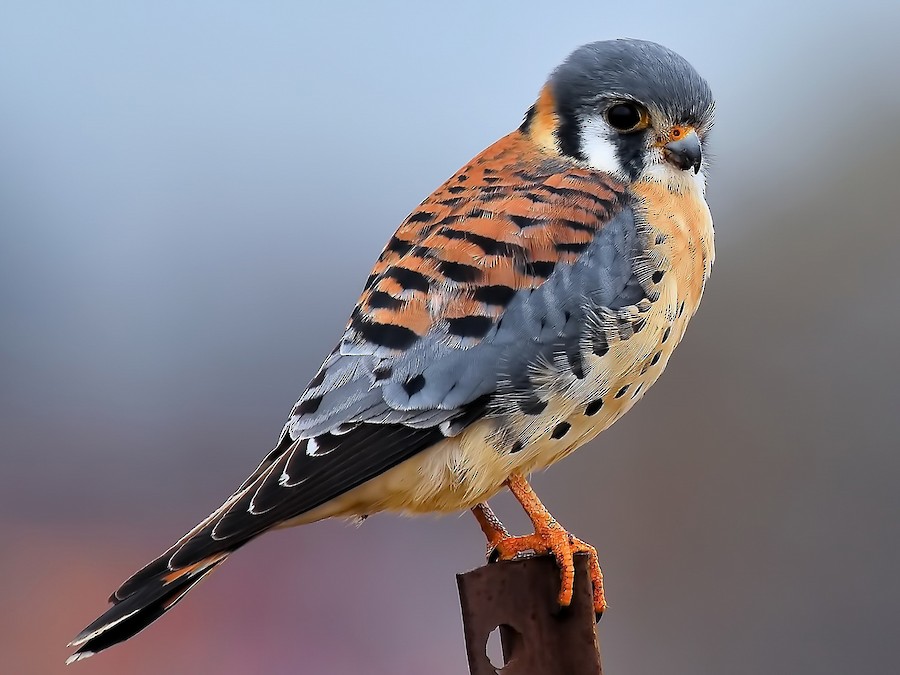
How to identify the American Kestrel
Falco sparverius
Spotted a bird? Identify it instantly with the Birdby app
Open the appTo correctly identify the American Kestrel (Falco sparverius), check each of these features. Birds can be tricky: habit, habitat, and call often confirm a sighting that a single photo cannot.
Size at a glance
- Length
- 21-31 cm (8.3-12.2 in)
- Wingspan
- 51-61 cm (20-24 in)
- Weight
- 80-165 g (2.8-5.8 oz)
Physical features to check
- 1
Plumage
Overall feather coloration and pattern.
Males have slate-blue wings, rufous back with black barring, and a rufous tail with a broad black subterminal band and white tip. Underparts are white to buff, often with light spotting on the flanks. Females have rufous wings and back, both barred with black, and a rufous tail with multiple narrow black bars. Underparts are streaked. Both sexes have two prominent black vertical stripes on each side of the face (malar stripes) and two black spots on the nape (ocelli).
- 2
Beak shape
Shape and color of the bill: a key field mark.
Short, sharply hooked, dark gray to black with a yellow cere.
- 3
Eye color
Iris color and any distinctive eye markings.
Dark brown
- 4
Leg color
Leg and foot color.
Yellow
- 5
Distinguishing features
Standout features that separate this species.
Small size, colorful plumage (especially males), pointed wings, two black facial stripes, two black spots on the nape, and characteristic hovering flight.
- 6
Juvenile appearance
How young birds differ from adults.
Juveniles resemble adult females, with rufous wings and back barred with black, and a barred rufous tail. Males begin to show blue-gray in their wings as they mature, but juvenile males are often indistinguishable from juvenile females in the field.
- 7
Seasonal changes
Plumage variation between breeding and non-breeding seasons.
No significant seasonal plumage changes; plumage remains consistent year-round after molting into adult feathers.
- 8
Sexual dimorphism
How males and females differ.
Pronounced. Males have slate-blue wings and fewer black bars on the back and tail. Females have rufous wings and back with more extensive black barring, and a more heavily barred tail.
Key field marks
- Size and Shape. Look for a small, slender falcon with pointed wings and a relatively long tail. Often seen perched upright on wires or poles.
- Plumage (Male). Note the striking slate-blue wings, rufous back with black barring, and a rufous tail with a single broad black band near the tip. Underparts are pale with light spotting.
- Plumage (Female). Observe the rufous wings and back, both heavily barred with black, and a rufous tail with multiple narrow black bars. Underparts are streaked.
- Head Markings. Crucial for identification: two prominent black vertical stripes on each side of the face (malar stripes) and two black spots on the nape (ocelli) are present in both sexes.
- Flight Pattern. Watch for its characteristic hovering (kiting) flight, where it hangs motionless in the air on rapidly beating wings, scanning the ground below. Also has a direct, rapid flight.
- Vocalizations. Listen for its distinctive, high-pitched 'klee-klee-klee' or 'killy-killy-killy' calls.
Explore the American Kestrel
Identify birds anywhere
Free on iOS, Android, and Web. Photo & sound identification, full species database, and your personal life list.