
Spotted a bird? Identify it instantly with the Birdby app
Open the appAbout
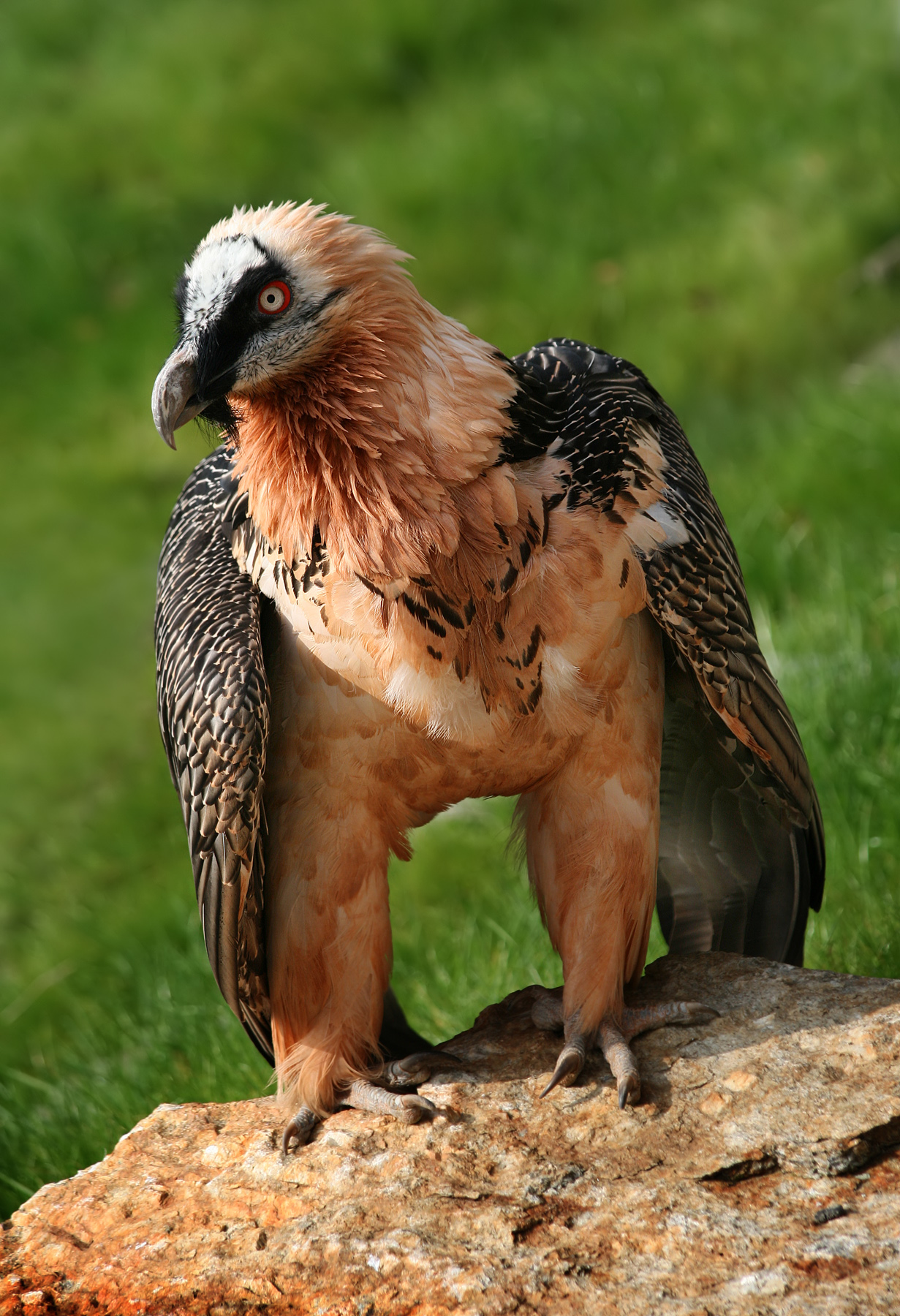
The Bearded Vulture, also known as the Lammergeier, is a large Old World vulture and the only member of the genus Gypaetus. It is unique among vultures for its diet, which consists almost exclusively of bone marrow, earning it the nickname 'bone breaker'. This magnificent raptor is characterized by its impressive size, diamond-shaped tail, and the distinctive 'beard' of bristles under its beak.
Size & lifespan
- Length
- 94-125 cm (37-49 in)
- Wingspan
- 2.31-2.83 m (7 ft 7 in - 9 ft 3 in)
- Weight
- 4.5-7.8 kg (9.9-17.2 lb), rarely up to 8.5 kg (18.7 lb)
- Lifespan
- 20-25 years in the wild, up to 45 years in captivity
- Diet
- Carnivore (primarily osteophagous, feeding on bone marrow)
Physical characteristics
- Plumage
- Adults have a creamy-white to rusty-orange head and underparts, often stained by iron oxides from bathing in mineral-rich soils. The back and wings are dark grey to blackish, with a contrasting pale leading edge on the underwing. Juveniles are entirely dark brown to blackish, gradually acquiring adult plumage over several years.
- Beak shape
- Strong, hooked beak, dark grey to blackish. The upper mandible is particularly robust for breaking bones.
- Eye color
- Adults have a striking yellow iris with a bright red scleral ring, which becomes more prominent with excitement. Juveniles have a darker iris.
- Leg color
- Greyish-yellow to pale grey.
- Distinguishing features
- Long, wedge-shaped or diamond-shaped tail (unique among vultures), long and narrow wings, and the distinctive 'beard' of black bristles under the chin. In flight, the long tail and narrow wings give it a falcon-like silhouette, unlike other vultures.
- Juvenile appearance
- Juveniles are uniformly dark brown to blackish, lacking the pale head and underparts of adults. Their 'beard' is less developed, and their eyes are darker. They take 5-7 years to attain full adult plumage.
- Seasonal changes
- No significant seasonal plumage changes. The rusty coloration of the head and underparts is acquired through cosmetic staining, not genetic pigmentation, and can vary in intensity.
- Sexual dimorphism
- Minimal sexual dimorphism; females are typically slightly larger and heavier than males, but plumage is identical.
How to identify
- 1
Overall Silhouette and Flight
Look for its unique silhouette: long, narrow, pointed wings and a long, diamond-shaped (or wedge-shaped) tail. It soars gracefully, often holding its wings in a slight dihedral, appearing almost falcon-like or kite-like, unlike other Old World vultures.
- 2
Plumage (Adult)
Adults have a striking creamy-white to rusty-orange head and underparts, contrasting sharply with dark grey to blackish upperparts and wings. The rusty coloration is often a key field mark, though it can vary.
- 3
Facial Features
The most distinctive feature is the 'beard' – a tuft of black bristles hanging from under the chin. Also note the bright yellow iris with a red scleral ring in adults.
- 4
Plumage (Juvenile)
Juveniles are uniformly dark brown to blackish, lacking the pale head and underparts of adults. They still retain the long, diamond-shaped tail and narrow wings, which are crucial for identification.
- 5
Behavior
Observe its feeding behavior if possible: dropping bones from height onto rocks. This unique osteophagous diet is a strong indicator.
Habitat & range
- Biomes
- High mountains, rocky cliffs, alpine meadows, arid and semi-arid mountainous regions.
- Geographic range
- Discontinuous distribution across Eurasia and Africa. Found in the Pyrenees, Alps (reintroduced), Balkans, Turkey, Caucasus, Central Asia, Himalayas, Tibet, and parts of East and Southern Africa.
- Elevation range
- Typically found at elevations between 500-4,000 meters (1,600-13,000 ft), but can range up to 7,500 meters (24,600 ft) in the Himalayas.
- Preferred environments
- Steep, rugged mountain terrain with deep gorges, cliffs for nesting, and open areas for foraging. Requires access to ungulate carcasses for bones.
Behavior
- Activity time
- Diurnal, active during daylight hours, primarily soaring and foraging.
- Feeding habits
- Highly specialized osteophage. Feeds almost exclusively on bones and bone marrow, which can constitute 85-90% of its diet. It drops large bones from heights onto rocks to shatter them, then consumes the fragments and marrow. Also eats small amounts of meat, skin, and ligaments. Does not typically feed on putrid flesh like other vultures.
- Social behavior
- Generally solitary or found in pairs. They are monogamous and maintain large territories. While foraging, multiple individuals may be seen in the vicinity of a carcass, but interactions are usually limited.
- Flight pattern
- Graceful and powerful flier, often soaring for hours on thermals and updrafts along mountain ridges. Holds wings in a slight dihedral. Its long, narrow wings and diamond-shaped tail give it a distinctive silhouette, often described as falcon-like or kite-like.
- Migration pattern
- Mostly resident throughout its range. Juveniles may disperse widely from their natal areas, but adults typically remain within their established territories year-round.
- Territoriality
- Highly territorial, especially around nesting sites. Pairs defend large home ranges, which can span hundreds of square kilometers.
Song & calls
- Song
- Bearded Vultures are generally silent birds. They do not have a complex song.
- Call
- Vocalizations are rare and typically limited to soft, high-pitched whistles, hisses, or short, sharp 'kree-kree-kree' calls, mainly around the nest or during aggressive interactions. They are not known for loud or frequent calls.
- When they vocalize
- Mainly during breeding season, around the nest, or when interacting with conspecifics or intruders.
Breeding & reproduction
- Breeding season
- Highly variable depending on geographic location, but generally starts in late autumn/early winter (October-December) with egg-laying in December-February. This early breeding allows chicks to fledge when food resources (carcasses from winter deaths) are abundant.
- Nesting habits
- Nests are large, bulky structures built on inaccessible cliff ledges or in caves, often adorned with bones, wool, and dung. Both parents contribute to nest building and maintenance. Nests are reused for many years.
- Clutch size
- 1-2 eggs (usually 1 chick survives due to siblicide, known as 'Cainism').
- Egg description
- Typically 1-2 eggs (rarely 3), dull white or yellowish-white, often with reddish-brown blotches or streaks. Eggs are large, measuring approximately 85 x 67 mm.
- Incubation period
- 53-60 days, primarily by the female, but both parents participate.
- Fledging period
- 110-130 days (around 4 months). Young birds remain dependent on parents for several more months after fledging.
- Parental care
- Both parents share incubation duties and care for the chick. The older chick often kills the younger one (siblicide), ensuring only one strong chick survives to fledging.
Where to find
High Mountain Ranges
Focus on rugged, inaccessible mountain areas with steep cliffs and deep valleys. Key regions include the Pyrenees, Alps (reintroduction sites), Caucasus, Himalayas, and parts of East Africa (e.g., Simien Mountains).
National Parks and Protected Areas
Many populations are found within protected areas specifically established for their conservation, such as the Vanoise National Park (Alps), Ordesa y Monte Perdido National Park (Pyrenees), or Simien Mountains National Park (Ethiopia).
Field tips
- Scan the Skies. Bearded Vultures spend much of their day soaring. Use binoculars or a spotting scope to scan the skies above mountain ridges and valleys, especially during mid-morning to late afternoon when thermals are strong.
- Look for Carcasses. While they don't typically feed on fresh meat, they are attracted to ungulate carcasses for bones. Observing other scavengers (e.g., Griffon Vultures, ravens) might indicate a potential food source nearby, which could attract a Bearded Vulture.
- Visit Reintroduction Sites. In areas like the Alps, reintroduction programs have made them more predictable. Local conservation groups or park rangers can often provide information on recent sightings or known territories.
- Patience and Persistence. Bearded Vultures are rare and wide-ranging. Spotting one often requires considerable patience and spending extended periods in suitable habitat.
Similar species
Griffon Vulture
Gyps fulvus
Griffon Vultures are bulkier, have shorter, broader wings, a short, square tail, and a prominent ruff of white feathers around the neck. Their plumage is generally buff-brown with darker flight feathers. They lack the 'beard' and the rusty underparts of the Bearded Vulture. In flight, Griffons have a more 'plank-like' wing profile and a shorter tail.
Egyptian Vulture
Neophron percnopterus
Egyptian Vultures are much smaller, with a white body, black flight feathers, and a yellow face. They have a wedge-shaped tail but it is shorter than that of the Bearded Vulture. They lack the 'beard' and the dark upperparts. Juveniles are dark brown but are significantly smaller and have a different flight profile.
Cinereous Vulture (Eurasian Black Vulture)
Aegypius monachus
The Cinereous Vulture is larger and entirely dark brown/blackish, with a massive dark beak and a short, slightly wedge-shaped tail. It lacks the pale head, rusty underparts, and 'beard' of the Bearded Vulture. In flight, it has broader wings and a shorter tail, appearing more 'door-like' compared to the elegant flight of the Bearded Vulture.
Quick facts
- Diet Specialization:
- Almost exclusively bones and bone marrow
- Unique Feeding Method:
- Drops bones from height to break them
- Tail Shape:
- Long, diamond-shaped/wedge-shaped
- Facial Feature:
- Distinctive 'beard' of bristles
- Plumage Coloration:
- Rusty underparts (cosmetic staining)
Fun facts
- The name 'Lammergeier' means 'lamb-vulture' in German, stemming from a historical misconception that they preyed on lambs, which is largely untrue.
- Their stomach acid is incredibly strong, allowing them to digest bone fragments, extracting nutrients from marrow and bone itself.
- The rusty-orange coloration of their plumage is not genetic but acquired by bathing in iron-rich mud and dust, a behavior unique among birds.
- They are one of the largest flying birds in the world, with an impressive wingspan that can exceed 2.8 meters.
- Bearded Vultures play a crucial ecological role as 'nature's clean-up crew,' removing bones that other scavengers leave behind, thus preventing the spread of disease.
Scientific classification
- Kingdom
- Animalia
- Phylum
- Chordata
- Class
- Aves
- Order
- Accipitriformes
- Family
- Accipitridae
- Genus
- Gypaetus
- Species
- Gypaetus barbatus
Explore the Bearded Vulture
Identify birds anywhere
Free on iOS, Android, and Web. Photo & sound identification, full species database, and your personal life list.