
How to identify the Bearded Vulture
Gypaetus barbatus
Spotted a bird? Identify it instantly with the Birdby app
Open the appTo correctly identify the Bearded Vulture (Gypaetus barbatus), check each of these features. Birds can be tricky: habit, habitat, and call often confirm a sighting that a single photo cannot.
Size at a glance
- Length
- 94-125 cm (37-49 in)
- Wingspan
- 2.31-2.83 m (7 ft 7 in - 9 ft 3 in)
- Weight
- 4.5-7.8 kg (9.9-17.2 lb), rarely up to 8.5 kg (18.7 lb)
Physical features to check
- 1
Plumage
Overall feather coloration and pattern.
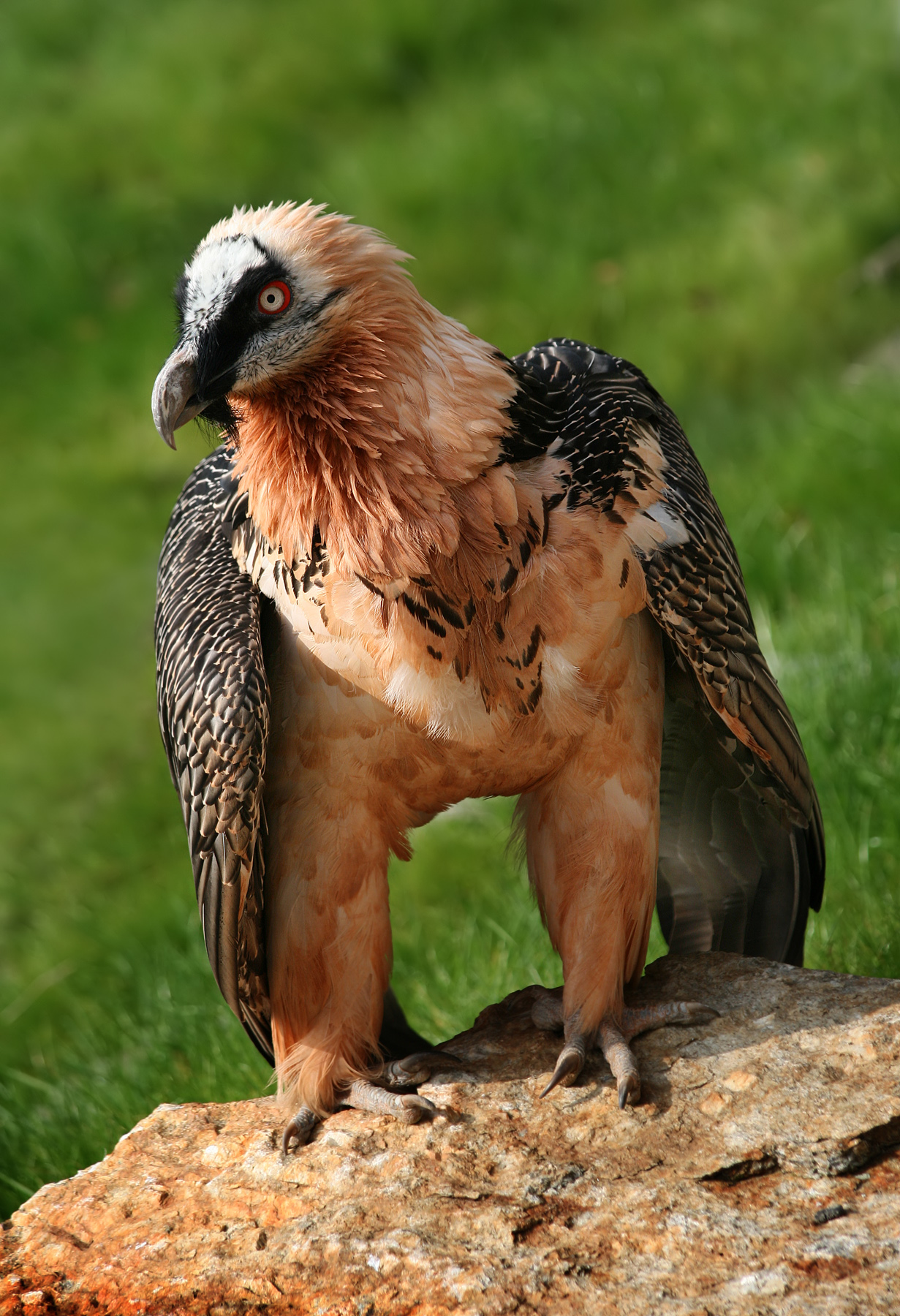
Adults have a creamy-white to rusty-orange head and underparts, often stained by iron oxides from bathing in mineral-rich soils. The back and wings are dark grey to blackish, with a contrasting pale leading edge on the underwing. Juveniles are entirely dark brown to blackish, gradually acquiring adult plumage over several years.
- 2
Beak shape
Shape and color of the bill: a key field mark.
Strong, hooked beak, dark grey to blackish. The upper mandible is particularly robust for breaking bones.
- 3
Eye color
Iris color and any distinctive eye markings.
Adults have a striking yellow iris with a bright red scleral ring, which becomes more prominent with excitement. Juveniles have a darker iris.
- 4
Leg color
Leg and foot color.
Greyish-yellow to pale grey.
- 5
Distinguishing features
Standout features that separate this species.
Long, wedge-shaped or diamond-shaped tail (unique among vultures), long and narrow wings, and the distinctive 'beard' of black bristles under the chin. In flight, the long tail and narrow wings give it a falcon-like silhouette, unlike other vultures.
- 6
Juvenile appearance
How young birds differ from adults.
Juveniles are uniformly dark brown to blackish, lacking the pale head and underparts of adults. Their 'beard' is less developed, and their eyes are darker. They take 5-7 years to attain full adult plumage.
- 7
Seasonal changes
Plumage variation between breeding and non-breeding seasons.
No significant seasonal plumage changes. The rusty coloration of the head and underparts is acquired through cosmetic staining, not genetic pigmentation, and can vary in intensity.
- 8
Sexual dimorphism
How males and females differ.
Minimal sexual dimorphism; females are typically slightly larger and heavier than males, but plumage is identical.
Key field marks
- Overall Silhouette and Flight. Look for its unique silhouette: long, narrow, pointed wings and a long, diamond-shaped (or wedge-shaped) tail. It soars gracefully, often holding its wings in a slight dihedral, appearing almost falcon-like or kite-like, unlike other Old World vultures.
- Plumage (Adult). Adults have a striking creamy-white to rusty-orange head and underparts, contrasting sharply with dark grey to blackish upperparts and wings. The rusty coloration is often a key field mark, though it can vary.
- Facial Features. The most distinctive feature is the 'beard' – a tuft of black bristles hanging from under the chin. Also note the bright yellow iris with a red scleral ring in adults.
- Plumage (Juvenile). Juveniles are uniformly dark brown to blackish, lacking the pale head and underparts of adults. They still retain the long, diamond-shaped tail and narrow wings, which are crucial for identification.
- Behavior. Observe its feeding behavior if possible: dropping bones from height onto rocks. This unique osteophagous diet is a strong indicator.
Explore the Bearded Vulture
Identify birds anywhere
Free on iOS, Android, and Web. Photo & sound identification, full species database, and your personal life list.