
Spotted a bird? Identify it instantly with the Birdby app
Open the appAbout
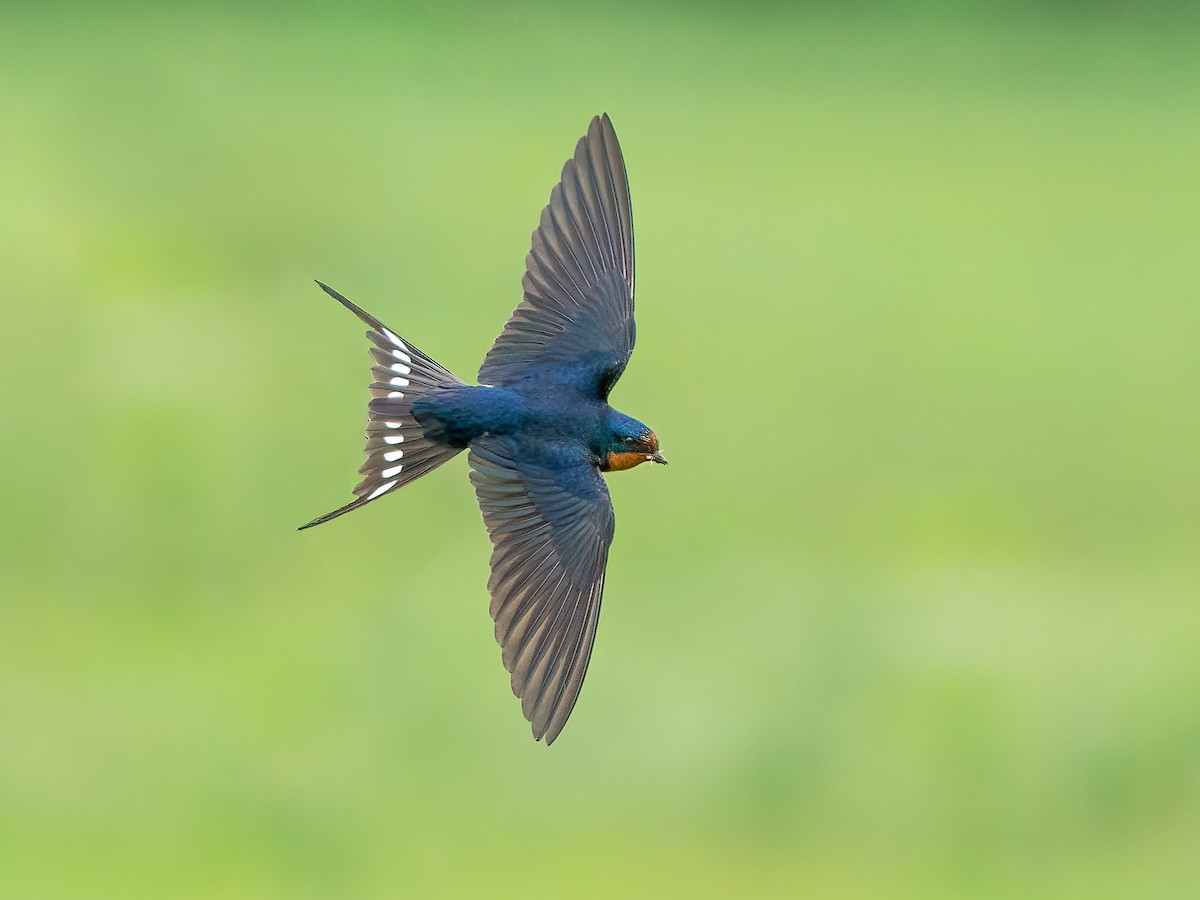
The Barn Swallow (Hirundo rustica) is the most widespread species of swallow in the world. It is a distinctive passerine bird known for its deeply forked tail, iridescent blue upperparts, and rufous underparts. Highly aerial, it is a skilled insectivore, often seen gracefully hawking insects in open country, particularly near water and human habitation. It is a long-distance migrant, breeding across the Northern Hemisphere and wintering in the Southern Hemisphere.
Size & lifespan
- Length
- 17-19 cm (including outer tail streamers of up to 7 cm)
- Wingspan
- 32-34.5 cm
- Weight
- 16-22 g
- Lifespan
- Typically 2-4 years in the wild, with records up to 11 years
- Diet
- Insectivore, primarily aerial insects
Physical characteristics
- Plumage
- Adults have iridescent steel-blue upperparts, a rufous (chestnut) forehead and throat, separated from the creamy-white to buff underparts by a broad, dark blue breast band. The tail is deeply forked with long outer streamers, and white spots are visible on the inner webs of the tail feathers when spread.
- Beak shape
- Small, flattened, and triangular, adapted for catching insects in flight; black in color.
- Eye color
- Dark brown.
- Leg color
- Short, blackish legs and feet, adapted for perching rather than walking.
- Distinguishing features
- Deeply forked tail with long streamers (especially in males), iridescent blue back, rufous face/throat, and dark breast band. White spots on the tail are a key field mark.
- Juvenile appearance
- Juveniles are duller than adults, with browner upperparts, paler and less rufous underparts, and a shorter, less deeply forked tail with shorter streamers. The breast band is often less distinct.
- Seasonal changes
- Plumage remains largely consistent throughout the year, though wear can make colors appear duller towards the end of the breeding season or migration. No distinct non-breeding plumage.
- Sexual dimorphism
- Males typically have longer, more prominent outer tail streamers than females, and often a slightly darker, more intense rufous on the throat and forehead. Females may have duller plumage and shorter streamers.
How to identify
- 1
Tail Shape
Look for the deeply forked tail with long, slender outer streamers, especially prominent in males. White spots on the inner webs of the tail feathers are visible when spread.
- 2
Plumage Coloration
Note the iridescent steel-blue upperparts, contrasting with the rufous (chestnut) forehead and throat. A dark blue breast band separates the rufous throat from the creamy-white underparts.
- 3
Flight Pattern
Observe its characteristic agile, acrobatic flight, often low over open fields or water, with frequent glides and sharp turns as it hunts insects.
- 4
Habitat
Barn Swallows are almost always found in open country, often near water and human structures like barns, sheds, or bridges, which they use for nesting.
- 5
Vocalization
Listen for its cheerful, warbling, twittering song, often ending with a distinctive 'squeaky gate' sound.
Habitat & range
- Biomes
- Temperate grasslands, agricultural areas, open woodlands, savannas, and human-modified landscapes.
- Geographic range
- Breeds across most of the Northern Hemisphere, including North America, Europe, Asia, and parts of North Africa. Winters in the Southern Hemisphere, including South America, sub-Saharan Africa, and parts of southern Asia and northern Australia.
- Elevation range
- From sea level up to approximately 3,000 meters, though typically found at lower elevations.
- Preferred environments
- Open country with access to water, often near human structures like barns, bridges, and houses for nesting. Requires open air space for foraging and mud for nest building.
Behavior
- Activity time
- Diurnal.
- Feeding habits
- Exclusively insectivorous, catching insects (flies, beetles, moths, aphids, grasshoppers) in continuous, agile flight. They often forage low over fields, water, or pastures, especially in warm weather. They drink by skimming low over water surfaces.
- Social behavior
- Highly social, especially during migration and in wintering grounds, forming large communal roosts. During breeding, they are colonial, nesting in loose groups, but defend their immediate nest site. They often forage in mixed-species flocks with other swallows and swifts.
- Flight pattern
- Graceful, agile, and highly acrobatic flight, characterized by rapid wing beats interspersed with glides. They are masters of aerial pursuit, making sharp turns and dives.
- Migration pattern
- Long-distance migratory. Northern Hemisphere breeders migrate south for the winter, crossing vast distances, often thousands of kilometers. Migration occurs in large flocks, typically during the day.
- Territoriality
- Males defend a small territory around the nest site during the breeding season, primarily against other males. They are less territorial on wintering grounds.
Song & calls
- Song
- A cheerful, warbling, and twittering song, often ending with a distinctive 'squeaky gate' or 'squeaky wheel' sound. It's a rapid series of trills and chirps, often delivered from a perch or in flight.
- Call
- Common calls include a sharp 'wit-wit' or 'tswit' alarm call, a soft 'chiv-it' contact call, and a harsh 'splee-plink' when agitated or defending the nest.
- When they vocalize
- Most vocal during the breeding season, particularly males singing to attract mates and defend territory. Calls are used year-round for communication within flocks and as alarm signals.
Breeding & reproduction
- Breeding season
- Varies geographically, typically April to August in the Northern Hemisphere.
- Nesting habits
- Nests are cup-shaped, made of mud pellets mixed with grass and lined with feathers. They are typically built on vertical surfaces under eaves, inside barns, sheds, bridges, or culverts. Both sexes participate in nest building.
- Clutch size
- Typically 2-3 clutches per season in warmer regions, 1-2 in cooler regions.
- Egg description
- 3-7 (usually 4-5) white, glossy eggs, speckled with reddish-brown or purplish-grey spots, particularly at the larger end. Dimensions average 20 x 14 mm.
- Incubation period
- 13-17 days, primarily by the female.
- Fledging period
- 18-23 days after hatching. Young are fed by both parents.
- Parental care
- Both parents feed and care for the young. After fledging, juveniles remain dependent on parents for several days to weeks, often returning to the nest to roost.
Where to find
Agricultural Areas
Look in and around barns, sheds, and other farm buildings where they often nest.
Open Fields and Pastures
They forage over open grassy areas, especially where livestock are present, attracting insects.
Near Water Bodies
Lakes, ponds, rivers, and coastal areas provide abundant insect prey and mud for nest building.
Bridges and Culverts
These structures offer sheltered sites for nesting, particularly in areas lacking traditional farm buildings.
Field tips
- Look up!. Barn Swallows spend most of their active time in the air. Scan the skies, especially over open areas.
- Visit farms or rural areas. Their strong association with human structures makes farms, stables, and rural outbuildings prime locations.
- Observe near water. They frequently skim over water to drink and catch emerging insects. Look for them at dawn and dusk.
- Listen for their song. Their distinctive warbling song can often alert you to their presence, even before you see them.
- Watch for mud nests. During breeding season, look for their characteristic mud cup nests attached to vertical surfaces under eaves or inside structures.
Similar species
Cliff Swallow
Petrochelidon pyrrhonota
Barn Swallows have a deeply forked tail and rufous throat/forehead. Cliff Swallows have a square-tipped tail, a pale rump, and a dark throat with a pale forehead patch.
Cave Swallow
Petrochelidon fulva
Similar to Cliff Swallow but with a more rufous throat and a less distinct pale rump. Barn Swallows are distinguished by their deeply forked tail and dark breast band.
Red-rumped Swallow
Cecropis daurica
Red-rumped Swallows have a distinctive rufous rump and a less deeply forked tail than the Barn Swallow. Their underparts are also paler and less marked.
Welcome Swallow
Hirundo neoxena
Found in Australia and New Zealand. Very similar in appearance to Barn Swallow, often considered conspecific or a very close relative. Key differences are subtle in plumage and tail streamer length, and their geographic ranges generally do not overlap in breeding areas.
Quick facts
- Global Distribution:
- Most widespread swallow species globally
- Diet:
- Strictly insectivorous, catching prey in flight
- Nesting Material:
- Mud pellets and grass, lined with feathers
- Migration Distance:
- Can travel thousands of kilometers between breeding and wintering grounds
- Tail Streamers:
- Longer in males, used in sexual selection
Fun facts
- Barn Swallows are considered a symbol of spring and good luck in many cultures due to their return from migration.
- Male Barn Swallows with longer tail streamers are generally preferred by females, indicating better health and genetic quality.
- They are incredibly agile flyers, capable of catching insects at high speeds and performing complex aerial maneuvers.
- Barn Swallows often reuse their mud nests from previous years, sometimes repairing and adding to them.
- They drink water by flying low over the surface and scooping it up with their open mouths.
Scientific classification
- Kingdom
- Animalia
- Phylum
- Chordata
- Class
- Aves
- Order
- Passeriformes
- Family
- Hirundinidae
- Genus
- Hirundo
- Species
- Hirundo rustica
Explore the Barn Swallow
Identify birds anywhere
Free on iOS, Android, and Web. Photo & sound identification, full species database, and your personal life list.