
Spotted a bird? Identify it instantly with the Birdby app
Open the appAbout
The Common Nightingale is a small passerine bird renowned for its powerful and beautiful song, particularly at night. Despite its celebrated vocal abilities, its appearance is rather plain and unobtrusive, making it more often heard than seen. It is a migratory species, breeding in Europe and Asia and wintering in sub-Saharan Africa. It prefers dense, shrubby vegetation, often near water.
Size & lifespan
- Length
- 15-16.5 cm
- Wingspan
- 23-26 cm
- Weight
- 16-27 g
- Lifespan
- Typically 3-5 years in the wild, though up to 8 years recorded.
- Diet
- Primarily insects and other invertebrates, supplemented with berries and fruits, especially in late summer and autumn.
Physical characteristics
- Plumage
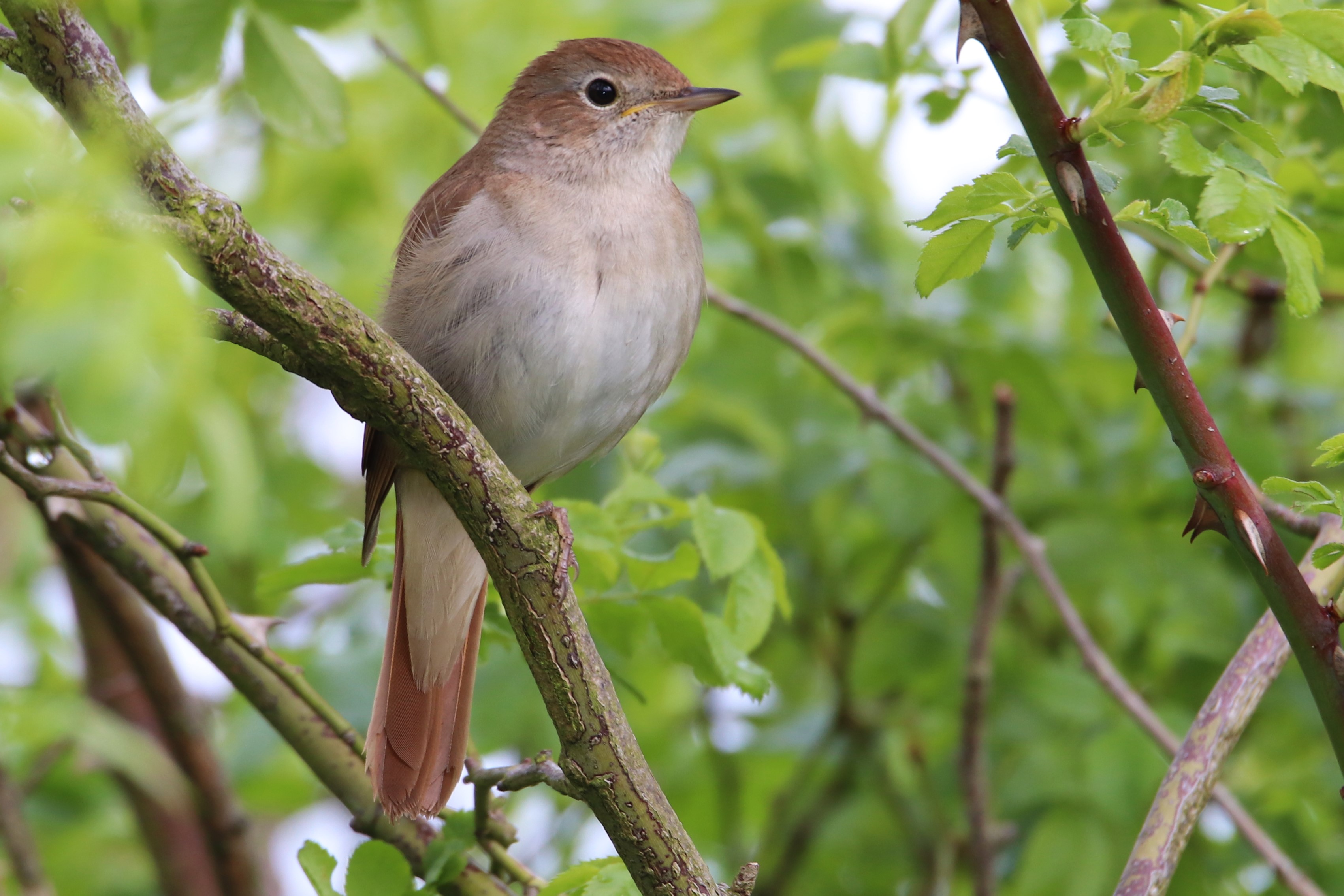
- The adult Common Nightingale has plain, warm brown upperparts (back, wings, and head), with a slightly rufous-chestnut rump and tail. The underparts are grayish-white, often buffier on the flanks and undertail coverts. The breast may have a faint mottling. There is a pale yellowish eye-ring and a dusky lore line, but otherwise, the head lacks prominent markings.
- Beak shape
- Small, slender, and pointed, dark grayish-brown.
- Eye color
- Dark brown.
- Leg color
- Dusky pinkish-brown to dark gray.
- Distinguishing features
- Its most distinctive feature is its rufous-chestnut tail, which is often fanned and held cocked when agitated. Its overall plain brown plumage with the contrasting reddish tail is a key identification mark. It typically holds its body horizontally or slightly angled upwards.
- Juvenile appearance
- Juveniles are mottled overall, appearing scalloped dark brown and tawny on the upperparts and breast. They still possess the rufous-chestnut tail. This mottled plumage is lost after the post-juvenile molt.
- Seasonal changes
- No significant seasonal changes in adult plumage outside of plumage wear. Fresh plumage after post-breeding molt may appear slightly richer brown and less worn.
- Sexual dimorphism
- No significant sexual dimorphism in plumage; males and females look alike. Males tend to be slightly larger on average, but this is not discernible in the field.
How to identify
- 1
Song
The most effective identification method. Listen for its powerful, varied song with crescendo trills ('churr-churr-churr') and fluty whistles, often at night or dawn/dusk. The sheer complexity and volume are distinctive.
- 2
Plumage
Look for plain, warm brown upperparts with a contrasting rufous-chestnut rump and tail. Underparts are off-white/grayish-buff. Lack of strong facial markings (unlike a Robin).
- 3
Behavior
Observe its secretive nature, usually staying hidden in dense undergrowth. When seen, it often holds its tail slightly cocked and may flick it. Forages low down or on the ground.
- 4
Habitat
Search in dense, bushy vegetation, thickets, woodland edges, and areas with good ground cover, often near water. If you hear a spectacular song from such a habitat, it's very likely a Nightingale.
Habitat & range
- Biomes
- Temperate forests, shrublands, grasslands.
- Geographic range
- Breeds across most of Europe (west to Portugal, north to southern Scandinavia, east into western Asia, including the Caucasus and parts of Central Asia). Winters in sub-Saharan Africa, from Senegal east to Kenya and south to South Africa.
- Elevation range
- Typically lowlands to mid-altitudes, up to 1,500-2,000 meters in some parts of its breeding range.
- Preferred environments
- Dense thickets, scrubland, coppices, hedgerows, woodland edges, riverine forests, parks, and large gardens with dense undergrowth. It favors moist soil and often occurs near water sources. Requires dense horizontal cover for nesting and foraging, often with scattered tall trees for song perches.
Behavior
- Activity time
- Principally crepuscular and nocturnal, especially during the breeding season, when males sing extensively at night. They also forage and actively during the day.
- Feeding habits
- Forages mainly on the ground, often among leaf litter or in dense vegetation. It probes with its bill and gleans insects from foliage. It is generally secretive and shy.
- Social behavior
- Solitary and territorial during the breeding season. Outside the breeding season and during migration, it is generally solitary, although sometimes seen in small loose groups at rich feeding sites.
- Flight pattern
- Short, low, and rather straight flights between patches of cover. When alarmed, it often flies into the densest part of a bush.
- Migration pattern
- Long-distance nocturnal migrant. Migrates south to its African wintering grounds from late summer to autumn (August-October) and returns to breeding grounds in spring (April-May). They undertake substantial trans-Saharan journeys.
- Territoriality
- Highly territorial during the breeding season. Males establish and defend territories with their elaborate song to attract mates and exclude rivals.
Song & calls
- Song
- The song is exceptionally rich, varied, and powerful, often delivered with great volume and emotional intensity. It features a wide repertoire of whistles, trills, GÜTT-GÜTT-GÜTT calls, and crescendo phrases, particularly the characteristic 'churr-churr-churr' increasing in speed and intensity, often ending with a sudden, loud, fluty whistle. Known for singing both day and night, especially before dawn and after dusk. Each male has a vast and unique repertoire, which suggests song learning and cultural transmission.
- Call
- Calls include a soft 'hweet' or 'huit' contact call, a harsh 'charr' when alarmed, and various 'tak-tak-tak' or 'tuc-tuc-tuc' notes resembling stones knocking together, often given when agitated or in interactions.
- When they vocalize
- Males sing most intensely from arrival in spring until incubation begins, often throughout the night, especially unmated males. During the day, singing is more sporadic but still occurs.
Breeding & reproduction
- Breeding season
- April to July, depending on latitude. Most commonly May-June.
- Nesting habits
- Nests are typically built on or very close to the ground, well concealed within dense vegetation (e.g., bramble thickets, nettles, low shrubs). The nest is a loose cup of dry leaves, grass stems, and moss, lined with finer material like rootlets and hair. The female builds the nest.
- Clutch size
- Typically 4-6 eggs, usually one brood per year.
- Egg description
- Usually 4-6 eggs, typically dark olive, brownish-green, or bluish-green, sometimes finely speckled with reddish-brown.
- Incubation period
- 13-14 days, primarily by the female.
- Fledging period
- 11-13 days. Young are altricial and leave the nest before they can fly well. Both parents feed the fledglings.
- Parental care
- Both parents participate in feeding the young after hatching. The female primarily incubates and broods, while the male often continues singing and assists with feeding.
Where to find
Woodland Edges
Areas where woodlands transition into clearings or fields, offering both cover and open foraging opportunities.
Dense Thickets & Scrub
Brambly patches, gorse, and other dense shrubbery are prime habitats for nesting and concealment.
Riverine Vegetation
Brushy banks and undergrowth along rivers and streams provide preferred moist conditions and insect availability.
Parks & Large Gardens
Well-vegetated urban and suburban green spaces with neglected corners and dense shrubberies can host Nightingales.
Field tips
- Listen at Dawn/Dusk (or Night). This is when the male's song is most prominent and can lead you to its general location.
- Be Patient and Still. Nightingales are shy. Find a suitable habitat, remain quiet and still, and let the bird reveal itself. Use your ears more than your eyes initially.
- Scan Low Vegetation. If you hear one, try to spot movement within the lower branches and dense undergrowth. They rarely perch high in the open.
- Look for Tail Action. If you glimpse a bird, watch for the characteristic cocking and fanning of its rufous-chestnut tail, especially when it's agitated or moving through cover.
Similar species
Thrush Nightingale
Luscinia luscinia
The Thrush Nightingale has duller, more grayish-brown upperparts and a less rufous tail. Its underparts are more heavily mottled, particularly on the breast, giving it a 'thrush-like' appearance. The song is similar but lacks the characteristic crescendo churring and often has a more rasping, guttural quality, without the clear, fluty whistles of the Common Nightingale.
Rufous-tailed Scrub Robin
Cercotrichas galactotes
While also having a rufous tail, the Rufous-tailed Scrub Robin is generally paler and sandier overall, with a longer tail which it often cocks high and spreads prominently. It has a more upright posture and typically inhabits drier, more open scrubland.
Robin
Erithacus rubecula
The Robin is easily distinguished by its bright orange-red breast and face. Its song is also distinct, though melodious, it lacks the power and varied repertoire of the Nightingale. Robins are smaller and have a different foraging style.
Quick facts
- Primary Identification:
- Distinctive rich, powerful, and varied song, especially at night.
- Tail Color:
- Rufous-chestnut, contrasting with brown body.
- Habitat Preference:
- Dense undergrowth, thickets, woodland edges, often near water.
- Migration:
- Long-distance trans-Saharan migrant.
- Diet Specialty:
- Insects and other invertebrates.
Fun facts
- The Common Nightingale is often referred to simply as 'the Nightingale' due to its iconic status and song.
- Despite its beautiful song, it is remarkably plain-looking, a classic example of a bird that is purely auditory in its appeal to humans.
- Only male Nightingales sing. Unmated males sing most intensely throughout the night to attract a mate.
- Its song has been a source of inspiration for countless poets, writers, and musicians throughout history, symbolizing love, beauty, and longing.
Scientific classification
- Kingdom
- Animalia
- Phylum
- Chordata
- Class
- Aves
- Order
- Passeriformes
- Family
- Muscicapidae
- Genus
- Luscinia
- Species
- Luscinia megarhynchos
Explore the Common Nightingale
Identify birds anywhere
Free on iOS, Android, and Web. Photo & sound identification, full species database, and your personal life list.