
Spotted a bird? Identify it instantly with the Birdby app
Open the appAbout
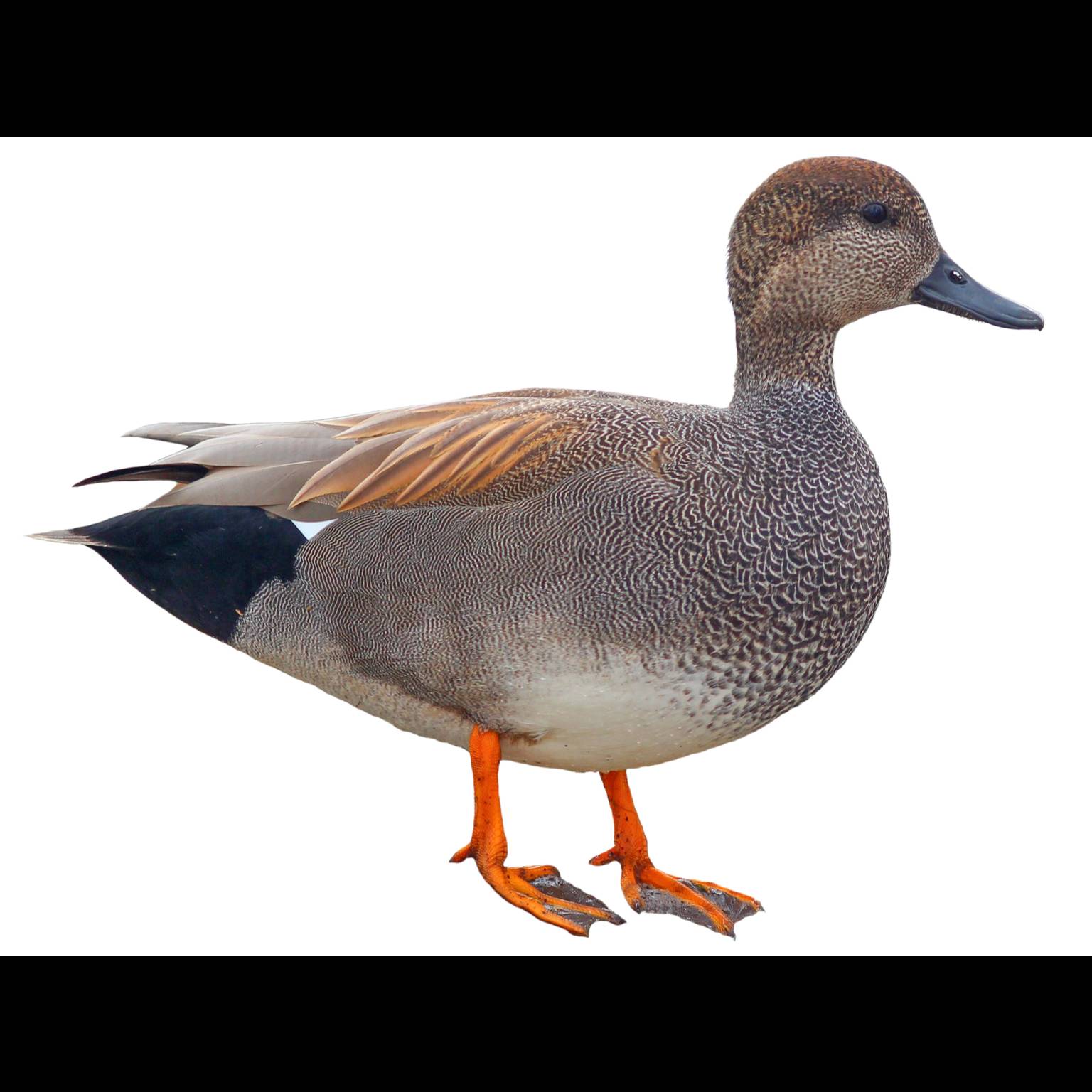
The Gadwall (Mareca strepera) is a medium-sized dabbling duck, known for its subtle but distinctive plumage. It is less colorful than many other dabbling ducks, often appearing grayish-brown, but close observation reveals intricate vermiculations and a prominent white speculum, especially noticeable in flight. It is a widespread species, breeding across temperate regions of the Northern Hemisphere and migrating to warmer climes for winter.
Size & lifespan
- Length
- 46-56 cm (18-22 in)
- Wingspan
- 78-90 cm (31-35 in)
- Weight
- 700-1300 g (1.5-2.9 lbs)
- Lifespan
- Typically 5-10 years in the wild, with records up to 20 years.
- Diet
- Herbivore, primarily consuming aquatic vegetation, seeds, and some invertebrates.
Physical characteristics
- Plumage
- Males in breeding plumage are predominantly gray with fine vermiculations, a black rear end, and a chestnut patch on the forewing, followed by a striking white speculum. Females are mottled brown, similar to a female Mallard, but with a more slender neck, a smaller head, and a prominent white speculum. Both sexes have a white belly.
- Beak shape
- Slightly flattened, dark gray to black bill in males, often with an orange tinge on the sides in females, especially at the base.
- Eye color
- Dark brown.
- Leg color
- Dull orange to yellowish-orange.
- Distinguishing features
- The most distinctive feature for both sexes is the large white speculum on the secondary flight feathers, visible in flight and often at rest. Males also show a black rump and a chestnut patch on the upperwing coverts.
- Juvenile appearance
- Juveniles resemble adult females but are generally duller, with less distinct markings and often a more mottled appearance. The white speculum is present but may be less prominent.
- Seasonal changes
- Males undergo an eclipse plumage in late summer/early autumn, resembling females but often retaining some darker markings and the white speculum. They regain their breeding plumage by late autumn/early winter.
- Sexual dimorphism
- Pronounced. Males are grayer with a black rump and chestnut/white wing patches. Females are mottled brown with a white speculum, resembling a female Mallard but with key differences.
How to identify
- 1
White Speculum
This is the most crucial field mark for both sexes. Look for a prominent white patch on the trailing edge of the wing, visible both in flight and often when the bird is resting with wings folded.
- 2
Male Plumage
Observe the overall gray body with fine vermiculations, a black rump, and a chestnut patch on the upperwing coverts (just in front of the white speculum). The bill is dark gray to black.
- 3
Female Plumage
Look for a mottled brown body, similar to a female Mallard, but note the more slender neck and smaller head. The white speculum is still key. The bill is often dark with an orange tinge, especially at the base.
- 4
Behavior
Gadwalls are dabbling ducks, feeding by tipping up in shallow water. They are less prone to 'head-bobbing' than some other dabblers. Watch for their direct, strong flight.
- 5
Vocalization
Listen for the male's low 'kreh-kreh' or whistle, and the female's softer, higher-pitched 'quack' or 'ga-ga-ga', distinct from the louder Mallard quack.
Habitat & range
- Biomes
- Wetlands, marshes, shallow lakes, slow-moving rivers, and estuaries.
- Geographic range
- Breeds across temperate North America, Europe, and Asia. Winters in southern North America, Central America, northern Africa, southern Europe, and southern Asia.
- Elevation range
- Primarily lowlands, up to approximately 1,000 meters (3,300 feet) in some areas.
- Preferred environments
- Prefers shallow, freshwater wetlands with abundant emergent and submerged vegetation, often with muddy bottoms. Less common in highly acidic or saline waters.
Behavior
- Activity time
- Diurnal, primarily feeding during daylight hours, though some nocturnal feeding may occur.
- Feeding habits
- Primarily a dabbling duck, feeding by tipping head-down to reach submerged vegetation and seeds. Also grazes on emergent vegetation and occasionally filters invertebrates from the water surface. They are known to steal food from diving ducks.
- Social behavior
- Often found in pairs during the breeding season, but forms larger flocks during migration and in winter. Can associate with other dabbling duck species.
- Flight pattern
- Strong, direct flight with rapid wingbeats. The white speculum is very conspicuous in flight. They take off directly from the water without a running start.
- Migration pattern
- Migratory across much of its range. Northern populations move south for winter, while southern populations may be resident or undertake shorter movements. Migration occurs in broad fronts, often at night.
- Territoriality
- Males defend a small territory around the female during the breeding season, but are not strongly territorial over nesting sites.
Song & calls
- Song
- Males have a low, reedy 'kreh-kreh' or 'quack' and a distinctive, high-pitched whistle. They are generally less vocal than many other duck species.
- Call
- Females give a Mallard-like 'quack' but it is typically softer and higher-pitched, often described as a 'ga-ga-ga' or 'rrah-rrah'.
- When they vocalize
- Most vocal during the breeding season, particularly during courtship displays. Less vocal during migration and winter.
Breeding & reproduction
- Breeding season
- Typically April to July, varying geographically.
- Nesting habits
- Nests are usually built on dry ground, often concealed in dense vegetation near water. The nest is a shallow depression lined with grass, leaves, and down plucked from the female's breast.
- Clutch size
- Typically 7-12 eggs.
- Egg description
- 8-12 eggs, creamy white to pale buff, unspotted. Approximately 54 x 38 mm.
- Incubation period
- 24-27 days, incubated solely by the female.
- Fledging period
- Ducklings are precocial and leave the nest shortly after hatching. They are capable of flight at 45-50 days.
- Parental care
- Only the female cares for the ducklings, leading them to water and foraging areas, and protecting them from predators.
Where to find
Freshwater Marshes
Areas with emergent vegetation like cattails and reeds, and shallow open water.
Shallow Lakes and Ponds
Especially those with abundant aquatic vegetation and muddy bottoms.
Slow-moving Rivers and Backwaters
Areas with calm water and dense shoreline vegetation.
Estuaries and Coastal Lagoons
During migration and winter, they can be found in brackish waters, particularly those with extensive mudflats and seagrass beds.
Field tips
- Look for the White Speculum. This is the most reliable field mark. Even at a distance, the white patch on the wing can help distinguish it from other ducks, especially in flight.
- Observe Feeding Behavior. Gadwalls are dabblers. Watch for ducks tipping up in shallow water, exposing their rear ends, as they forage for submerged vegetation.
- Study Female Plumage Carefully. Distinguishing female Gadwalls from female Mallards requires attention to subtle differences in head shape, bill color, and the crucial white speculum.
- Listen for Calls. Their calls are generally quieter than Mallards. Learning the male's whistle and the female's softer quack can aid identification, especially in dense cover.
- Check for Black Rump (Males). In breeding males, the contrasting black rump is a good identifier, especially when the bird is preening or in flight.
Similar species
Mallard
Anas platyrhynchos
Female Gadwalls are often confused with female Mallards. Gadwalls are generally smaller, more slender, and have a smaller head and bill. The most reliable distinction is the white speculum of the Gadwall (Mallards have a blue speculum bordered with white) and the lack of an orange bill in female Gadwalls (Mallards often have an orange bill with a dark saddle). Male Gadwalls lack the iridescent green head of male Mallards.
American Wigeon
Mareca americana
Both Gadwall and American Wigeon are dabbling ducks. Male American Wigeons have a prominent white crown and green patch behind the eye, and a white belly. Female American Wigeons have a gray head and neck, and a smaller, less distinct white speculum than Gadwalls. Gadwalls have a black rump, which Wigeons lack.
Northern Shoveler
Spatula clypeata
While distinct due to the large spatulate bill, female Northern Shovelers can have mottled brown plumage. However, the bill shape is an unmistakable difference. Gadwalls have a more typical duck bill.
Quick facts
- Diet:
- Primarily aquatic vegetation and seeds
- Key ID Feature:
- White speculum on wing
- Habitat:
- Shallow freshwater wetlands
- Migration:
- Migratory across much of its range
- Conservation Status:
- Least Concern
Fun facts
- Gadwalls are one of the few dabbling ducks where both sexes possess a white speculum, making it a key identification feature for both.
- They are known to 'kleptoparasitize' other diving ducks, stealing food that the divers bring to the surface.
- The name 'Gadwall' is thought to derive from an old English word 'gaddel' meaning 'to wander' or 'to gad about', referring to its migratory habits.
- Despite their subtle coloration, the intricate vermiculations on the male's plumage are considered quite beautiful upon close inspection.
Scientific classification
- Kingdom
- Animalia
- Phylum
- Chordata
- Class
- Aves
- Order
- Anseriformes
- Family
- Anatidae
- Genus
- Mareca
- Species
- Mareca strepera
Explore the Gadwall
Identify birds anywhere
Free on iOS, Android, and Web. Photo & sound identification, full species database, and your personal life list.