
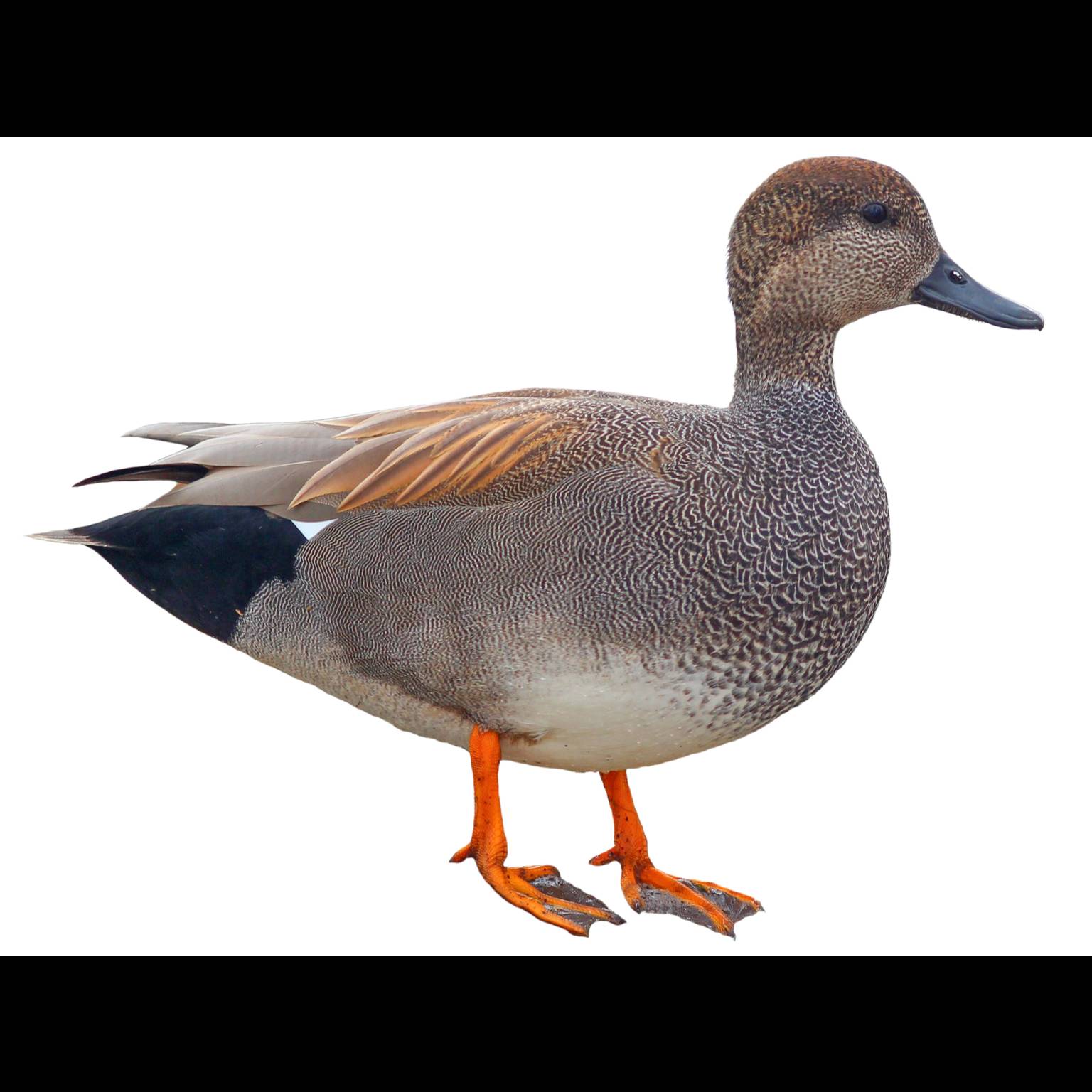
How to identify the Gadwall
Mareca strepera
Spotted a bird? Identify it instantly with the Birdby app
Open the appTo correctly identify the Gadwall (Mareca strepera), check each of these features. Birds can be tricky: habit, habitat, and call often confirm a sighting that a single photo cannot.
Size at a glance
- Length
- 46-56 cm (18-22 in)
- Wingspan
- 78-90 cm (31-35 in)
- Weight
- 700-1300 g (1.5-2.9 lbs)
Physical features to check
- 1
Plumage
Overall feather coloration and pattern.
Males in breeding plumage are predominantly gray with fine vermiculations, a black rear end, and a chestnut patch on the forewing, followed by a striking white speculum. Females are mottled brown, similar to a female Mallard, but with a more slender neck, a smaller head, and a prominent white speculum. Both sexes have a white belly.
- 2
Beak shape
Shape and color of the bill: a key field mark.
Slightly flattened, dark gray to black bill in males, often with an orange tinge on the sides in females, especially at the base.
- 3
Eye color
Iris color and any distinctive eye markings.
Dark brown.
- 4
Leg color
Leg and foot color.
Dull orange to yellowish-orange.
- 5
Distinguishing features
Standout features that separate this species.
The most distinctive feature for both sexes is the large white speculum on the secondary flight feathers, visible in flight and often at rest. Males also show a black rump and a chestnut patch on the upperwing coverts.
- 6
Juvenile appearance
How young birds differ from adults.
Juveniles resemble adult females but are generally duller, with less distinct markings and often a more mottled appearance. The white speculum is present but may be less prominent.
- 7
Seasonal changes
Plumage variation between breeding and non-breeding seasons.
Males undergo an eclipse plumage in late summer/early autumn, resembling females but often retaining some darker markings and the white speculum. They regain their breeding plumage by late autumn/early winter.
- 8
Sexual dimorphism
How males and females differ.
Pronounced. Males are grayer with a black rump and chestnut/white wing patches. Females are mottled brown with a white speculum, resembling a female Mallard but with key differences.
Key field marks
- White Speculum. This is the most crucial field mark for both sexes. Look for a prominent white patch on the trailing edge of the wing, visible both in flight and often when the bird is resting with wings folded.
- Male Plumage. Observe the overall gray body with fine vermiculations, a black rump, and a chestnut patch on the upperwing coverts (just in front of the white speculum). The bill is dark gray to black.
- Female Plumage. Look for a mottled brown body, similar to a female Mallard, but note the more slender neck and smaller head. The white speculum is still key. The bill is often dark with an orange tinge, especially at the base.
- Behavior. Gadwalls are dabbling ducks, feeding by tipping up in shallow water. They are less prone to 'head-bobbing' than some other dabblers. Watch for their direct, strong flight.
- Vocalization. Listen for the male's low 'kreh-kreh' or whistle, and the female's softer, higher-pitched 'quack' or 'ga-ga-ga', distinct from the louder Mallard quack.
Explore the Gadwall
Identify birds anywhere
Free on iOS, Android, and Web. Photo & sound identification, full species database, and your personal life list.