
Spotted a bird? Identify it instantly with the Birdby app
Open the appAbout
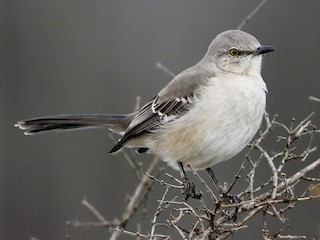
The Northern Mockingbird is a medium-sized passerine bird known for its remarkable ability to mimic the songs and calls of other birds, as well as other sounds. It is a common and conspicuous bird across much of North America, often found in open areas with scattered shrubs and trees.
Size & lifespan
- Length
- 20.5-28 cm (8.1-11.0 in)
- Wingspan
- 31-38 cm (12-15 in)
- Weight
- 40-58 g (1.4-2.0 oz)
- Lifespan
- Typically 8 years in the wild, with records up to 15 years.
- Diet
- Omnivore, primarily insects and berries.
Physical characteristics
- Plumage
- Adults are gray-brown on the upperparts and pale gray to whitish on the underparts. They have two white wing bars and prominent white patches on the primary flight feathers, especially visible in flight. The tail is long and dark with white outer tail feathers. There is a faint white eye-line.
- Beak shape
- Slender, slightly decurved, and black.
- Eye color
- Yellowish-orange.
- Leg color
- Dark gray to black.
- Distinguishing features
- The most distinctive features are the large white wing patches, especially noticeable during flight or when flashing the wings, and the long tail with white outer rectrices. Its upright posture and frequent tail-cocking are also characteristic.
- Juvenile appearance
- Juveniles resemble adults but have a more mottled or spotted breast, often with faint streaking, and may appear slightly browner overall. Their eyes are typically grayish-brown, gradually changing to yellow-orange.
- Seasonal changes
- No significant seasonal plumage changes. Plumage remains consistent year-round, though wear and tear can make feathers appear duller before molting.
- Sexual dimorphism
- Males and females are outwardly identical in plumage and size.
How to identify
- 1
Plumage and Size
Look for a medium-sized, slender gray bird with a long tail. The overall gray-brown upperparts and paler underparts are characteristic.
- 2
White Wing Patches
The most definitive field mark is the large white patch on the primaries, highly visible in flight and often noticeable when perched. Also look for two faint white wing bars.
- 3
White Outer Tail Feathers
When the bird flies or cocks its tail, the white outer tail feathers are very prominent against the dark central tail.
- 4
Behavior
Observe its behavior: frequent tail-cocking, running and hopping on the ground, and aggressive territorial displays. They often 'wing-flash' by raising their wings to expose the white patches, though the purpose of this behavior is debated (possibly to startle insects or display).
- 5
Song
Listen for its incredibly varied and repetitive song, mimicking other birds and sounds. Each phrase is typically repeated 3-6 times before a new phrase is introduced.
Habitat & range
- Biomes
- Temperate forests, shrublands, grasslands, urban and suburban areas.
- Geographic range
- Resident throughout the southeastern United States, extending west to central Texas and north to southern Canada (primarily Ontario). Also found in Mexico, the Caribbean, and occasionally as a vagrant further north.
- Elevation range
- Sea level up to approximately 2,000 meters (6,500 feet), primarily in lower elevations.
- Preferred environments
- Open woodlands, forest edges, suburban gardens, parks, agricultural lands, and areas with dense shrubbery for nesting and cover, often near human habitation.
Behavior
- Activity time
- Diurnal. Highly active during the day, often singing late into the evening and sometimes through the night, especially during full moons or breeding season.
- Feeding habits
- Forages on the ground and in vegetation. Diet consists mainly of insects (grasshoppers, crickets, beetles, ants, wasps) during spring and summer, and fruits/berries (holly, elderberry, blackberry, sumac) during fall and winter. They may also consume small lizards or snails. They often run or hop on the ground, pausing to scan for prey.
- Social behavior
- Generally solitary or found in pairs, especially during the breeding season. They can be quite aggressive and territorial, particularly when defending nests or food sources. Non-breeding birds may occasionally form loose flocks.
- Flight pattern
- Strong, undulating flight with rapid wing beats. The prominent white wing patches are very conspicuous in flight.
- Migration pattern
- Mostly resident throughout its range. Northernmost populations may undertake short-distance migrations south during harsh winters, but most individuals remain on their breeding territories year-round.
- Territoriality
- Highly territorial, especially males during the breeding season. They will aggressively defend their territory against other mockingbirds and even other bird species, often performing elaborate aerial displays and chases.
Song & calls
- Song
- Famous for its complex and varied song, which is a continuous series of phrases, each repeated 3-6 times before switching to a new phrase. It mimics the songs and calls of dozens of other bird species (e.g., jays, orioles, wrens, killdeer, hawks) and even non-avian sounds (e.g., car alarms, squeaky gates). Males sing year-round, but most intensely during the breeding season, often from a prominent perch. Unpaired males may sing at night.
- Call
- Common calls include a harsh 'check' or 'churr' call, often given when agitated or as an alarm. They also have a 'hew' call and various scolding notes.
- When they vocalize
- Sings most frequently from dawn to dusk, with peak activity during the breeding season (spring and early summer). Unpaired males are known to sing extensively at night, particularly during full moons.
Breeding & reproduction
- Breeding season
- Typically March to August, with peak activity from April to July. Can raise 2-3 broods per year.
- Nesting habits
- Nests are built by both sexes, usually in dense shrubs or small trees, 1-15 feet (0.3-4.6 m) above the ground. The nest is a bulky, open cup made of twigs, grass, leaves, and sometimes artificial materials, lined with finer materials like rootlets, hair, or plant down.
- Clutch size
- 3-5 eggs, most commonly 3-4.
- Egg description
- Eggs are oval, pale blue or greenish-blue, heavily marked with reddish-brown or purplish-brown spots and blotches, often concentrated at the larger end. Typically 2.3-2.6 cm (0.9-1.0 in) long.
- Incubation period
- 12-13 days, primarily by the female.
- Fledging period
- 10-13 days after hatching. Young are fed by both parents.
- Parental care
- Both parents feed the nestlings and fledglings. Males continue to feed fledglings from the first brood while the female begins incubating the second clutch.
Where to find
Suburban Gardens and Parks
Very common in residential areas, often perching on rooftops, utility wires, or prominent tree branches.
Open Woodlands and Forest Edges
Look in areas where forests transition to open fields or clearings, providing both cover and foraging opportunities.
Agricultural Lands
Found in orchards, farms, and fields with scattered trees and shrubs.
Shrublands and Thickets
Dense thorny bushes provide ideal nesting and roosting sites.
Field tips
- Listen for its song. The Northern Mockingbird's song is its most distinctive feature. Learn to recognize its repetitive phrases and mimicry. They often sing from high, exposed perches.
- Look for white wing patches in flight. When a gray bird flies, especially with an undulating flight, look for the prominent white flashes on its wings. This is a key identifier.
- Observe tail movements. Mockingbirds frequently pump or cock their long tails, revealing the white outer tail feathers. This behavior is often seen when they are perched or foraging on the ground.
- Check prominent perches. They often perch conspicuously on the highest point of a tree, antenna, or utility wire, especially when singing or surveying their territory.
Similar species
Loggerhead Shrike
Lanius ludovicianus
Mockingbirds are larger, lack the shrike's prominent black mask, and have a more slender bill. Shrikes have a hooked bill and a more upright, hawk-like posture. Mockingbirds have much more white in the wings and tail.
Gray Catbird
Dumetella carolinensis
Catbirds are uniformly slate-gray with a rusty undertail covert patch and a black cap. They lack the white wing patches and white outer tail feathers of the mockingbird. Catbirds also have a different song, often described as a 'cat-like' mewing call.
Northern Shrike
Lanius borealis
Similar to Loggerhead Shrike, but Northern Shrikes are larger and have a less distinct mask. Both shrike species have a hooked bill and different flight patterns and vocalizations compared to the mockingbird.
Quick facts
- State Bird:
- Arkansas, Florida, Mississippi, Tennessee, and Texas
- Mimicry:
- Can mimic up to 200 different songs and sounds
- Territorial Defense:
- Known for aggressively defending nests, even dive-bombing humans or pets
- Nocturnal Singing:
- Unpaired males often sing at night, especially during breeding season
Fun facts
- The scientific name 'Mimus polyglottos' literally means 'many-tongued mimic'.
- Male mockingbirds with larger song repertoires are more successful at attracting mates.
- They are known to 'wing-flash' by raising their wings in a jerky motion, possibly to startle insects or display to rivals.
- Northern Mockingbirds can recognize individual humans who have previously disturbed their nests and will scold or dive-bomb them.
- They are one of the few bird species that sing at night, particularly during the breeding season and under a full moon.
Scientific classification
- Kingdom
- Animalia
- Phylum
- Chordata
- Class
- Aves
- Order
- Passeriformes
- Family
- Mimidae
- Genus
- Mimus
- Species
- Mimus polyglottos
Explore the Northern Mockingbird
Identify birds anywhere
Free on iOS, Android, and Web. Photo & sound identification, full species database, and your personal life list.