
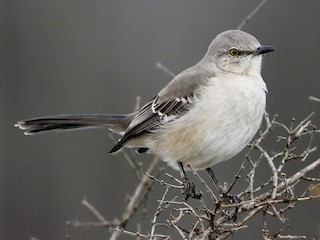
How to identify the Northern Mockingbird
Mimus polyglottos
Spotted a bird? Identify it instantly with the Birdby app
Open the appTo correctly identify the Northern Mockingbird (Mimus polyglottos), check each of these features. Birds can be tricky: habit, habitat, and call often confirm a sighting that a single photo cannot.
Size at a glance
- Length
- 20.5-28 cm (8.1-11.0 in)
- Wingspan
- 31-38 cm (12-15 in)
- Weight
- 40-58 g (1.4-2.0 oz)
Physical features to check
- 1
Plumage
Overall feather coloration and pattern.
Adults are gray-brown on the upperparts and pale gray to whitish on the underparts. They have two white wing bars and prominent white patches on the primary flight feathers, especially visible in flight. The tail is long and dark with white outer tail feathers. There is a faint white eye-line.
- 2
Beak shape
Shape and color of the bill: a key field mark.
Slender, slightly decurved, and black.
- 3
Eye color
Iris color and any distinctive eye markings.
Yellowish-orange.
- 4
Leg color
Leg and foot color.
Dark gray to black.
- 5
Distinguishing features
Standout features that separate this species.
The most distinctive features are the large white wing patches, especially noticeable during flight or when flashing the wings, and the long tail with white outer rectrices. Its upright posture and frequent tail-cocking are also characteristic.
- 6
Juvenile appearance
How young birds differ from adults.
Juveniles resemble adults but have a more mottled or spotted breast, often with faint streaking, and may appear slightly browner overall. Their eyes are typically grayish-brown, gradually changing to yellow-orange.
- 7
Seasonal changes
Plumage variation between breeding and non-breeding seasons.
No significant seasonal plumage changes. Plumage remains consistent year-round, though wear and tear can make feathers appear duller before molting.
- 8
Sexual dimorphism
How males and females differ.
Males and females are outwardly identical in plumage and size.
Key field marks
- Plumage and Size. Look for a medium-sized, slender gray bird with a long tail. The overall gray-brown upperparts and paler underparts are characteristic.
- White Wing Patches. The most definitive field mark is the large white patch on the primaries, highly visible in flight and often noticeable when perched. Also look for two faint white wing bars.
- White Outer Tail Feathers. When the bird flies or cocks its tail, the white outer tail feathers are very prominent against the dark central tail.
- Behavior. Observe its behavior: frequent tail-cocking, running and hopping on the ground, and aggressive territorial displays. They often 'wing-flash' by raising their wings to expose the white patches, though the purpose of this behavior is debated (possibly to startle insects or display).
- Song. Listen for its incredibly varied and repetitive song, mimicking other birds and sounds. Each phrase is typically repeated 3-6 times before a new phrase is introduced.
Explore the Northern Mockingbird
Identify birds anywhere
Free on iOS, Android, and Web. Photo & sound identification, full species database, and your personal life list.