
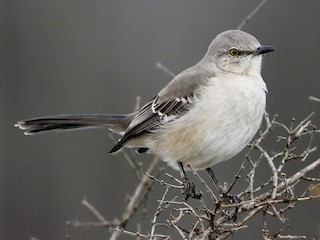
Where does the Northern Mockingbird live?
Mimus polyglottos
Spotted a bird? Identify it instantly with the Birdby app
Open the appThe Northern Mockingbird lives in specific habitats and regions. Knowing where, and when, to look improves your chances of a successful sighting.
Biomes
Temperate forests, shrublands, grasslands, urban and suburban areas.
Geographic range
Resident throughout the southeastern United States, extending west to central Texas and north to southern Canada (primarily Ontario). Also found in Mexico, the Caribbean, and occasionally as a vagrant further north.
Preferred environments
Open woodlands, forest edges, suburban gardens, parks, agricultural lands, and areas with dense shrubbery for nesting and cover, often near human habitation.
Elevation range
Sea level up to approximately 2,000 meters (6,500 feet), primarily in lower elevations.
Where to look
Suburban Gardens and Parks
Very common in residential areas, often perching on rooftops, utility wires, or prominent tree branches.
Open Woodlands and Forest Edges
Look in areas where forests transition to open fields or clearings, providing both cover and foraging opportunities.
Agricultural Lands
Found in orchards, farms, and fields with scattered trees and shrubs.
Shrublands and Thickets
Dense thorny bushes provide ideal nesting and roosting sites.
Field tips
- Listen for its song. The Northern Mockingbird's song is its most distinctive feature. Learn to recognize its repetitive phrases and mimicry. They often sing from high, exposed perches.
- Look for white wing patches in flight. When a gray bird flies, especially with an undulating flight, look for the prominent white flashes on its wings. This is a key identifier.
- Observe tail movements. Mockingbirds frequently pump or cock their long tails, revealing the white outer tail feathers. This behavior is often seen when they are perched or foraging on the ground.
- Check prominent perches. They often perch conspicuously on the highest point of a tree, antenna, or utility wire, especially when singing or surveying their territory.
Migration
Mostly resident throughout its range. Northernmost populations may undertake short-distance migrations south during harsh winters, but most individuals remain on their breeding territories year-round.
Explore the Northern Mockingbird
Identify birds anywhere
Free on iOS, Android, and Web. Photo & sound identification, full species database, and your personal life list.