
Spotted a bird? Identify it instantly with the Birdby app
Open the appAbout
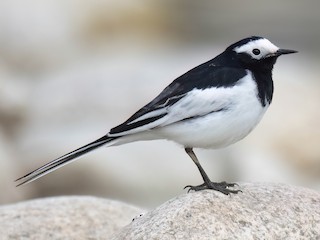
The Pied Wagtail is a small, slender passerine bird, a subspecies of the White Wagtail (Motacilla alba), primarily found in the British Isles. It is characterized by its striking black and white plumage and its distinctive habit of constantly wagging its long tail. It is a familiar sight in a variety of open habitats, often near water or human habitation.
Size & lifespan
- Length
- 16.5-19 cm
- Wingspan
- 25-27 cm
- Weight
- 17-25 g
- Lifespan
- Typically 2-5 years in the wild, with records up to 10 years.
- Diet
- Insectivore
Physical characteristics
- Plumage
- Adult males in breeding plumage have a black crown, nape, and throat, contrasting with a white forehead, cheeks, and sides of the neck. The back is black, and the underparts are white. The wings are dark with prominent white wing-bars, and the long tail is black with white outer tail feathers. Females are similar but often have a greyer back and less intense black on the head and throat, especially outside of breeding season. Non-breeding adults (both sexes) show a reduction in black on the throat, often appearing as a black crescent or bib, with more grey on the back.
- Beak shape
- Slender, pointed, and black, adapted for catching insects.
- Eye color
- Dark brown
- Leg color
- Black
- Distinguishing features
- Long, constantly wagging tail; striking black and white plumage; undulating flight pattern; upright posture.
- Juvenile appearance
- Juveniles are duller and greyer overall, lacking the strong black and white contrast of adults. They have a greyish-brown crown and back, a dirty white throat and underparts, and a yellowish wash on the face. The black bib is absent or very faint. They gradually acquire adult plumage through their first autumn and winter.
- Seasonal changes
- Breeding plumage (spring/summer) is characterized by crisp black and white patterns, particularly the full black cap and bib in males. Non-breeding plumage (autumn/winter) sees a reduction in the black bib, often appearing as a crescent, and a greyer wash on the back, especially in females.
- Sexual dimorphism
- Males in breeding plumage have a more extensive and intense black on the crown, nape, and throat compared to females, whose black areas may be duller or mixed with grey, especially on the back. Outside of breeding season, differences are less pronounced, with both sexes showing reduced black on the throat.
How to identify
- 1
Plumage Coloration
Look for the stark black and white pattern. Males have a black back, crown, and bib. Females have a dark grey back and often a less extensive black bib. This distinguishes it from the grey-backed White Wagtail.
- 2
Tail Wagging
The constant, rhythmic up-and-down wagging of its long tail is a key and almost constant identifier for all wagtail species, but particularly noticeable in the Pied Wagtail.
- 3
Behavior and Gait
Observe its distinctive foraging style: running quickly on the ground, stopping abruptly, and then darting to catch insects. Its upright posture is also characteristic.
- 4
Call
Listen for the sharp 'chissick' or 'tissick' call, often given in flight. This is a good auditory clue, especially when the bird is distant.
- 5
Habitat
While adaptable, their presence in open, short-grass areas, often near water or human structures, is a strong indicator.
Habitat & range
- Biomes
- Temperate grasslands, urban and suburban areas, agricultural land, wetlands, coastal areas.
- Geographic range
- Primarily the British Isles (Great Britain and Ireland). Other subspecies of Motacilla alba are widespread across Europe, Asia, and parts of North Africa.
- Elevation range
- Sea level up to approximately 1,000 meters, though typically found at lower elevations.
- Preferred environments
- Open, short-grass areas, often near water bodies such as rivers, lakes, ponds, and reservoirs. Also common in parks, gardens, playing fields, car parks, farmyards, and urban environments where insects are abundant and there are open spaces for foraging.
Behavior
- Activity time
- Diurnal
- Feeding habits
- Primarily insectivorous, feeding on a wide range of invertebrates including flies, beetles, ants, spiders, and small aquatic insects. They forage by running rapidly on the ground, making sudden dashes to catch prey, or by making short, agile flights to snatch insects from the air or vegetation. They also follow livestock or farm machinery to catch disturbed insects.
- Social behavior
- Often seen singly or in pairs during the breeding season. Outside of breeding, they can form large communal roosts, sometimes numbering hundreds or even thousands of individuals, particularly in urban areas or reedbeds during autumn and winter.
- Flight pattern
- Undulating, bouncy flight pattern, often close to the ground, with rapid wing beats interspersed with short glides.
- Migration pattern
- Resident in much of the British Isles, though some northern populations may move south for winter. Continental White Wagtails (M. a. alba) are migratory, passing through or wintering in the UK, which can make identification challenging. British-bred Pied Wagtails are largely sedentary.
- Territoriality
- Males are territorial during the breeding season, defending their nesting and foraging areas. Outside of breeding, they are less territorial, especially at communal roosts.
Song & calls
- Song
- A pleasant, rambling, and rather jumbled warbling song, often incorporating mimicry of other birds. It is delivered from a perch or in flight, and is less musical than many other passerine songs.
- Call
- The most common call is a sharp, distinctive 'chissick' or 'tissick', often given in flight or when agitated. Also a softer 'tsip' or 'chup' contact call.
- When they vocalize
- Calls are given year-round. Song is primarily heard during the breeding season (spring and early summer).
Breeding & reproduction
- Breeding season
- Typically April to August, with two or sometimes three broods per year.
- Nesting habits
- Nests are typically built in crevices or cavities, often in man-made structures such as walls, bridges, sheds, or under eaves. Natural sites include tree holes, rock crevices, or dense vegetation. The nest is a cup-shaped structure made of grass, moss, roots, and leaves, lined with hair, wool, or feathers. Both parents participate in nest building.
- Clutch size
- 3-7 eggs
- Egg description
- 3-7 (usually 5-6) eggs, smooth and glossy, whitish or pale grey, heavily speckled and mottled with grey-brown or dark brown, often concentrated at the broad end. Average size is about 20 x 15 mm.
- Incubation period
- 12-14 days, primarily by the female.
- Fledging period
- 12-15 days after hatching. Young are fed by both parents.
- Parental care
- Both parents share incubation duties (though female does most) and actively feed the nestlings and fledglings. They continue to care for the young for a period after they leave the nest.
Where to find
Urban and Suburban Areas
Parks, gardens, car parks, playing fields, industrial estates, and even city centers are common places to find them, especially in winter when they form communal roosts.
Agricultural Land
Farmyards, fields with short grass, and areas around livestock often attract Pied Wagtails due to abundant insect prey.
Water Bodies
Riverbanks, lake shores, reservoirs, and ponds provide foraging opportunities for aquatic insects.
Coastal Areas
Beaches, estuaries, and coastal grasslands can also host Pied Wagtails.
Field tips
- Look for movement. Their constant tail wagging and quick, darting movements on the ground make them relatively easy to spot, even from a distance.
- Listen for calls. Their distinctive 'chissick' call is often heard before the bird is seen, especially when they are flying overhead.
- Check open, short-grass areas. Focus your search on lawns, playing fields, and paved areas where they forage for insects.
- Visit communal roosts in winter. In colder months, large numbers can gather at specific roost sites, often in city centers (e.g., on buildings, in trees with artificial lighting) or reedbeds, offering excellent viewing opportunities.
- Observe near water. Pied Wagtails frequently forage along the edges of water bodies.
Similar species
White Wagtail
Motacilla alba alba
The White Wagtail (the nominate subspecies of Motacilla alba, found across continental Europe) has a grey back, whereas the Pied Wagtail (M. a. yarrellii) has a black back in males (and often dark grey in females). This is the primary distinguishing feature. White Wagtails are often seen in the UK as passage migrants or winter visitors.
Grey Wagtail
Motacilla cinerea
The Grey Wagtail has a distinctive yellow vent (under the tail), a grey back, and a longer tail than the Pied Wagtail. Males have a black throat in breeding plumage. It is typically found near fast-flowing water.
Yellow Wagtail
Motacilla flava
The Yellow Wagtail is predominantly yellow on its underparts and has an olive-green back. It lacks the strong black and white contrast of the Pied Wagtail and prefers open grassland habitats, often near livestock.
Quick facts
- Distinctive Feature:
- Constantly wagging tail
- Plumage:
- Black and white (males have black back, females dark grey back)
- Diet:
- Insects
- Habitat:
- Open areas, often near water or human habitation
- Conservation Status:
- Least Concern
Fun facts
- The Pied Wagtail is the national bird of Latvia, where it is known as the 'baltā cielava' (White Wagtail), referring to the species Motacilla alba as a whole.
- The constant tail wagging is thought to help flush out insects from vegetation, or it may be a signal of vigilance to predators or other wagtails.
- Despite being a common and familiar bird, the exact reason for their tail wagging behavior is still debated among ornithologists.
- Pied Wagtails are known to exploit artificial light sources in urban areas during winter, using the warmth and light to attract insects for foraging, and forming large roosts in well-lit trees or buildings.
Scientific classification
- Kingdom
- Animalia
- Phylum
- Chordata
- Class
- Aves
- Order
- Passeriformes
- Family
- Motacillidae
- Genus
- Motacilla
- Species
- Motacilla alba
Explore the Pied Wagtail
Identify birds anywhere
Free on iOS, Android, and Web. Photo & sound identification, full species database, and your personal life list.