
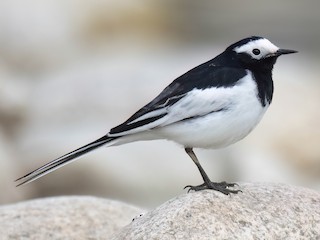
How to identify the Pied Wagtail
Motacilla alba
Spotted a bird? Identify it instantly with the Birdby app
Open the appTo correctly identify the Pied Wagtail (Motacilla alba), check each of these features. Birds can be tricky: habit, habitat, and call often confirm a sighting that a single photo cannot.
Size at a glance
- Length
- 16.5-19 cm
- Wingspan
- 25-27 cm
- Weight
- 17-25 g
Physical features to check
- 1
Plumage
Overall feather coloration and pattern.
Adult males in breeding plumage have a black crown, nape, and throat, contrasting with a white forehead, cheeks, and sides of the neck. The back is black, and the underparts are white. The wings are dark with prominent white wing-bars, and the long tail is black with white outer tail feathers. Females are similar but often have a greyer back and less intense black on the head and throat, especially outside of breeding season. Non-breeding adults (both sexes) show a reduction in black on the throat, often appearing as a black crescent or bib, with more grey on the back.
- 2
Beak shape
Shape and color of the bill: a key field mark.
Slender, pointed, and black, adapted for catching insects.
- 3
Eye color
Iris color and any distinctive eye markings.
Dark brown
- 4
Leg color
Leg and foot color.
Black
- 5
Distinguishing features
Standout features that separate this species.
Long, constantly wagging tail; striking black and white plumage; undulating flight pattern; upright posture.
- 6
Juvenile appearance
How young birds differ from adults.
Juveniles are duller and greyer overall, lacking the strong black and white contrast of adults. They have a greyish-brown crown and back, a dirty white throat and underparts, and a yellowish wash on the face. The black bib is absent or very faint. They gradually acquire adult plumage through their first autumn and winter.
- 7
Seasonal changes
Plumage variation between breeding and non-breeding seasons.
Breeding plumage (spring/summer) is characterized by crisp black and white patterns, particularly the full black cap and bib in males. Non-breeding plumage (autumn/winter) sees a reduction in the black bib, often appearing as a crescent, and a greyer wash on the back, especially in females.
- 8
Sexual dimorphism
How males and females differ.
Males in breeding plumage have a more extensive and intense black on the crown, nape, and throat compared to females, whose black areas may be duller or mixed with grey, especially on the back. Outside of breeding season, differences are less pronounced, with both sexes showing reduced black on the throat.
Key field marks
- Plumage Coloration. Look for the stark black and white pattern. Males have a black back, crown, and bib. Females have a dark grey back and often a less extensive black bib. This distinguishes it from the grey-backed White Wagtail.
- Tail Wagging. The constant, rhythmic up-and-down wagging of its long tail is a key and almost constant identifier for all wagtail species, but particularly noticeable in the Pied Wagtail.
- Behavior and Gait. Observe its distinctive foraging style: running quickly on the ground, stopping abruptly, and then darting to catch insects. Its upright posture is also characteristic.
- Call. Listen for the sharp 'chissick' or 'tissick' call, often given in flight. This is a good auditory clue, especially when the bird is distant.
- Habitat. While adaptable, their presence in open, short-grass areas, often near water or human structures, is a strong indicator.
Explore the Pied Wagtail
Identify birds anywhere
Free on iOS, Android, and Web. Photo & sound identification, full species database, and your personal life list.