
Spotted a bird? Identify it instantly with the Birdby app
Open the appAbout
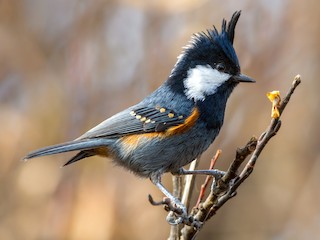
The Coal Tit (Periparus ater) is a small passerine bird in the tit family Paridae. It is a widespread and common resident breeder throughout temperate Eurasia and northern Africa. Known for its distinctive black cap, white cheek patches, and a prominent white patch on the nape, it is often found in coniferous and mixed woodlands, where it forages for insects and seeds.
Size & lifespan
- Length
- 10-11.5 cm
- Wingspan
- 17-21 cm
- Weight
- 7-12 g
- Lifespan
- 2-3 years (up to 6 years in the wild)
- Diet
- Omnivore (primarily insects, spiders, and seeds, especially conifer seeds)
Physical characteristics
- Plumage
- Adults have a glossy black head with prominent white cheek patches and a distinctive white patch on the nape. The back is greyish-blue, and the underparts are buffy-white, often with a yellowish wash on the flanks. The wings are dark with two white wing-bars. The tail is dark grey.
- Beak shape
- Small, conical, and pointed, black in color, adapted for picking insects and seeds.
- Eye color
- Dark brown.
- Leg color
- Dark grey to blackish.
- Distinguishing features
- The most distinctive features are the white nape patch, black cap, and white cheek patches. The two white wing-bars are also a good field mark.
- Juvenile appearance
- Juveniles are similar to adults but have a duller, more yellowish-buff wash on the underparts and cheek patches. The white nape patch may be less distinct, and the black cap can appear browner.
- Seasonal changes
- No significant seasonal plumage changes. Plumage may appear slightly duller or more worn outside of the breeding season due to feather abrasion.
- Sexual dimorphism
- Males and females are virtually identical in plumage. There are no significant visual differences.
How to identify
- 1
Head Pattern
Look for the glossy black cap, prominent white cheek patches, and, most importantly, the distinct white patch on the nape (back of the neck).
- 2
Wing-bars
Observe the two clear white wing-bars on the dark wings, a key distinguishing feature from Marsh and Willow Tits.
- 3
Size and Shape
It's a small, compact tit, slightly smaller than a Blue Tit, with a relatively short tail.
- 4
Habitat
Often found in coniferous trees, where its grey-blue back provides camouflage.
- 5
Vocalization
Listen for its high-pitched, repetitive 'pee-choo pee-choo' song, which is faster and higher than a Great Tit's.
Habitat & range
- Biomes
- Temperate forests, coniferous forests, mixed woodlands, parks, and gardens.
- Geographic range
- Widespread across Eurasia, from Western Europe to Japan, and in parts of North Africa. Absent from Iceland and parts of northern Scandinavia.
- Elevation range
- Sea level up to 2,000 meters, sometimes higher in mountainous regions.
- Preferred environments
- Prefers coniferous forests (spruce, pine, fir) but also inhabits mixed woodlands, parks, and large gardens, especially those with mature trees. Often found in the canopy and mid-story.
Behavior
- Activity time
- Diurnal.
- Feeding habits
- Primarily insectivorous during the breeding season, feeding on caterpillars, aphids, and other small invertebrates. In autumn and winter, their diet shifts to seeds, particularly those of conifers, which they often extract from cones. They are known to hoard food, caching seeds and insects in bark crevices, moss, or under lichens for later retrieval.
- Social behavior
- Often solitary or in pairs during the breeding season. In autumn and winter, they frequently join mixed-species foraging flocks with other tits, goldcrests, and treecreepers.
- Flight pattern
- Undulating flight, typical of tits, with rapid wing beats interspersed with short glides.
- Migration pattern
- Mostly resident throughout its range. Some northern populations may undertake short-distance altitudinal or irruptive movements in harsh winters or when food resources are scarce.
- Territoriality
- Territorial during the breeding season, with males defending nesting sites and foraging areas. Outside of breeding, they are less territorial and more tolerant of other birds.
Song & calls
- Song
- A high-pitched, repetitive 'pee-choo pee-choo pee-choo' or 'wit-chee wit-chee wit-chee' song, often described as sounding like a bicycle pump. It is faster and higher-pitched than the Great Tit's song.
- Call
- Various calls include a sharp 'tsee-tsee-tsee', a thin 'sitt' or 'tsit', and a scolding 'churr' when alarmed. They also have a 'tiss-sii' contact call.
- When they vocalize
- Most vocal during the breeding season (spring and early summer) but can be heard year-round, especially when foraging in flocks.
Breeding & reproduction
- Breeding season
- April to July, typically two broods per year.
- Nesting habits
- Nests are usually built in holes in trees, stumps, or banks, often utilizing old mouse holes or crevices. They may also use nest boxes. The nest is a cup-shaped structure made of moss, hair, and feathers.
- Clutch size
- 6-11 eggs (average 7-9).
- Egg description
- 6-11 eggs, white with reddish-brown speckles, particularly at the broader end. Approximately 14 x 11 mm.
- Incubation period
- 14-16 days, primarily by the female.
- Fledging period
- 18-20 days after hatching. Both parents feed the young.
- Parental care
- Both parents participate in feeding the nestlings and fledglings. The female incubates, while the male brings food to her and later to the young.
Where to find
Coniferous Forests
The primary habitat, especially spruce, pine, and fir forests, where they forage among needles and cones.
Mixed Woodlands
Also common in woodlands with a mix of deciduous and coniferous trees.
Parks and Gardens
Can be found in urban and suburban areas with mature trees, especially if conifers are present.
Bird Feeders
Will visit feeders, particularly in winter, for seeds and suet.
Field tips
- Look in the canopy. Coal Tits often forage high in trees, especially conifers, meticulously searching for insects and seeds.
- Listen for their song. Their distinctive 'pee-choo' song is a good way to locate them, especially during spring.
- Observe mixed flocks. In winter, join mixed-species tit flocks; Coal Tits are often part of these groups.
- Check bird feeders. They are regular visitors to feeders, particularly those offering sunflower seeds or suet.
- Watch for food caching. In autumn, observe them hiding seeds in bark crevices, a characteristic behavior.
Similar species
Marsh Tit
Poecile palustris
Lacks the white nape patch and white wing-bars of the Coal Tit. Its cap is duller black, and its cheeks are uniformly white without the distinct contrast seen in the Coal Tit. Marsh Tits also have a more uniform grey-brown back.
Willow Tit
Poecile montanus
Similar to Marsh Tit, but often has a duller, more extensive black bib and a pale panel on the wing (though not as distinct as Coal Tit's wing-bars). Like Marsh Tit, it lacks the white nape patch. Its call is a distinctive 'zee-zoo-zee'.
Crested Tit
Lophophanes cristatus
Easily distinguished by its prominent erectile crest and a black 'collar' around its white cheeks. Found primarily in coniferous forests in central and northern Europe.
Quick facts
- Distinguishing Mark:
- White nape patch
- Preferred Habitat:
- Coniferous forests
- Winter Behavior:
- Food caching and mixed-species flocks
- Diet Shift:
- Insects in summer, seeds in winter
- Song:
- High-pitched 'pee-choo pee-choo'
Fun facts
- Coal Tits are renowned for their food-hoarding behavior, caching thousands of seeds and insects, especially in autumn, to survive the winter months. They have an excellent memory for these hidden stashes.
- Despite their small size, Coal Tits are quite hardy and can survive harsh winter conditions, thanks to their ability to find and remember cached food.
- The scientific name 'Periparus ater' means 'dark titmouse', referring to its black cap and overall darker appearance compared to some other tits.
- They are highly acrobatic foragers, often hanging upside down from branches to access insects and seeds.
- There are numerous subspecies of Coal Tit across its vast range, showing slight variations in plumage color and size, reflecting adaptations to local environments.
Scientific classification
- Kingdom
- Animalia
- Phylum
- Chordata
- Class
- Aves
- Order
- Passeriformes
- Family
- Paridae
- Genus
- Periparus
- Species
- Periparus ater
Explore the Coal Tit
Identify birds anywhere
Free on iOS, Android, and Web. Photo & sound identification, full species database, and your personal life list.