
Spotted a bird? Identify it instantly with the Birdby app
Open the appAbout
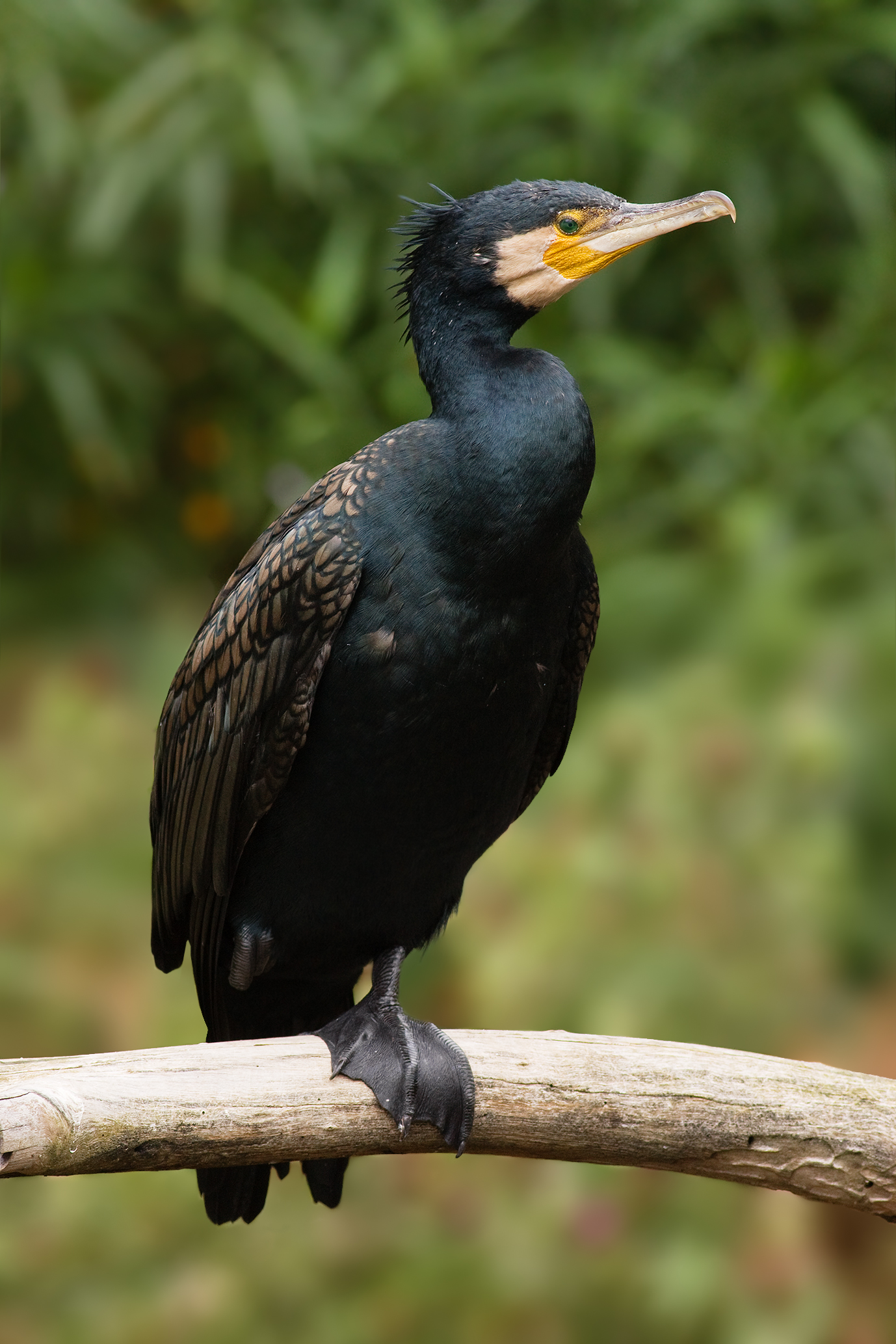
The Great Cormorant is a large, dark-plumaged aquatic bird found across a wide range of the Old World and parts of North America. It is a highly successful and adaptable species, primarily feeding on fish caught by diving. Known for its distinctive posture with wings spread to dry, it is a common sight in coastal and inland aquatic environments.
Size & lifespan
- Length
- 70-102 cm (28-40 in)
- Wingspan
- 121-160 cm (48-63 in)
- Weight
- 1.5-5.3 kg (3.3-11.7 lbs), typically 2.6-3.7 kg (5.7-8.2 lbs)
- Lifespan
- Up to 20 years in the wild, typically 10-15 years
- Diet
- Carnivore (primarily piscivorous)
Physical characteristics
- Plumage
- Adults are predominantly glossy black with a metallic sheen, especially on the back and wings. The throat and cheeks are white, bordered by a yellow-orange gular pouch. During breeding season, adults develop white patches on the flanks (thighs) and fine white streaking on the head and neck.
- Beak shape
- Long, slender, and hooked at the tip, dark grey to black, with a prominent yellow-orange gular pouch at the base.
- Eye color
- Bright emerald green.
- Leg color
- Blackish-grey, with webbed feet.
- Distinguishing features
- Large size, entirely dark body (adults), white throat/cheek patch, yellow-orange gular pouch, and the characteristic upright posture with wings spread to dry after diving. In flight, it has a heavy, direct flight with relatively slow wingbeats and often flies in V-formations or lines.
- Juvenile appearance
- Juveniles are duller, brownish-black overall, with a paler, often whitish or mottled brown belly and chest. The white throat patch is less defined, and the gular pouch is duller yellow. They lack the breeding white flank patches and head streaking.
- Seasonal changes
- During the breeding season (typically late winter to early summer), adults develop distinct white patches on the flanks (thighs) and fine white filamentous feathers on the head and neck. These features are lost outside the breeding season.
- Sexual dimorphism
- Males are generally slightly larger than females, but plumage is identical. Differences are not reliably discernible in the field.
How to identify
- 1
Size and Shape
Look for a large, heavy-bodied waterbird with a long neck, relatively short legs, and a long, hooked bill. Often seen sitting upright.
- 2
Plumage (Adult)
Entirely glossy black body with a metallic sheen. Distinctive white throat and cheek patch, bordered by a yellow-orange gular pouch. Breeding adults will have white flank patches and fine white head streaking.
- 3
Plumage (Juvenile)
Duller, brownish-black overall with a paler, often mottled brown or whitish belly and chest. The white throat patch is less defined.
- 4
Behavior - Drying Wings
Frequently seen perched with wings outstretched, drying their feathers. This is a classic cormorant posture as their feathers are not fully waterproof.
- 5
Flight
Heavy, direct flight with slow, powerful wingbeats. Often flies low over water, with neck extended and a slightly hunched appearance. May fly in V-formations or lines.
- 6
Habitat
Found in both coastal marine and large inland freshwater environments. If seen far inland on a large lake or river, it's likely a Great Cormorant rather than a Shag.
Habitat & range
- Biomes
- Coastal marine environments, large freshwater lakes, rivers, estuaries, and reservoirs.
- Geographic range
- Widespread across Europe, Asia, Africa, Australasia, and eastern North America (specifically the 'New World' subspecies P. c. carbo, though often considered distinct as P. c. lucidus or P. auritus in some classifications).
- Elevation range
- Primarily sea level to low elevations, associated with water bodies.
- Preferred environments
- Coastal cliffs, rocky shores, islands, large inland lakes, slow-moving rivers, and estuaries. Requires calm or sheltered waters for foraging and undisturbed sites for nesting, often on cliffs, trees, or artificial structures.
Behavior
- Activity time
- Diurnal. Most active during daylight hours for foraging and social interactions.
- Feeding habits
- Primarily piscivorous. Dives from the surface to pursue fish underwater, using its powerful webbed feet for propulsion. Can dive to depths of 10 meters or more and remain submerged for up to a minute. Swallows prey head-first. Often fishes communally.
- Social behavior
- Highly social, especially outside the breeding season. Roosts communally in large groups on trees, rocks, or artificial structures. Breeds in colonies, often alongside other waterbirds. Can be aggressive towards conspecifics, especially during nesting.
- Flight pattern
- Strong, direct flight with powerful, relatively slow wingbeats. Often flies low over the water. When migrating or moving between feeding and roosting sites, they frequently form V-shaped flocks or long lines. They have a distinctive 'hunched' appearance in flight with the neck extended.
- Migration pattern
- Varies geographically. Northern populations are migratory, moving south for the winter. Southern populations are largely resident or undertake local dispersal. Migration typically occurs in autumn and spring, often in large flocks.
- Territoriality
- Highly territorial around the nest site during the breeding season, defending a small area immediately surrounding the nest. Less territorial outside the breeding season, though roosting sites may be defended.
Song & calls
- Song
- Great Cormorants do not have a complex song. Vocalizations are generally limited to guttural calls.
- Call
- A variety of deep, guttural grunts, croaks, and hisses, particularly around colonies or when disturbed. Calls include 'gra-gra-gra' or 'karr-karr'. Juveniles may beg with persistent, reedy calls.
- When they vocalize
- Most vocal during the breeding season at colonies, during courtship, and when interacting with chicks. Generally silent away from the colony.
Breeding & reproduction
- Breeding season
- Varies geographically, typically March to July in temperate regions, year-round in tropical areas.
- Nesting habits
- Colonial nesters, often in large groups on cliffs, rocky islets, trees (especially dead ones), or artificial structures like pylons. Nests are bulky platforms made of sticks, seaweed, and other vegetation, cemented with guano. Both parents contribute to nest building.
- Clutch size
- 3-4 eggs
- Egg description
- Typically 3-4 (range 1-6) pale blue or greenish-white eggs, often stained brown by nest material. Oval-shaped, with a chalky surface.
- Incubation period
- 28-31 days, incubated by both parents.
- Fledging period
- 50-60 days. Young are altricial, hatching naked and helpless, and are fed by both parents until they can fly and forage independently.
- Parental care
- Both parents share incubation duties and care for the young, feeding them regurgitated fish. Young remain dependent on parents for several weeks after fledging.
Where to find
Coastal Areas
Look along rocky coastlines, cliffs, estuaries, and sheltered bays. They often perch on rocks, buoys, or jetties.
Large Inland Water Bodies
Check large lakes, reservoirs, and slow-moving rivers, especially those with abundant fish populations and suitable perching/nesting sites (e.g., dead trees, islands).
Breeding Colonies
During the breeding season, locate known cormorant colonies, often on remote islands, cliffs, or in trees within protected areas. The smell and noise will often give them away.
Field tips
- Scan for drying birds. Look for birds perched with their wings spread wide, a very characteristic cormorant behavior, especially after diving for fish.
- Observe diving behavior. Watch for birds diving from the surface, often disappearing for a significant period before resurfacing, sometimes quite a distance from where they submerged.
- Look for communal roosts. Great Cormorants often gather in large numbers at favored roosting sites, especially in the evening. These can be prominent trees, rock outcrops, or artificial structures.
- Distinguish from other waterbirds. Their large size, entirely dark plumage (adults), and distinctive head pattern (white throat, yellow gular pouch) help differentiate them from ducks, geese, or gulls.
Similar species
European Shag
Phalacrocorax aristotelis
Smaller and more slender than the Great Cormorant. Adults have a distinctive crest during breeding season (lacking in Great Cormorant). The Shag has a smaller, more delicate bill, and lacks the prominent white throat patch and yellow gular pouch of the Great Cormorant. Juveniles are browner overall, but still lack the white throat. Shags are almost exclusively marine, rarely found inland.
Double-crested Cormorant
Phalacrocorax auritus
Found in North America. Similar in size and overall dark plumage. Key differences include the Double-crested Cormorant's more orange gular pouch (lacking the white border of the Great Cormorant), and the presence of two small crests during breeding season (often difficult to see). The Great Cormorant (P. c. carbo) in North America is restricted to the Atlantic coast and is generally larger and heavier-billed than the Double-crested Cormorant, with a more extensive white throat patch.
Indian Cormorant
Phalacrocorax fuscicollis
Smaller and more slender than the Great Cormorant, with a noticeably thinner bill. Found in South Asia. Lacks the prominent white throat patch and yellow gular pouch of the Great Cormorant. Breeding adults have a small white tuft behind the eye.
Quick facts
- Primary Diet:
- Fish
- Nesting Type:
- Colonial
- Diving Depth:
- Up to 10+ meters
- Wing Drying:
- Common behavior due to less waterproof plumage
- Global Distribution:
- Europe, Asia, Africa, Australasia, eastern North America
Fun facts
- In some parts of Asia, particularly China and Japan, Great Cormorants have been traditionally used for 'cormorant fishing,' where trained birds catch fish for human fishermen.
- Despite their aquatic lifestyle, cormorant feathers are not as waterproof as those of ducks or geese. This necessitates their frequent wing-drying behavior to prevent waterlogging and maintain insulation.
- The Great Cormorant is one of the most widespread cormorant species globally, with a vast distribution across multiple continents.
- Their emerald green eyes are particularly striking and are a good field mark when seen up close.
Scientific classification
- Kingdom
- Animalia
- Phylum
- Chordata
- Class
- Aves
- Order
- Suliformes
- Family
- Phalacrocoracidae
- Genus
- Phalacrocorax
- Species
- Phalacrocorax carbo
Explore the Great Cormorant
Identify birds anywhere
Free on iOS, Android, and Web. Photo & sound identification, full species database, and your personal life list.