
Where does the Great Cormorant live?
Phalacrocorax carbo
Spotted a bird? Identify it instantly with the Birdby app
Open the appThe Great Cormorant lives in specific habitats and regions. Knowing where, and when, to look improves your chances of a successful sighting.
Biomes
Coastal marine environments, large freshwater lakes, rivers, estuaries, and reservoirs.
Geographic range
Widespread across Europe, Asia, Africa, Australasia, and eastern North America (specifically the 'New World' subspecies P. c. carbo, though often considered distinct as P. c. lucidus or P. auritus in some classifications).
Preferred environments
Coastal cliffs, rocky shores, islands, large inland lakes, slow-moving rivers, and estuaries. Requires calm or sheltered waters for foraging and undisturbed sites for nesting, often on cliffs, trees, or artificial structures.
Elevation range
Primarily sea level to low elevations, associated with water bodies.
Where to look
Coastal Areas
Look along rocky coastlines, cliffs, estuaries, and sheltered bays. They often perch on rocks, buoys, or jetties.
Large Inland Water Bodies
Check large lakes, reservoirs, and slow-moving rivers, especially those with abundant fish populations and suitable perching/nesting sites (e.g., dead trees, islands).
Breeding Colonies
During the breeding season, locate known cormorant colonies, often on remote islands, cliffs, or in trees within protected areas. The smell and noise will often give them away.
Field tips
- Scan for drying birds. Look for birds perched with their wings spread wide, a very characteristic cormorant behavior, especially after diving for fish.
- Observe diving behavior. Watch for birds diving from the surface, often disappearing for a significant period before resurfacing, sometimes quite a distance from where they submerged.
- Look for communal roosts. Great Cormorants often gather in large numbers at favored roosting sites, especially in the evening. These can be prominent trees, rock outcrops, or artificial structures.
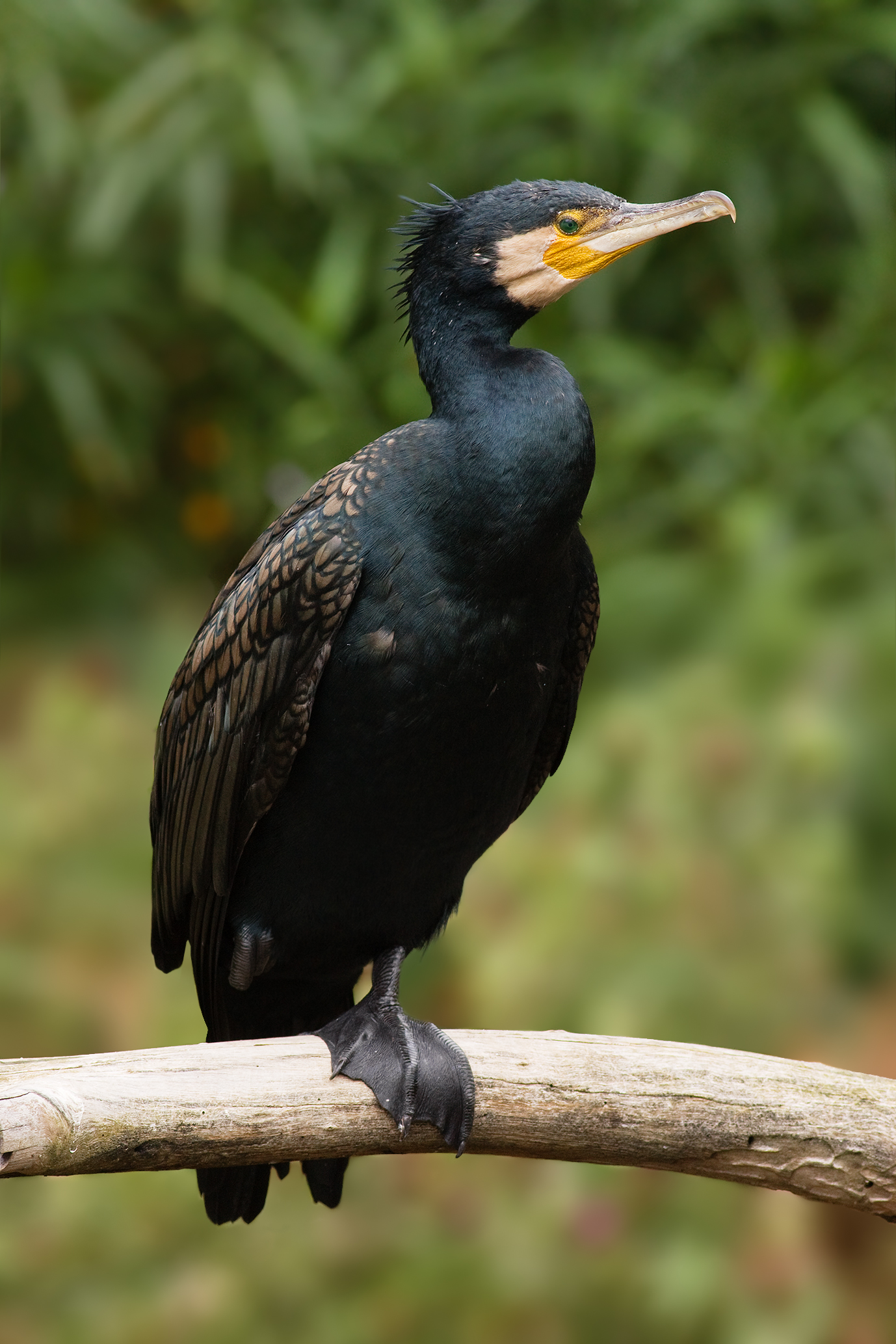
- Distinguish from other waterbirds. Their large size, entirely dark plumage (adults), and distinctive head pattern (white throat, yellow gular pouch) help differentiate them from ducks, geese, or gulls.
Migration
Varies geographically. Northern populations are migratory, moving south for the winter. Southern populations are largely resident or undertake local dispersal. Migration typically occurs in autumn and spring, often in large flocks.
Explore the Great Cormorant
Identify birds anywhere
Free on iOS, Android, and Web. Photo & sound identification, full species database, and your personal life list.