
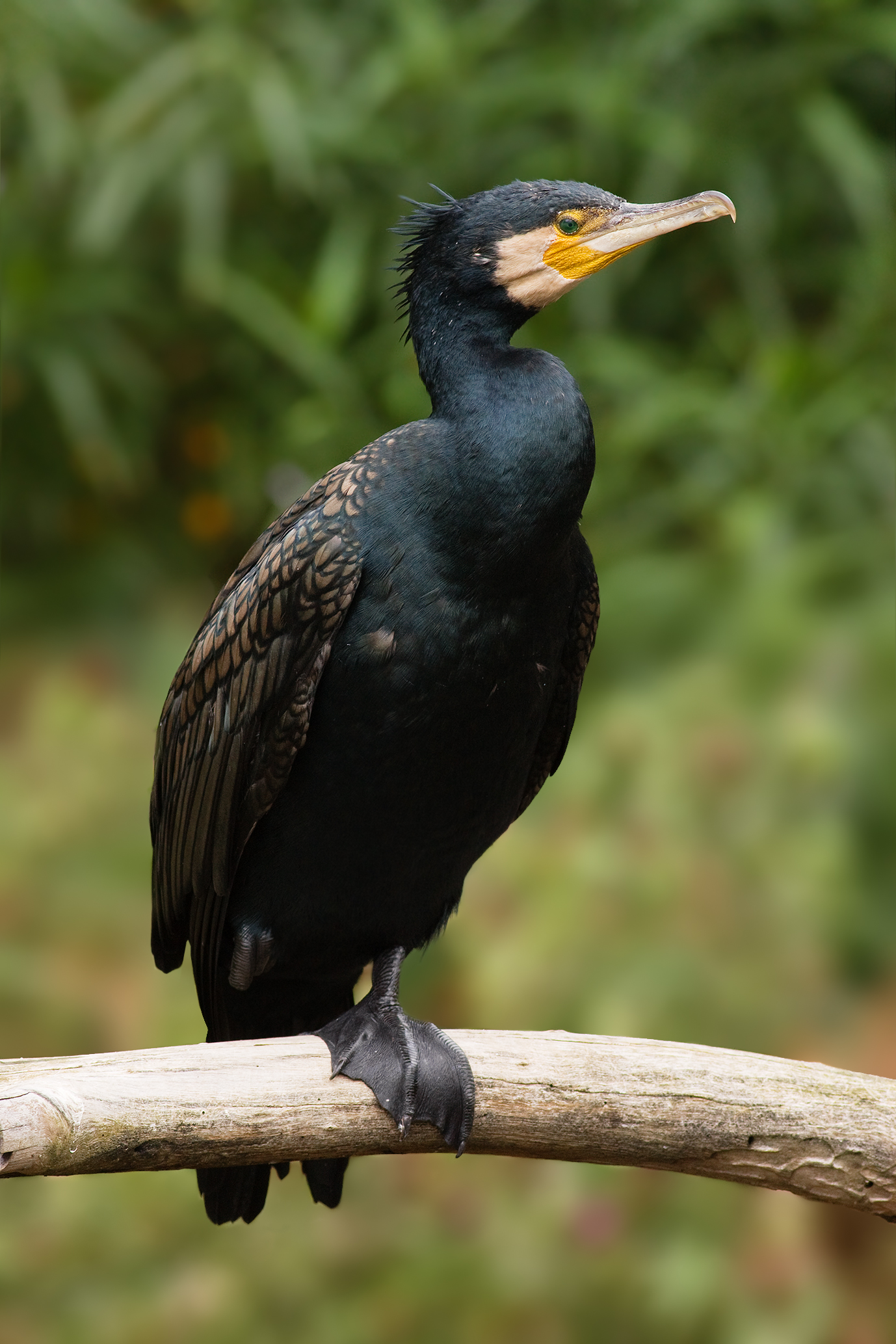
How to identify the Great Cormorant
Phalacrocorax carbo
Spotted a bird? Identify it instantly with the Birdby app
Open the appTo correctly identify the Great Cormorant (Phalacrocorax carbo), check each of these features. Birds can be tricky: habit, habitat, and call often confirm a sighting that a single photo cannot.
Size at a glance
- Length
- 70-102 cm (28-40 in)
- Wingspan
- 121-160 cm (48-63 in)
- Weight
- 1.5-5.3 kg (3.3-11.7 lbs), typically 2.6-3.7 kg (5.7-8.2 lbs)
Physical features to check
- 1
Plumage
Overall feather coloration and pattern.
Adults are predominantly glossy black with a metallic sheen, especially on the back and wings. The throat and cheeks are white, bordered by a yellow-orange gular pouch. During breeding season, adults develop white patches on the flanks (thighs) and fine white streaking on the head and neck.
- 2
Beak shape
Shape and color of the bill: a key field mark.
Long, slender, and hooked at the tip, dark grey to black, with a prominent yellow-orange gular pouch at the base.
- 3
Eye color
Iris color and any distinctive eye markings.
Bright emerald green.
- 4
Leg color
Leg and foot color.
Blackish-grey, with webbed feet.
- 5
Distinguishing features
Standout features that separate this species.
Large size, entirely dark body (adults), white throat/cheek patch, yellow-orange gular pouch, and the characteristic upright posture with wings spread to dry after diving. In flight, it has a heavy, direct flight with relatively slow wingbeats and often flies in V-formations or lines.
- 6
Juvenile appearance
How young birds differ from adults.
Juveniles are duller, brownish-black overall, with a paler, often whitish or mottled brown belly and chest. The white throat patch is less defined, and the gular pouch is duller yellow. They lack the breeding white flank patches and head streaking.
- 7
Seasonal changes
Plumage variation between breeding and non-breeding seasons.
During the breeding season (typically late winter to early summer), adults develop distinct white patches on the flanks (thighs) and fine white filamentous feathers on the head and neck. These features are lost outside the breeding season.
- 8
Sexual dimorphism
How males and females differ.
Males are generally slightly larger than females, but plumage is identical. Differences are not reliably discernible in the field.
Key field marks
- Size and Shape. Look for a large, heavy-bodied waterbird with a long neck, relatively short legs, and a long, hooked bill. Often seen sitting upright.
- Plumage (Adult). Entirely glossy black body with a metallic sheen. Distinctive white throat and cheek patch, bordered by a yellow-orange gular pouch. Breeding adults will have white flank patches and fine white head streaking.
- Plumage (Juvenile). Duller, brownish-black overall with a paler, often mottled brown or whitish belly and chest. The white throat patch is less defined.
- Behavior - Drying Wings. Frequently seen perched with wings outstretched, drying their feathers. This is a classic cormorant posture as their feathers are not fully waterproof.
- Flight. Heavy, direct flight with slow, powerful wingbeats. Often flies low over water, with neck extended and a slightly hunched appearance. May fly in V-formations or lines.
- Habitat. Found in both coastal marine and large inland freshwater environments. If seen far inland on a large lake or river, it's likely a Great Cormorant rather than a Shag.
Explore the Great Cormorant
Identify birds anywhere
Free on iOS, Android, and Web. Photo & sound identification, full species database, and your personal life list.