
Spotted a bird? Identify it instantly with the Birdby app
Open the appAbout
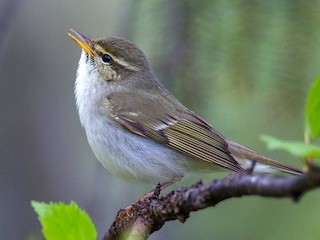
The Arctic Warbler is a small, migratory passerine bird, known for its distinctive loud, whirring song and its remarkable long-distance migration from the Arctic breeding grounds to Southeast Asian wintering areas. It is generally drab olive-green on its upperparts with pale underparts, characterized by a prominent supercilium and a single pale wing-bar.
Size & lifespan
- Length
- 11.5-13 cm (4.5-5.1 in)
- Wingspan
- 18.5-22 cm (7.3-8.7 in)
- Weight
- 7-12.5 g (0.25-0.44 oz)
- Lifespan
- Typically 2-3 years in the wild, with a maximum recorded lifespan of over 5 years.
- Diet
- Primarily insectivorous, feeding on a wide variety of small insects and their larvae, spiders, and occasionally other small invertebrates. During migration and in autumn, it may supplement its diet with berries.
Physical characteristics
- Plumage
- Adults are typically plain olive-green on the upperparts, including the crown, nape, back, and rump. The underparts are whitish, often with a grayish wash on the flanks and breast. A key feature is a prominent yellowish-white supercilium (eyebrow stripe) that extends well beyond the eye. There is also a distinct pale wing-bar on the greater coverts, and often a fainter or less complete bar on the median coverts. The flight feathers and tail are dark brown with narrow pale edgings. The tertials have prominent pale edges, creating a pale panel on the folded wing.
- Beak shape
- Small, slender, and pointed; typically dark brown to black above and yellowish or orange at the base of the lower mandible.
- Eye color
- Dark brown.
- Leg color
- Pale flesh-colored or yellowish-brown.
- Distinguishing features
- Erect posture, prominent yellowish supercilium, single distinctive pale wing-bar (sometimes a fainter second bar), and pale legs. Its overall appearance is quite 'plain' compared to many other warblers, but the combination of its wing-bar and supercilium is key.
- Juvenile appearance
- Juveniles resemble adults but often have a slightly brighter, more yellowish wash on the underparts, especially the flanks and throat. The wing-bar might be slightly less distinct than in adults, but still present.
- Seasonal changes
- Plumage does not undergo significant seasonal changes. Birds appear slightly fresher and greener after the complete post-breeding molt in autumn, and can look a bit duller and browner by spring due to feather wear.
- Sexual dimorphism
- Males and females are visually identical in plumage.
How to identify
- 1
Supercilium
Look for a very prominent, long, yellowish-white stripe above the eye, extending well behind it.
- 2
Wing-bar
Observe for a distinct single pale wing-bar (on the greater coverts). A fainter second bar on the median coverts can sometimes be present but is less reliable.
- 3
Leg Color
Note the pale, flesh-colored or yellowish-brown legs, which contrast with the darker legs of many similar warblers.
- 4
Plumage Color
Olive-green upperparts and pale whitish underparts. It generally has a 'cleaner' and slightly brighter overall appearance compared to some duller leaf warblers.
- 5
Song
Listen for its characteristic loud, rapid, and whirring 'zhweezh-zhweezh-zhweezh' song, which is quite distinctive and insect-like. This is often the best identification feature in breeding areas.
- 6
Behavior
Observe its active foraging style, constantly moving and gleaning insects from foliage or making short sallies.
Habitat & range
- Biomes
- Breeds in boreal forests, taiga, and subarctic birch forest and scrub. Winters in tropical and subtropical moist broadleaf forests.
- Geographic range
- Breeds across Northern Europe and Asia, from Fennoscandia eastward through Siberia to Kamchatka, Sakhalin, and Hokkaido (Japan). Winters in Southeast Asia, from India and Sri Lanka eastward through Indochina, southern China, and parts of the Malay Archipelago.
- Elevation range
- Breeds from sea level up to about 1,000 meters (3,300 feet). In wintering grounds, found from lowlands up to around 2,000 meters (6,600 feet) in mountainous regions.
- Preferred environments
- Breeding: Open coniferous or mixed forests, birch woodlands, willow and alder thickets, often near water bodies, clearings, or forest edges with dense undergrowth. Wintering: Broadleaf evergreen forests, secondary growth, plantations, often near rivers or forest clearings.
Behavior
- Activity time
- Diurnal. Highly active during daylight hours, especially while foraging.
- Feeding habits
- Forages actively in the canopy and mid-story of trees and shrubs, gleaning insects from leaves and twigs. It is a very active feeder, constantly moving, flitting, and sometimes hovering briefly to catch prey. Can also sally out to catch flying insects.
- Social behavior
- Generally solitary during the breeding season, though pairs maintain territories. During migration and in winter, they can be found singly or in mixed-species foraging flocks.
- Flight pattern
- Undulating flight over short distances within woodlands, characterized by quick wing-beats. Long-distance migration involves sustained, direct flight.
- Migration pattern
- Long-distance migrant. Breeds in the Arctic and sub-Arctic regions of Eurasia and migrates to Southeast Asia for the non-breeding season. This is one of the longest migratory journeys for any small passerine, with distances of up to 13,000 km (8,000 miles) one way. Migration occurs broadly from August to October and April to May.
- Territoriality
- Males establish and defend breeding territories through song and displays. Territories can be quite large to support breeding and foraging.
Song & calls
- Song
- A distinctive, loud, ringing, and rapid trill or whirring buzz, often described as 'zhweezh-zhweezh-zhweezh' or 'tsee-tsee-tsee-tsui-tsui-tsui'. It is quite electric and insect-like, delivered quickly and intensely. The song is often given from an exposed perch at the top of a tree. There is some geographical variation in song structure.
- Call
- A sharp, clear 'tseep' or 'chip', often given in alarm or contact. Also a soft, sometimes slightly hoarse 'churrr' call.
- When they vocalize
- Most vocal during the breeding season, primarily from late May to July. Calls are given year-round, especially during foraging or when disturbed.
Breeding & reproduction
- Breeding season
- Typically late May to July, varying geographically with the arrival of spring in their northern breeding grounds.
- Nesting habits
- Nests are typically built on or very close to the ground, often hidden beneath dense vegetation, moss, roots, or at the base of a small shrub or tree. The nest is a cup-shaped structure made of moss, grass, leaves, and other plant material, lined with finer grasses, hair, and feathers.
- Clutch size
- Usually 4-7 eggs, most commonly 5 or 6.
- Egg description
- 4-7 eggs, typically white or creamy-white, often unmarked or with very fine, sparse reddish-brown speckles, particularly at the blunt end.
- Incubation period
- Approximately 11-13 days, primarily by the female.
- Fledging period
- Chicks fledge around 12-14 days after hatching. Both parents participate in feeding the young.
- Parental care
- Both parents participate in feeding the nestlings and fledglings, though the female does most or all of the incubation. Young become independent a few weeks after fledging.
Where to find
Breeding Grounds (Summer)
Look in open coniferous forests, mixed birch woodlands, willow/alder thickets, and areas with dense undergrowth near clearings or rivers across Fennoscandia and Siberia, extending to the Russian Far East and northern Japan.
Wintering Grounds (Winter)
Search in tropical and subtropical moist broadleaf forests, secondary growth, and plantations in Southeast Asia, including parts of India, Sri Lanka, Indochina, southern China, and the Malay Peninsula.
Migration Routes (Spring/Autumn)
Can be found in a variety of wooded habitats, parks, and gardens across broad migratory flyways between its breeding and wintering grounds, including Europe, Central Asia, and East Asia, making it a rare vagrant further west in Europe.
Field tips
- Listen for the Song. In its breeding range, the loud, whirring song is often the first and most reliable indicator of its presence. It can be heard from a significant distance.
- Scan the Canopy and Mid-story. Arctic Warblers are active foragers. Watch for small, fast-moving birds gleaning insects from the leaves and branches of trees and shrubs.
- Check Migratory Hotspots. During migration, especially in spring and autumn, check well-vegetated areas, coastal sites, and islands that act as stopover points, as vagrants can appear far from their normal range.
- Look for Key Field Marks. Focus on the prominent supercilium, the single pale wing-bar, and pale legs. These features, in combination, are crucial for identification, especially when silent.
Similar species
Willow Warbler
Phylloscopus trochilus
Willow Warbler is generally duller, lacks a prominent wing-bar (though some can show a very faint one), has darker legs, and a different song (a melancholic descending series of notes) and call (a softer 'hoo-eet'). Arctic Warbler has a much stronger supercilium and a striking wing-bar.
Chiffchaff
Phylloscopus collybita
Chiffchaff is smaller, lacks a distinct wing-bar, has darker legs, and a distinct 'chiff-chaff' song. Arctic Warbler's supercilium is longer and more prominent.
Greenish Warbler
Phylloscopus trochiloides
Greenish Warbler also has a wing-bar, but it is typically less prominent than that of the Arctic Warbler, and often has two wing-bars. Its supercilium is also less extensive. The song is very different, a repeated 'chup-chup-chup...chui-chui-chui' with rapid acceleration.
Pale-legged Leaf Warbler
Phylloscopus tenellipes
Found in similar wintering grounds. Pale-legged Leaf Warbler is generally browner on the upperparts, has a longer bill, and a less distinct wing-bar (sometimes none). Its call is also distinct.
Quick facts
- Migration Distance:
- One of the longest migratory journeys for a small passerine, traveling up to 13,000 km (8,000 miles) one way.
- Primary Diet:
- Insects and other small invertebrates.
- Nesting Site:
- On or very close to the ground, well-concealed.
- Distinctive Feature:
- Loud, whirring song and prominent supercilium with a single wing-bar.
- Taxonomic Status:
- Formerly considered conspecific with species now recognized separately (e.g., Japanese Leaf Warbler, Kamchatka Leaf Warbler).
Fun facts
- The Arctic Warbler undertakes one of the most incredible migrations of any small bird, traveling from its Arctic breeding grounds all the way to Southeast Asia and back each year.
- Its loud, whirring song is so powerful that it can sometimes be heard over the rush of large rivers, allowing ornithologists to locate them in vast boreal forests.
- Despite its 'arctic' name, its wintering grounds are in the warm, humid tropics of Southeast Asia, showcasing its adaptability to vastly different climates.
- Early spring migrants arrive on breeding grounds when snow and ice are still prevalent, demonstrating remarkable hardiness.
Scientific classification
- Kingdom
- Animalia
- Phylum
- Chordata
- Class
- Aves
- Order
- Passeriformes
- Family
- Phylloscopidae
- Genus
- Phylloscopus
- Species
- Phylloscopus borealis
Explore the Arctic Warbler
Identify birds anywhere
Free on iOS, Android, and Web. Photo & sound identification, full species database, and your personal life list.