
How to identify the Arctic Warbler
Phylloscopus borealis
Spotted a bird? Identify it instantly with the Birdby app
Open the appTo correctly identify the Arctic Warbler (Phylloscopus borealis), check each of these features. Birds can be tricky: habit, habitat, and call often confirm a sighting that a single photo cannot.
Size at a glance
- Length
- 11.5-13 cm (4.5-5.1 in)
- Wingspan
- 18.5-22 cm (7.3-8.7 in)
- Weight
- 7-12.5 g (0.25-0.44 oz)
Physical features to check
- 1
Plumage
Overall feather coloration and pattern.
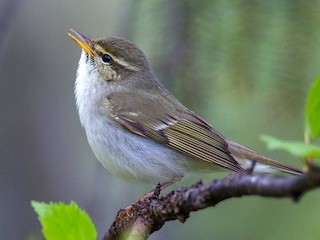
Adults are typically plain olive-green on the upperparts, including the crown, nape, back, and rump. The underparts are whitish, often with a grayish wash on the flanks and breast. A key feature is a prominent yellowish-white supercilium (eyebrow stripe) that extends well beyond the eye. There is also a distinct pale wing-bar on the greater coverts, and often a fainter or less complete bar on the median coverts. The flight feathers and tail are dark brown with narrow pale edgings. The tertials have prominent pale edges, creating a pale panel on the folded wing.
- 2
Beak shape
Shape and color of the bill: a key field mark.
Small, slender, and pointed; typically dark brown to black above and yellowish or orange at the base of the lower mandible.
- 3
Eye color
Iris color and any distinctive eye markings.
Dark brown.
- 4
Leg color
Leg and foot color.
Pale flesh-colored or yellowish-brown.
- 5
Distinguishing features
Standout features that separate this species.
Erect posture, prominent yellowish supercilium, single distinctive pale wing-bar (sometimes a fainter second bar), and pale legs. Its overall appearance is quite 'plain' compared to many other warblers, but the combination of its wing-bar and supercilium is key.
- 6
Juvenile appearance
How young birds differ from adults.
Juveniles resemble adults but often have a slightly brighter, more yellowish wash on the underparts, especially the flanks and throat. The wing-bar might be slightly less distinct than in adults, but still present.
- 7
Seasonal changes
Plumage variation between breeding and non-breeding seasons.
Plumage does not undergo significant seasonal changes. Birds appear slightly fresher and greener after the complete post-breeding molt in autumn, and can look a bit duller and browner by spring due to feather wear.
- 8
Sexual dimorphism
How males and females differ.
Males and females are visually identical in plumage.
Key field marks
- Supercilium. Look for a very prominent, long, yellowish-white stripe above the eye, extending well behind it.
- Wing-bar. Observe for a distinct single pale wing-bar (on the greater coverts). A fainter second bar on the median coverts can sometimes be present but is less reliable.
- Leg Color. Note the pale, flesh-colored or yellowish-brown legs, which contrast with the darker legs of many similar warblers.
- Plumage Color. Olive-green upperparts and pale whitish underparts. It generally has a 'cleaner' and slightly brighter overall appearance compared to some duller leaf warblers.
- Song. Listen for its characteristic loud, rapid, and whirring 'zhweezh-zhweezh-zhweezh' song, which is quite distinctive and insect-like. This is often the best identification feature in breeding areas.
- Behavior. Observe its active foraging style, constantly moving and gleaning insects from foliage or making short sallies.
Explore the Arctic Warbler
Identify birds anywhere
Free on iOS, Android, and Web. Photo & sound identification, full species database, and your personal life list.