
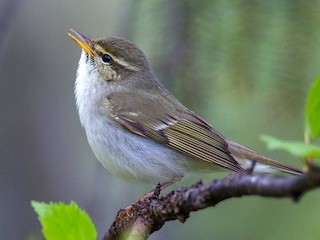
Where does the Arctic Warbler live?
Phylloscopus borealis
Spotted a bird? Identify it instantly with the Birdby app
Open the appThe Arctic Warbler lives in specific habitats and regions. Knowing where, and when, to look improves your chances of a successful sighting.
Biomes
Breeds in boreal forests, taiga, and subarctic birch forest and scrub. Winters in tropical and subtropical moist broadleaf forests.
Geographic range
Breeds across Northern Europe and Asia, from Fennoscandia eastward through Siberia to Kamchatka, Sakhalin, and Hokkaido (Japan). Winters in Southeast Asia, from India and Sri Lanka eastward through Indochina, southern China, and parts of the Malay Archipelago.
Preferred environments
Breeding: Open coniferous or mixed forests, birch woodlands, willow and alder thickets, often near water bodies, clearings, or forest edges with dense undergrowth. Wintering: Broadleaf evergreen forests, secondary growth, plantations, often near rivers or forest clearings.
Elevation range
Breeds from sea level up to about 1,000 meters (3,300 feet). In wintering grounds, found from lowlands up to around 2,000 meters (6,600 feet) in mountainous regions.
Where to look
Breeding Grounds (Summer)
Look in open coniferous forests, mixed birch woodlands, willow/alder thickets, and areas with dense undergrowth near clearings or rivers across Fennoscandia and Siberia, extending to the Russian Far East and northern Japan.
Wintering Grounds (Winter)
Search in tropical and subtropical moist broadleaf forests, secondary growth, and plantations in Southeast Asia, including parts of India, Sri Lanka, Indochina, southern China, and the Malay Peninsula.
Migration Routes (Spring/Autumn)
Can be found in a variety of wooded habitats, parks, and gardens across broad migratory flyways between its breeding and wintering grounds, including Europe, Central Asia, and East Asia, making it a rare vagrant further west in Europe.
Field tips
- Listen for the Song. In its breeding range, the loud, whirring song is often the first and most reliable indicator of its presence. It can be heard from a significant distance.
- Scan the Canopy and Mid-story. Arctic Warblers are active foragers. Watch for small, fast-moving birds gleaning insects from the leaves and branches of trees and shrubs.
- Check Migratory Hotspots. During migration, especially in spring and autumn, check well-vegetated areas, coastal sites, and islands that act as stopover points, as vagrants can appear far from their normal range.
- Look for Key Field Marks. Focus on the prominent supercilium, the single pale wing-bar, and pale legs. These features, in combination, are crucial for identification, especially when silent.
Migration
Long-distance migrant. Breeds in the Arctic and sub-Arctic regions of Eurasia and migrates to Southeast Asia for the non-breeding season. This is one of the longest migratory journeys for any small passerine, with distances of up to 13,000 km (8,000 miles) one way. Migration occurs broadly from August to October and April to May.
Explore the Arctic Warbler
Identify birds anywhere
Free on iOS, Android, and Web. Photo & sound identification, full species database, and your personal life list.