
Spotted a bird? Identify it instantly with the Birdby app
Open the appAbout
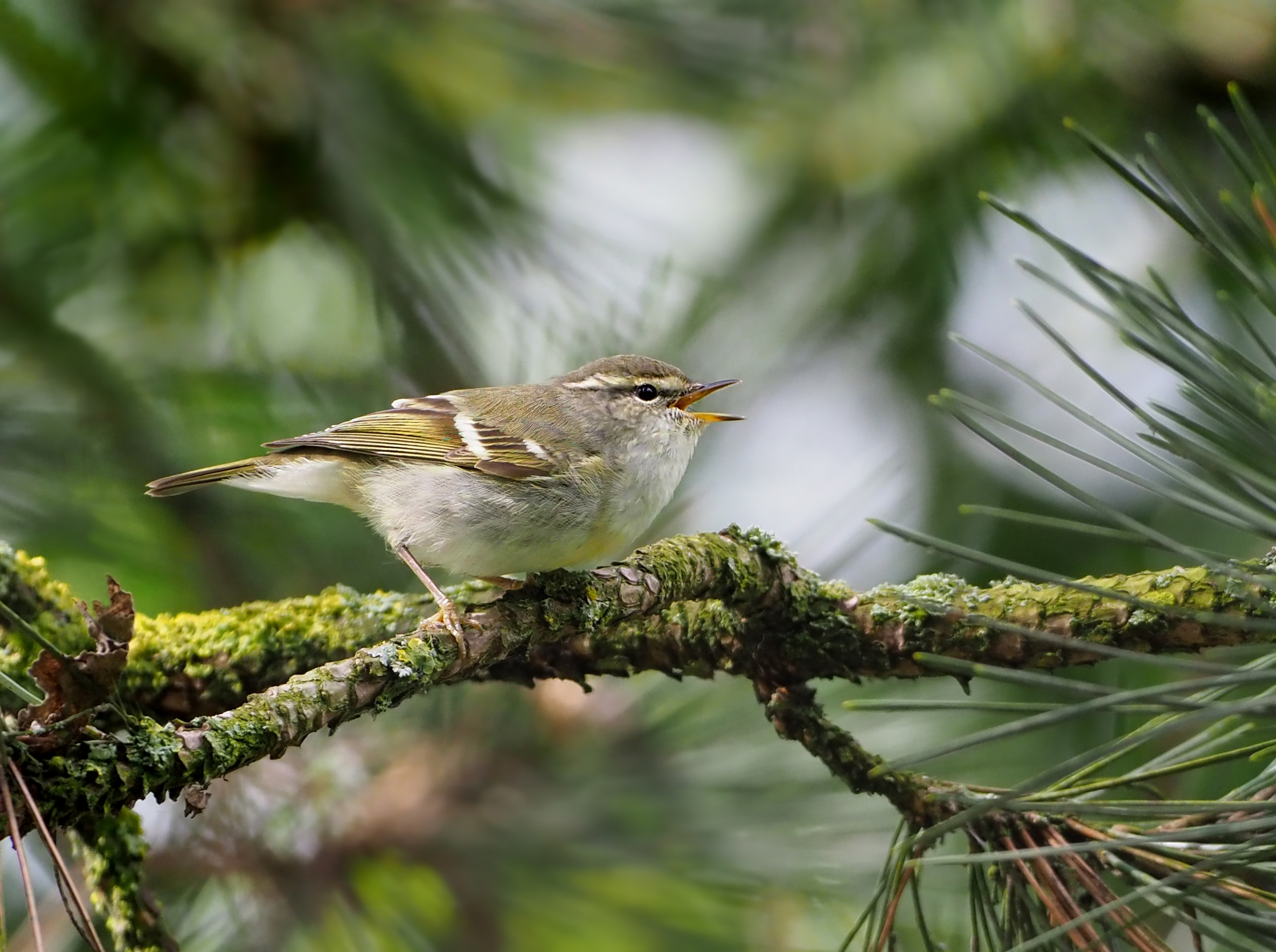
The Yellow-browed Warbler is a small, active passerine bird belonging to the 'leaf warbler' family. It is renowned for its distinctive calls and striking facial pattern, making it a highly sought-after autumn migrant in Western Europe, far from its Siberian breeding grounds.
Size & lifespan
- Length
- 9.5-11 cm (3.7-4.3 in)
- Wingspan
- 15-19 cm (5.9-7.5 in)
- Weight
- 4-9 g (0.14-0.32 oz)
- Lifespan
- Typically 2-3 years in the wild, though can live longer.
- Diet
- Primarily insectivorous, feeding on small insects, their larvae, and spiders. Occasionally consumes small berries, especially during migration.
Physical characteristics
- Plumage
- Upperparts are dull greenish-brown, underparts are whitish. The most striking features are two prominent yellowish wing-bars (formed by pale tips to greater and median coverts), a long, bright yellowish supercilium (eyebrow) extending from the bill to the nape, and a pale central crown stripe. The tertial feathers have noticeable pale fringes. The rump is subtly paler than the back. During non-breeding, the plumage remains essentially the same.
- Beak shape
- Small, slender, and pointed; dark above and paler, often yellowish, below.
- Eye color
- Dark brown.
- Leg color
- Dark, typically greyish-brown to blackish.
- Distinguishing features
- Bright yellow supercilium, two prominent pale wing-bars, pale tertial fringes, and a often faint pale crown stripe. Overall a very small, active warbler with a compact, short-tailed appearance. The flight is rapid and undulating.
- Juvenile appearance
- Juveniles are very similar to adults, perhaps slightly duller overall, with less intensely yellow wing-bars and supercilium, but the key identification features are still apparent.
- Seasonal changes
- No significant seasonal plumage changes. Breeding and non-breeding plumage are largely identical.
- Sexual dimorphism
- Males and females are visually identical in plumage and size.
How to identify
- 1
Supercilium
Look for the long, bright yellow supercilium extending well beyond the eye. This is a key distinguishing feature.
- 2
Wing-bars
Observe two distinct, yellowish wing-bars. The upper bar (median coverts) is usually shorter and less prominent than the lower bar (greater coverts).
- 3
Tertial Fringes
Note the prominent pale, often yellowish-white, fringes on the tertial feathers. This creates a striking pattern on the folded wing edge.
- 4
Pale Crown Stripe
A often subtle, pale central crown stripe can be visible, though it is less distinct than in species like Pallas's Leaf Warbler.
- 5
Vocalization
Listen for its distinctive, high-pitched, sharp 'squeet' or 'swee-ist' call. This is one of the best ways to identify it, especially for cryptic vagrants.
- 6
Behavior
Watch its active, restless foraging style, constantly flitting and gleaning in dense foliage.
Habitat & range
- Biomes
- Boreal forests, taiga, temperate forests, woodlands. During migration, can be found in a wider range of habitats including parks, gardens, scrub, and coastal areas.
- Geographic range
- Breeds in a broad band across the taiga zone of Siberia, from the Ural Mountains eastwards to the Pacific Ocean, including parts of Mongolia and northern China. Winters mainly in Southeast Asia (e.g., India, Nepal, Southeast China, Indochina). A regular autumn vagrant to Western Europe, particularly Great Britain and Ireland, but also Scandinavia and continental Europe.
- Elevation range
- Breeds from sea level up to around 2000 meters in mountainous regions. Wintering and migratory ranges can vary.
- Preferred environments
- Breeding habitat is typically coniferous or mixed coniferous-deciduous forest with a dense sub-canopy and undergrowth, often near water. During migration, they favour any dense, sheltered vegetation, including coastal scrub, hedgerows, and woodland edges.
Behavior
- Activity time
- Diurnal, active during daylight hours.
- Feeding habits
- Forages actively among foliage, gleaning insects and spiders from leaves and twigs. Frequently hovers briefly to snatch prey or makes short, rapid sallies to catch flying insects. Often seen at mid-canopy to lower canopy levels.
- Social behavior
- Generally solitary outside the breeding season, though loose groups may form during migration, especially at stopover sites. During breeding, they are territorial.
- Flight pattern
- Undulating and erratic, with rapid wingbeats. Appears very energetic and restless, constantly on the move whether foraging or in flight.
- Migration pattern
- Long-distance migrant. Breeding populations in Siberia migrate southwest to wintering grounds in Southeast Asia. A famous pattern of 'reverse migration' or 'overshooting' brings a significant number of individuals westwards into Europe during autumn, rather than southwards. This makes it a highly anticipated rarity in Western European birding.
- Territoriality
- Breeding pairs establish and defend territories. Males use their song to proclaim territory and attract mates.
Song & calls
- Song
- A high-pitched, thin, and often rather weak, repetitive 'tiss-yip tiss-yip tiss-yip...' or slightly buzzy 'tswee-tswee-tswee'. Can be faster and more jangling than other warblers, though it is not a spectacular song. Often sung from dense cover.
- Call
- The most characteristic and frequently heard vocalization is a very high-pitched, sharp, and slightly up-slurred 'squeet' or 'swee-ist'. This call is usually given frequently, acting as a key identification feature. Also has a softer, more subtle 'tsee-oo'.
- When they vocalize
- Calls are given regularly throughout the breeding and migratory periods. Song is primarily heard during the breeding season, but vagrants may occasionally sing on migration.
Breeding & reproduction
- Breeding season
- Typically May to July.
- Nesting habits
- Nests are usually built low down in dense vegetation, often hidden in a bush, shrub, or at the base of a small tree, often close to the ground. The nest is a well-camouflaged dome-shaped structure constructed from moss, grass, and leaves, lined with finer materials like hair or feathers.
- Clutch size
- Typically 4-6 eggs.
- Egg description
- Lays 4-6 eggs, which are white with fine reddish-brown speckles, often concentrated at the broad end.
- Incubation period
- Around 12-14 days, primarily by the female.
- Fledging period
- Chicks fledge approximately 12-14 days after hatching.
- Parental care
- Both parents participate in feeding the young, though the female does most of the incubation.
Where to find
Breeding Grounds (Siberia)
Dense coniferous or mixed forests, particularly near wetlands or rivers, with rich undergrowth. Look in the taiga zone from the Urals to the Pacific.
Wintering Grounds (Southeast Asia)
Broadleaf evergreen forests, secondary growth, plantations, and dense scrublands. Found at various altitudes.
Migration Stopovers (Western Europe)
Coastal headlands, islands, sheltered valleys, parks, gardens, and any area with dense cover that can offer food and shelter. Often found in isolated patches of trees or scrub.
Field tips
- Listen for its call. The 'squeet' call is arguably the most reliable field mark. Yellow-browed Warblers are often heard before they are seen, especially when they are vagrants.
- Scan dense foliage. They are very active birds and often difficult to get a clear view of. Focus on areas with constant movement and listen for sounds while scanning small branches in the mid-canopy and undergrowth.
- Check coastal areas during autumn migration. In Western Europe, coastal sites with sheltered vegetation, particularly after easterly winds in autumn (September-October), are prime locations for observing vagrants.
- Look for a combination of features. Rather than relying on a single mark, confirm the identification by noting the distinctive supercilium, two strong wing-bars, pale tertial fringes, and the characteristic call. Differentiating from similar species like Hume's Leaf Warbler requires careful attention to vocalizations and subtle plumage differences.
Similar species
Pallas's Leaf Warbler
Phylloscopus proregulus
Pallas's Leaf Warbler also has a strong supercilium and two wing-bars, but it is smaller, has a more pronounced yellow rump patch, and a much brighter, more intense facial pattern with yellow lore and eye-ring. Its call is a louder, more emphatic 'chup' or 'chip'.
Hume's Leaf Warbler
Phylloscopus humei
Hume's Leaf Warbler (formerly considered a subspecies of Yellow-browed Warbler) is very similar, but generally duller, with less prominent and often creamy (rather than yellowish) wing-bars. Its supercilium is often less bright and shorter. Crucially, its call is typically a double-noted 'chwee-ip' or 'swee-oo', distinctly different from the single-note 'squeet' of Yellow-browed Warbler. Taxonomic split largely based on vocalizations despite minimal morphological differences.
Arctic Warbler
Phylloscopus borealis
Arctic Warbler is larger, noticeably chunkier, with a stouter bill and usually only one prominent wing-bar (the median often much fainter or absent). Its supercilium is also strong but typically less yellow. Its call is a harsh, buzzing 'dzit' or 'tsik'.
Quick facts
- Call:
- High-pitched 'squeet' or 'swee-ist'
- Migration pattern:
- Long-distance migrant with a notable westward 'overshoot' to Europe
- Key plumage features:
- Bright yellow supercilium, two prominent wing-bars, pale tertial fringes
- Diet:
- Insects and spiders
- Breeding region:
- Siberian taiga
Fun facts
- The Yellow-browed Warbler is famous among European birdwatchers for its remarkable autumn vagrancy, travelling thousands of kilometres off course from its normal migration route.
- It was formerly considered conspecific with Hume's Leaf Warbler (Phylloscopus humei) but was split based on genetic and vocal differences.
- Despite its small size and the vast distances it travels, it is one of the more common Siberian vagrants encountered in Western Europe.
- Its 'squeet' call is arguably one of the most distinctive and helpful identification features for autumn vagrants, often revealing its presence before it's seen.
Scientific classification
- Kingdom
- Animalia
- Phylum
- Chordata
- Class
- Aves
- Order
- Passeriformes
- Family
- Phylloscopidae
- Genus
- Phylloscopus
- Species
- Phylloscopus inornatus
Explore the Yellow-browed Warbler
Identify birds anywhere
Free on iOS, Android, and Web. Photo & sound identification, full species database, and your personal life list.