
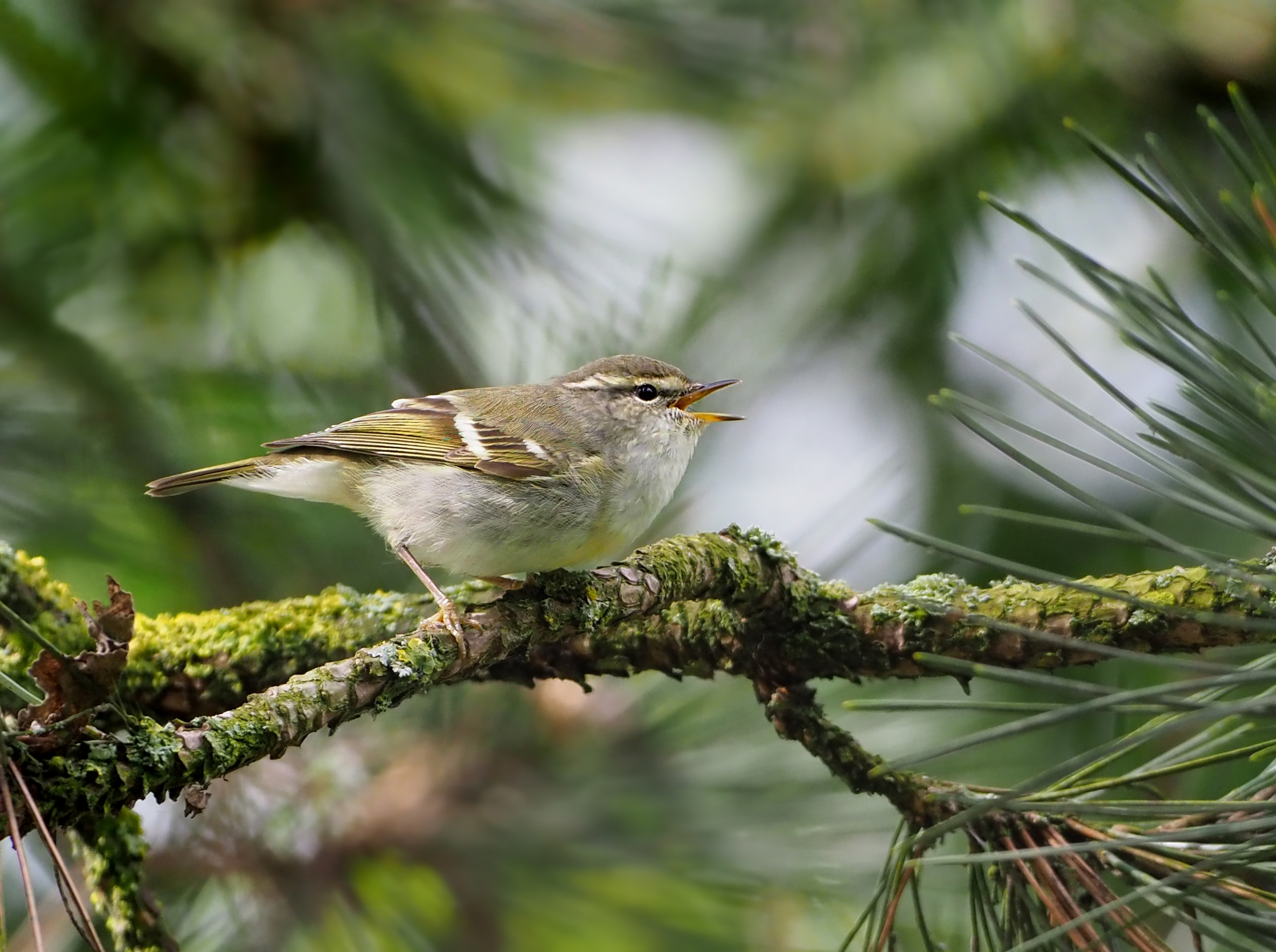
How to identify the Yellow-browed Warbler
Phylloscopus inornatus
Spotted a bird? Identify it instantly with the Birdby app
Open the appTo correctly identify the Yellow-browed Warbler (Phylloscopus inornatus), check each of these features. Birds can be tricky: habit, habitat, and call often confirm a sighting that a single photo cannot.
Size at a glance
- Length
- 9.5-11 cm (3.7-4.3 in)
- Wingspan
- 15-19 cm (5.9-7.5 in)
- Weight
- 4-9 g (0.14-0.32 oz)
Physical features to check
- 1
Plumage
Overall feather coloration and pattern.
Upperparts are dull greenish-brown, underparts are whitish. The most striking features are two prominent yellowish wing-bars (formed by pale tips to greater and median coverts), a long, bright yellowish supercilium (eyebrow) extending from the bill to the nape, and a pale central crown stripe. The tertial feathers have noticeable pale fringes. The rump is subtly paler than the back. During non-breeding, the plumage remains essentially the same.
- 2
Beak shape
Shape and color of the bill: a key field mark.
Small, slender, and pointed; dark above and paler, often yellowish, below.
- 3
Eye color
Iris color and any distinctive eye markings.
Dark brown.
- 4
Leg color
Leg and foot color.
Dark, typically greyish-brown to blackish.
- 5
Distinguishing features
Standout features that separate this species.
Bright yellow supercilium, two prominent pale wing-bars, pale tertial fringes, and a often faint pale crown stripe. Overall a very small, active warbler with a compact, short-tailed appearance. The flight is rapid and undulating.
- 6
Juvenile appearance
How young birds differ from adults.
Juveniles are very similar to adults, perhaps slightly duller overall, with less intensely yellow wing-bars and supercilium, but the key identification features are still apparent.
- 7
Seasonal changes
Plumage variation between breeding and non-breeding seasons.
No significant seasonal plumage changes. Breeding and non-breeding plumage are largely identical.
- 8
Sexual dimorphism
How males and females differ.
Males and females are visually identical in plumage and size.
Key field marks
- Supercilium. Look for the long, bright yellow supercilium extending well beyond the eye. This is a key distinguishing feature.
- Wing-bars. Observe two distinct, yellowish wing-bars. The upper bar (median coverts) is usually shorter and less prominent than the lower bar (greater coverts).
- Tertial Fringes. Note the prominent pale, often yellowish-white, fringes on the tertial feathers. This creates a striking pattern on the folded wing edge.
- Pale Crown Stripe. A often subtle, pale central crown stripe can be visible, though it is less distinct than in species like Pallas's Leaf Warbler.
- Vocalization. Listen for its distinctive, high-pitched, sharp 'squeet' or 'swee-ist' call. This is one of the best ways to identify it, especially for cryptic vagrants.
- Behavior. Watch its active, restless foraging style, constantly flitting and gleaning in dense foliage.
Explore the Yellow-browed Warbler
Identify birds anywhere
Free on iOS, Android, and Web. Photo & sound identification, full species database, and your personal life list.