
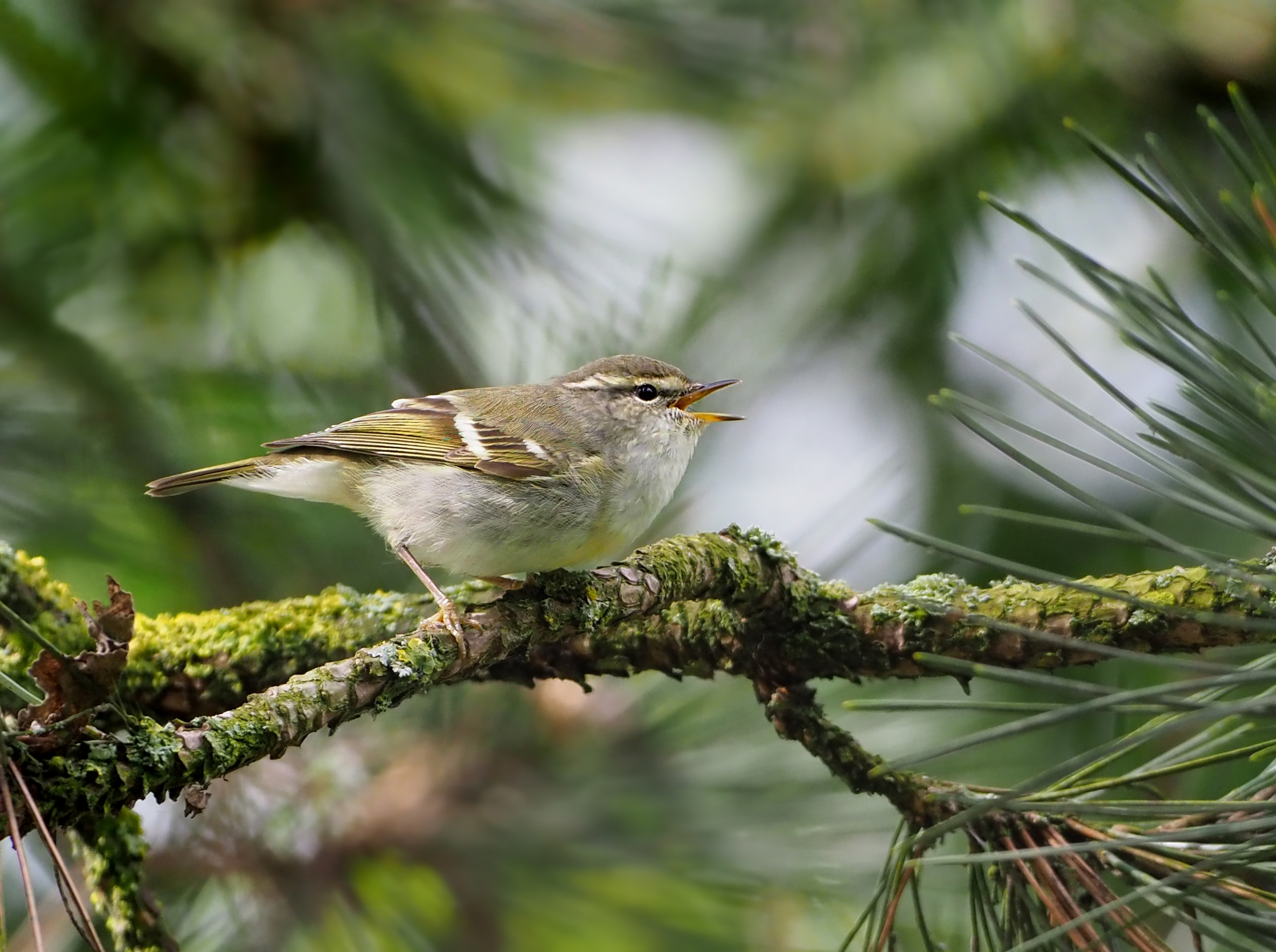
Where does the Yellow-browed Warbler live?
Phylloscopus inornatus
Spotted a bird? Identify it instantly with the Birdby app
Open the appThe Yellow-browed Warbler lives in specific habitats and regions. Knowing where, and when, to look improves your chances of a successful sighting.
Biomes
Boreal forests, taiga, temperate forests, woodlands. During migration, can be found in a wider range of habitats including parks, gardens, scrub, and coastal areas.
Geographic range
Breeds in a broad band across the taiga zone of Siberia, from the Ural Mountains eastwards to the Pacific Ocean, including parts of Mongolia and northern China. Winters mainly in Southeast Asia (e.g., India, Nepal, Southeast China, Indochina). A regular autumn vagrant to Western Europe, particularly Great Britain and Ireland, but also Scandinavia and continental Europe.
Preferred environments
Breeding habitat is typically coniferous or mixed coniferous-deciduous forest with a dense sub-canopy and undergrowth, often near water. During migration, they favour any dense, sheltered vegetation, including coastal scrub, hedgerows, and woodland edges.
Elevation range
Breeds from sea level up to around 2000 meters in mountainous regions. Wintering and migratory ranges can vary.
Where to look
Breeding Grounds (Siberia)
Dense coniferous or mixed forests, particularly near wetlands or rivers, with rich undergrowth. Look in the taiga zone from the Urals to the Pacific.
Wintering Grounds (Southeast Asia)
Broadleaf evergreen forests, secondary growth, plantations, and dense scrublands. Found at various altitudes.
Migration Stopovers (Western Europe)
Coastal headlands, islands, sheltered valleys, parks, gardens, and any area with dense cover that can offer food and shelter. Often found in isolated patches of trees or scrub.
Field tips
- Listen for its call. The 'squeet' call is arguably the most reliable field mark. Yellow-browed Warblers are often heard before they are seen, especially when they are vagrants.
- Scan dense foliage. They are very active birds and often difficult to get a clear view of. Focus on areas with constant movement and listen for sounds while scanning small branches in the mid-canopy and undergrowth.
- Check coastal areas during autumn migration. In Western Europe, coastal sites with sheltered vegetation, particularly after easterly winds in autumn (September-October), are prime locations for observing vagrants.
- Look for a combination of features. Rather than relying on a single mark, confirm the identification by noting the distinctive supercilium, two strong wing-bars, pale tertial fringes, and the characteristic call. Differentiating from similar species like Hume's Leaf Warbler requires careful attention to vocalizations and subtle plumage differences.
Migration
Long-distance migrant. Breeding populations in Siberia migrate southwest to wintering grounds in Southeast Asia. A famous pattern of 'reverse migration' or 'overshooting' brings a significant number of individuals westwards into Europe during autumn, rather than southwards. This makes it a highly anticipated rarity in Western European birding.
Explore the Yellow-browed Warbler
Identify birds anywhere
Free on iOS, Android, and Web. Photo & sound identification, full species database, and your personal life list.