
Spotted a bird? Identify it instantly with the Birdby app
Open the appAbout
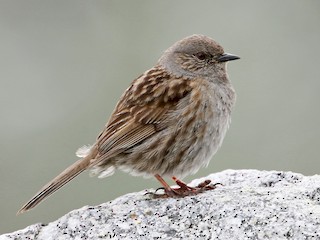
The Dunnock, also known as the Hedge Accentor or Prispolone in Italian, is a small passerine bird found throughout temperate Europe and into Asia. It is a rather inconspicuous bird, often overlooked due to its subtle brown and grey plumage, but it is well-known for its complex and variable breeding strategies, including polyandry and polygynandry.
Size & lifespan
- Length
- 13-14.5 cm
- Wingspan
- 19-21 cm
- Weight
- 16-25 g
- Lifespan
- 2-3 years (up to 9 years recorded)
- Diet
- Omnivore (primarily insects and spiders in summer, seeds and berries in winter)
Physical characteristics
- Plumage
- Adults have a streaky brown back and wings, a grey head and breast, and a buffy-brown flank with fine streaking. The throat is a paler grey. The undertail coverts are buffy-white. The overall impression is of a small, rather plain, sparrow-like bird, but with a finer bill and more upright posture.
- Beak shape
- Slender, pointed, dark grey to blackish bill, typical of an insectivorous/granivorous passerine.
- Eye color
- Dark brown.
- Leg color
- Reddish-brown to brownish-orange.
- Distinguishing features
- Its most distinctive feature is the combination of a grey head and breast with a streaky brown back, and its characteristic shuffling, 'mouse-like' movements when foraging low in vegetation.
- Juvenile appearance
- Juveniles are browner overall than adults, with a streaky brown head and breast, lacking the distinct grey coloration. They have a scaly appearance on the back and breast due to pale feather fringes.
- Seasonal changes
- There are no significant seasonal plumage changes. The plumage remains consistent throughout the year, though fresh plumage after the post-breeding moult may appear slightly richer in colour.
- Sexual dimorphism
- Males and females are virtually identical in plumage, making them difficult to distinguish visually in the field. Males may be slightly larger on average, but this is not a reliable field mark.
How to identify
- 1
Plumage
Look for the combination of a plain grey head and breast contrasting with a streaky brown back. This grey-brown pattern is key. No strong facial markings or wing bars.
- 2
Size and Shape
Small, rather dumpy passerine, slightly smaller and more slender than a House Sparrow, with a relatively long tail and a fine, pointed bill.
- 3
Behavior
Observe its foraging style: a characteristic shuffling, 'mouse-like' movement low in dense vegetation or on the ground, often flicking its tail. It is generally shy and keeps to cover.
- 4
Song
Listen for its distinctive, rapid, high-pitched, and somewhat 'tinkling' warble, often delivered from a hidden perch or the top of a bush.
- 5
Habitat
Often found in gardens, parks, hedgerows, and woodland edges where there is plenty of dense undergrowth.
Habitat & range
- Biomes
- Temperate forests, woodlands, scrublands, hedgerows, gardens, parks, and urban green spaces.
- Geographic range
- Widespread across Europe, from the Atlantic coast eastwards through Russia to the Ural Mountains. Also found in parts of the Middle East and North Africa. Introduced to New Zealand.
- Elevation range
- Sea level up to 2,000 meters in some mountainous regions, but typically found at lower elevations.
- Preferred environments
- Dense undergrowth, thickets, hedges, shrubbery, and areas with good ground cover. They prefer habitats with a mix of open ground for foraging and dense vegetation for cover and nesting.
Behavior
- Activity time
- Diurnal.
- Feeding habits
- Forages primarily on the ground or low in vegetation, often shuffling and creeping 'mouse-like' through dense cover. Diet consists mainly of insects (beetles, ants, flies, caterpillars) and spiders during the breeding season. In winter, they switch to seeds (especially from grasses and weeds) and small berries. They will also visit bird feeders for seeds and crumbs.
- Social behavior
- Generally solitary or found in pairs during the breeding season. Outside of breeding, they can be seen singly or in small, loose groups. They are known for their complex mating systems, which can include monogamy, polygyny (one male, multiple females), polyandry (one female, multiple males), and polygynandry (multiple males and females in a communal breeding group).
- Flight pattern
- Flight is typically short, low, and undulating, often between patches of dense cover. They are not strong or sustained fliers.
- Migration pattern
- Northern and eastern populations are migratory, moving south and west for the winter. Western and southern European populations are largely resident or undertake short-distance movements. British and Irish populations are mostly resident.
- Territoriality
- Males defend territories during the breeding season, often with complex interactions due to their varied mating systems. Females also defend territories, particularly against other females in polyandrous systems.
Song & calls
- Song
- The song is a rapid, high-pitched, and rather thin warbling, often described as a 'tinkling' or 'jingling' sound. It is delivered from a prominent perch (e.g., top of a bush or tree) or from within cover. It is quite distinctive once learned, though not particularly loud or far-carrying.
- Call
- Common calls include a sharp, high-pitched 'tseep' or 'tseet' contact call, and a thin, insistent 'sitt' or 'tiss' alarm call when disturbed.
- When they vocalize
- Males sing most frequently during the breeding season (February to July) to attract mates and defend territory. Calls are given year-round.
Breeding & reproduction
- Breeding season
- March to August, with peak activity from April to June. Can raise 2-3 broods per year.
- Nesting habits
- The nest is a neat, cup-shaped structure built by the female, typically low down in dense vegetation such as a hedge, bush, or conifer. It is made of moss, twigs, and roots, lined with finer materials like hair or feathers.
- Clutch size
- 3-6 eggs
- Egg description
- 3-6 (typically 4-5) eggs per clutch. The eggs are a distinctive bright, glossy blue, sometimes with a few faint reddish-brown speckles, but usually unmarked.
- Incubation period
- 12-14 days, primarily by the female, though males may assist in polyandrous systems.
- Fledging period
- 10-14 days after hatching. Young leave the nest before they can fly strongly.
- Parental care
- Both sexes feed the young, but the level of male involvement varies greatly depending on the mating system. In polyandrous systems, multiple males may feed the same brood. Females often do the majority of the incubation and initial brooding.
Where to find
Gardens and Parks
Common in suburban and urban gardens, especially those with dense shrubbery, hedges, and ground cover. Look near the base of hedges or under bushes.
Woodland Edges and Clearings
Frequents the edges of deciduous and coniferous woodlands, particularly where there is a thick understory or bramble patches.
Hedgerows and Farmland
Abundant in agricultural landscapes with extensive hedgerow networks, providing both cover and foraging opportunities.
Scrubland
Any area with dense scrub, gorse, or bramble thickets is a good place to find Dunnocks.
Field tips
- Be Patient and Quiet. Dunnocks are often shy and inconspicuous. Sit quietly near dense cover and wait for them to emerge to forage.
- Look Low. They spend most of their time foraging on the ground or very low in vegetation. Focus your attention on the base of hedges and bushes.
- Listen for the Song. Their distinctive song is often the first indication of their presence, even if they are hidden from view.
- Check Bird Feeders. In winter, they may visit ground feeders or feed under hanging feeders, picking up dropped seeds.
Similar species
House Sparrow
Passer domesticus
Dunnocks are more slender, have a finer bill, and lack the strong facial patterns (e.g., black bib of male House Sparrow) and chestnut cap. House Sparrows are generally bolder and more associated with human habitation, while Dunnocks are shyer and prefer dense cover. Dunnocks have grey on the head and breast, which House Sparrows lack.
Tree Sparrow
Passer montanus
Tree Sparrows have a distinct chestnut crown and a black spot on a white cheek, which Dunnocks lack. Dunnocks have a grey head and breast, and a more uniform, streaky brown back compared to the Tree Sparrow's more rufous back with black streaks.
Robin
Erithacus rubecula
While both are often found in similar habitats and forage on the ground, the Robin is easily distinguished by its prominent orange-red breast and face. Dunnocks are entirely lacking in such bright coloration.
Quick facts
- Family:
- Prunellidae (Accentors)
- Diet:
- Insects, spiders, seeds, berries
- Habitat:
- Gardens, hedgerows, woodlands, scrub
- Conservation Status:
- Least Concern
- Distinguishing Feature:
- Grey head/breast, streaky brown back, 'mouse-like' foraging
Fun facts
- Dunnocks are famous for their complex and varied mating systems, which can include monogamy, polygyny, polyandry, and polygynandry, often within the same population. This makes them a fascinating subject for behavioral ecologists.
- Despite their plain appearance, their social lives are anything but simple. Females often mate with multiple males, and males may help raise broods from multiple females, leading to intricate parental care arrangements.
- The Dunnock is a common host for the Cuckoo (Cuculus canorus) in Europe, which lays its eggs in the Dunnock's nest, relying on the Dunnock to raise its young.
- Their scientific name 'Prunella' comes from the Latin 'prunus' meaning 'brownish', referring to their plumage, and 'modularis' refers to their song, which is often described as 'modulating'.
Scientific classification
- Kingdom
- Animalia
- Phylum
- Chordata
- Class
- Aves
- Order
- Passeriformes
- Family
- Prunellidae
- Genus
- Prunella
- Species
- Prunella modularis
Explore the Dunnock
Identify birds anywhere
Free on iOS, Android, and Web. Photo & sound identification, full species database, and your personal life list.