
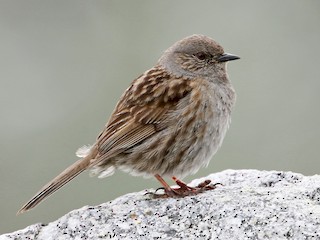
How to identify the Dunnock
Prunella modularis
Spotted a bird? Identify it instantly with the Birdby app
Open the appTo correctly identify the Dunnock (Prunella modularis), check each of these features. Birds can be tricky: habit, habitat, and call often confirm a sighting that a single photo cannot.
Size at a glance
- Length
- 13-14.5 cm
- Wingspan
- 19-21 cm
- Weight
- 16-25 g
Physical features to check
- 1
Plumage
Overall feather coloration and pattern.
Adults have a streaky brown back and wings, a grey head and breast, and a buffy-brown flank with fine streaking. The throat is a paler grey. The undertail coverts are buffy-white. The overall impression is of a small, rather plain, sparrow-like bird, but with a finer bill and more upright posture.
- 2
Beak shape
Shape and color of the bill: a key field mark.
Slender, pointed, dark grey to blackish bill, typical of an insectivorous/granivorous passerine.
- 3
Eye color
Iris color and any distinctive eye markings.
Dark brown.
- 4
Leg color
Leg and foot color.
Reddish-brown to brownish-orange.
- 5
Distinguishing features
Standout features that separate this species.
Its most distinctive feature is the combination of a grey head and breast with a streaky brown back, and its characteristic shuffling, 'mouse-like' movements when foraging low in vegetation.
- 6
Juvenile appearance
How young birds differ from adults.
Juveniles are browner overall than adults, with a streaky brown head and breast, lacking the distinct grey coloration. They have a scaly appearance on the back and breast due to pale feather fringes.
- 7
Seasonal changes
Plumage variation between breeding and non-breeding seasons.
There are no significant seasonal plumage changes. The plumage remains consistent throughout the year, though fresh plumage after the post-breeding moult may appear slightly richer in colour.
- 8
Sexual dimorphism
How males and females differ.
Males and females are virtually identical in plumage, making them difficult to distinguish visually in the field. Males may be slightly larger on average, but this is not a reliable field mark.
Key field marks
- Plumage. Look for the combination of a plain grey head and breast contrasting with a streaky brown back. This grey-brown pattern is key. No strong facial markings or wing bars.
- Size and Shape. Small, rather dumpy passerine, slightly smaller and more slender than a House Sparrow, with a relatively long tail and a fine, pointed bill.
- Behavior. Observe its foraging style: a characteristic shuffling, 'mouse-like' movement low in dense vegetation or on the ground, often flicking its tail. It is generally shy and keeps to cover.
- Song. Listen for its distinctive, rapid, high-pitched, and somewhat 'tinkling' warble, often delivered from a hidden perch or the top of a bush.
- Habitat. Often found in gardens, parks, hedgerows, and woodland edges where there is plenty of dense undergrowth.
Explore the Dunnock
Identify birds anywhere
Free on iOS, Android, and Web. Photo & sound identification, full species database, and your personal life list.