
Spotted a bird? Identify it instantly with the Birdby app
Open the appAbout
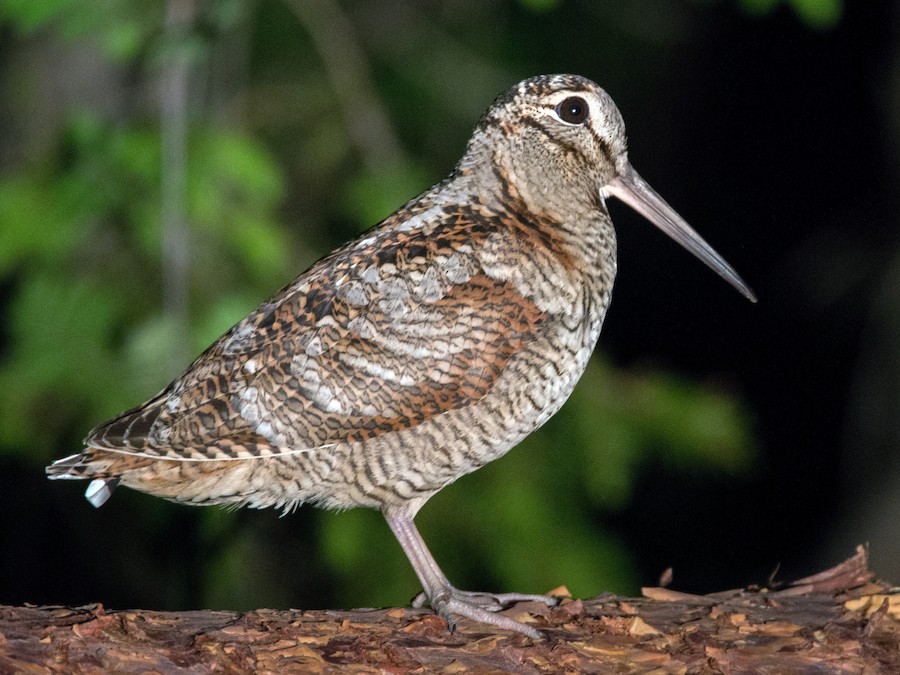
The Eurasian Woodcock is a medium-sized wading bird with cryptic plumage, perfectly adapted for camouflage in woodland undergrowth. It is known for its long, straight bill, large eyes set high and far back on its head, and its distinctive 'roding' display flight.
Size & lifespan
- Length
- 33-38 cm (13-15 in)
- Wingspan
- 55-65 cm (22-26 in)
- Weight
- 140-420 g (4.9-14.8 oz), typically 200-350 g
- Lifespan
- Up to 15 years in the wild, typically 3-5 years
- Diet
- Invertebrates, primarily earthworms, but also insects, larvae, spiders, and occasionally plant material like seeds and berries.
Physical characteristics
- Plumage
- Upperparts are a complex pattern of rufous, brown, black, and grey, providing excellent camouflage against leaf litter. Underparts are buffy-white with fine dark barring. The head has distinctive dark bands running from the bill to the eye and across the crown, separated by buffy stripes. The rump and tail are rufous with black barring and a white tip.
- Beak shape
- Very long (6-8 cm), straight, and slender, dark brown to blackish, paler at the base of the lower mandible.
- Eye color
- Large, dark brown eyes, set high and far back on the head, providing 360-degree vision without moving its head.
- Leg color
- Short, stout legs, typically greyish-pink to brownish-grey.
- Distinguishing features
- Cryptic plumage, long bill, large eyes set far back on the head, stocky body, short neck, and rounded wings. The unique head pattern with transverse dark bands on the crown is a key identifier.
- Juvenile appearance
- Juveniles resemble adults but may have slightly duller plumage and less distinct barring on the underparts. Their flight feathers are typically less worn than adults.
- Seasonal changes
- No significant seasonal plumage changes. The cryptic coloration remains consistent year-round.
- Sexual dimorphism
- Males and females are virtually identical in plumage and size. There are no reliable external features to distinguish sexes in the field.
How to identify
- 1
Size and Shape
Look for a plump, stocky wader with a short neck, rounded wings, and a very long, straight bill. It's larger than a snipe.
- 2
Plumage and Camouflage
Observe its incredibly cryptic brown, black, and rufous plumage, designed to blend perfectly with leaf litter. The dark transverse bands on the crown are a key feature.
- 3
Eye Placement
Note the large, dark eyes set high and far back on the head, providing almost 360-degree vision.
- 4
Behavior (Roding Flight)
During breeding season, listen for and watch the male's distinctive 'roding' display flight at dusk and dawn: a slow, undulating flight over treetops, accompanied by guttural croaks and high-pitched whistles.
- 5
Flight when Flushed
If flushed from cover, it will typically fly up rapidly with a whirring sound, often in a straight line for a short distance before dropping back into cover. Listen for the sharp 'scap' call.
Habitat & range
- Biomes
- Temperate and boreal forests, mixed woodlands, coniferous forests, and dense scrub.
- Geographic range
- Breeds across a wide range of Eurasia, from Western Europe (including the UK and Ireland) eastward through Russia and Siberia to Japan. Winters in Western and Southern Europe, North Africa, and South Asia.
- Elevation range
- Typically found from sea level up to 2,500 meters (8,200 ft), depending on the region and season.
- Preferred environments
- Prefers damp, deciduous or mixed woodlands with dense undergrowth, soft soil for probing, and open clearings for display flights. Often found near streams, bogs, or wet areas.
Behavior
- Activity time
- Primarily crepuscular and nocturnal, especially for feeding. During the breeding season, males perform their 'roding' display flights at dusk and dawn.
- Feeding habits
- Primarily nocturnal or crepuscular feeder. It probes its long bill deep into soft soil and leaf litter to extract earthworms and other invertebrates. The flexible tip of its upper mandible allows it to grasp prey while the bill is still in the ground.
- Social behavior
- Generally solitary and secretive, especially outside the breeding season. During migration, loose aggregations may form. Males are territorial during the breeding season.
- Flight pattern
- Typically flies with rapid, shallow wing beats, often erratically, especially when flushed. During its 'roding' display, the flight is slow, deliberate, and undulating, often just above the treetops.
- Migration pattern
- Northern and eastern populations are migratory, moving south and west for the winter. Western and southern populations are largely resident or undertake short-distance movements. Migration occurs mainly at night.
- Territoriality
- Males establish and defend breeding territories, primarily through their 'roding' display flights. Females defend their nest sites.
Song & calls
- Song
- The 'song' is part of the male's 'roding' display flight. It consists of a series of low, guttural croaks or grunts ('orrrt-orrrt-orrrt') followed by high-pitched, whistling notes ('psiss-psiss-psiss'). This sequence is repeated.
- Call
- When flushed, it often emits a sharp, high-pitched 'scap' or 'tzick' call. Other calls include soft 'chip' notes.
- When they vocalize
- Mainly vocalizes during the breeding season (March to July), particularly at dusk and dawn during 'roding' flights. Alarm calls can be heard if disturbed at any time.
Breeding & reproduction
- Breeding season
- March to July, with peak activity in April-May.
- Nesting habits
- Nests on the ground in a shallow scrape, often at the base of a tree or shrub, well-hidden by dense vegetation. The nest is lined with leaves, moss, and grass.
- Clutch size
- Usually 4 eggs.
- Egg description
- Typically 4 eggs, oval to pyriform in shape. Color varies from pale buff to creamy-white or yellowish-brown, heavily blotched and spotted with reddish-brown, grey, and black, often concentrated at the broad end.
- Incubation period
- 20-24 days, primarily by the female.
- Fledging period
- Chicks are precocial and leave the nest shortly after hatching (within hours). They are able to feed themselves but are brooded and protected by the female. They can fly short distances at about 15-20 days and are fully independent around 5-6 weeks.
- Parental care
- Mainly by the female, who incubates the eggs and cares for the young. She is known to carry chicks between her legs if danger approaches.
Where to find
Damp Woodlands
Look in mature deciduous or mixed woodlands with dense undergrowth, especially areas with soft, moist soil for probing.
Forest Edges and Clearings
During the breeding season, males perform their 'roding' flights over forest edges, rides, and small clearings at dusk and dawn.
Wet Areas
Areas near streams, bogs, or marshy patches within woodlands are often favored due to the abundance of earthworms.
Field tips
- Timing is Key. The best time to observe Eurasian Woodcocks is at dusk or dawn, particularly during the breeding season (March-July), when males perform their 'roding' display flights. They are largely nocturnal feeders.
- Listen Carefully. Learn the distinctive 'orrrt-orrrt-orrrt psiss-psiss-psiss' call of the roding male. This is often the first indication of their presence.
- Be Patient and Quiet. Woodcocks are extremely secretive and well-camouflaged. Walk slowly and quietly through suitable habitat, scanning the ground. If you flush one, it will likely fly a short distance and drop back into cover.
- Look for Signs. Look for probing holes in soft ground, which indicate recent feeding activity. These are small, conical holes made by their long bills.
- Use Binoculars. Even if you spot one, its camouflage can make it hard to discern details. Binoculars are essential for observing its unique features.
Similar species
American Woodcock
Scolopax minor
The American Woodcock is smaller, has a shorter bill, and its crown stripes run lengthwise (longitudinal) rather than transversely. Its underparts are more uniformly buffy without the strong barring seen in the Eurasian Woodcock. The 'peent' call of the American Woodcock is also distinct from the Eurasian's roding calls.
Great Snipe
Gallinago media
Great Snipe is generally smaller, has a shorter bill, and a more streaked back. Its eyes are not as far back on the head. It lacks the distinctive transverse head banding of the Woodcock. Great Snipe also has prominent white outer tail feathers, which are less obvious or absent in Woodcock.
Common Snipe
Gallinago gallinago
Common Snipe is significantly smaller, has a shorter bill, and a more slender body. Its plumage is more streaked, and it has a distinct pale supercilium. Its flight is more erratic and zig-zagging when flushed, and its 'drumming' display flight is very different from the Woodcock's roding.
Quick facts
- Vision:
- Almost 360-degree monocular vision due to eye placement.
- Bill Flexibility:
- Can open the tip of its upper mandible independently to grasp prey underground.
- Carrying Young:
- Female can carry chicks between her legs or against her body when moving them.
- Roding Display:
- Male's aerial display flight at dusk/dawn to attract mates.
- Camouflage:
- One of the most cryptically plumaged birds, making it incredibly difficult to spot.
Fun facts
- The Eurasian Woodcock's eyes are positioned so far back on its head that it has a nearly 360-degree field of vision, allowing it to detect predators from almost any angle without moving its head.
- Its long bill has a flexible tip, which it can open and close independently of the rest of the bill. This allows it to grasp earthworms and other prey while its bill is still buried in the soil.
- The 'roding' flight of the male Woodcock is a unique and ancient courtship display, performed at twilight over its territory, making distinctive calls.
- Despite its plump appearance, the Woodcock is a strong flyer and undertakes long migratory journeys, often flying at high altitudes.
- In some cultures, the Woodcock is considered a delicacy, and its hunting has a long tradition, though regulated in many areas.
Scientific classification
- Kingdom
- Animalia
- Phylum
- Chordata
- Class
- Aves
- Order
- Charadriiformes
- Family
- Scolopacidae
- Genus
- Scolopax
- Species
- Scolopax rusticola
Explore the Eurasian Woodcock
Identify birds anywhere
Free on iOS, Android, and Web. Photo & sound identification, full species database, and your personal life list.