
How to identify the Eurasian Woodcock
Scolopax rusticola
Spotted a bird? Identify it instantly with the Birdby app
Open the appTo correctly identify the Eurasian Woodcock (Scolopax rusticola), check each of these features. Birds can be tricky: habit, habitat, and call often confirm a sighting that a single photo cannot.
Size at a glance
- Length
- 33-38 cm (13-15 in)
- Wingspan
- 55-65 cm (22-26 in)
- Weight
- 140-420 g (4.9-14.8 oz), typically 200-350 g
Physical features to check
- 1
Plumage
Overall feather coloration and pattern.
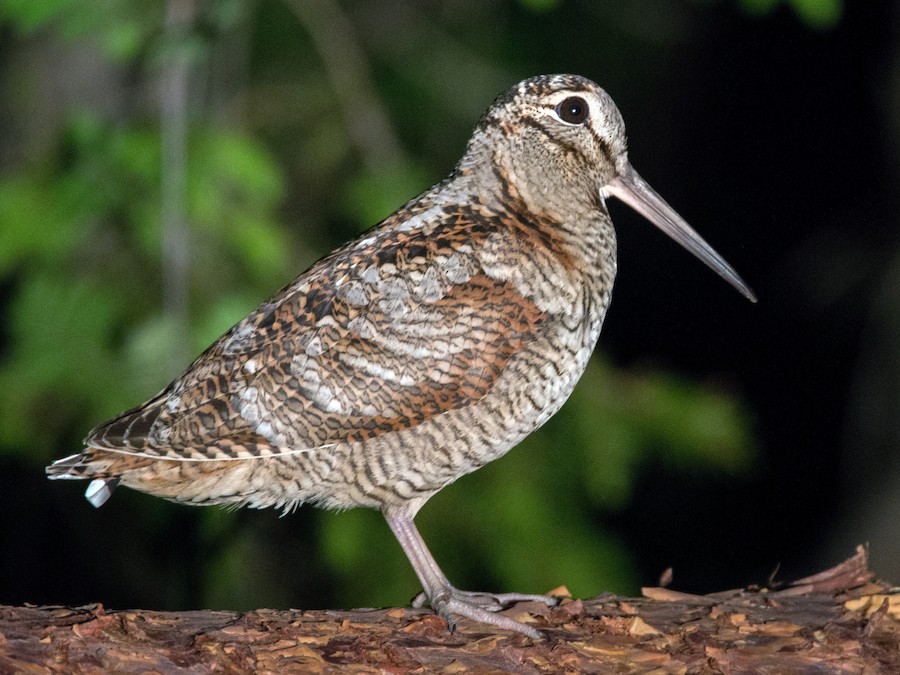
Upperparts are a complex pattern of rufous, brown, black, and grey, providing excellent camouflage against leaf litter. Underparts are buffy-white with fine dark barring. The head has distinctive dark bands running from the bill to the eye and across the crown, separated by buffy stripes. The rump and tail are rufous with black barring and a white tip.
- 2
Beak shape
Shape and color of the bill: a key field mark.
Very long (6-8 cm), straight, and slender, dark brown to blackish, paler at the base of the lower mandible.
- 3
Eye color
Iris color and any distinctive eye markings.
Large, dark brown eyes, set high and far back on the head, providing 360-degree vision without moving its head.
- 4
Leg color
Leg and foot color.
Short, stout legs, typically greyish-pink to brownish-grey.
- 5
Distinguishing features
Standout features that separate this species.
Cryptic plumage, long bill, large eyes set far back on the head, stocky body, short neck, and rounded wings. The unique head pattern with transverse dark bands on the crown is a key identifier.
- 6
Juvenile appearance
How young birds differ from adults.
Juveniles resemble adults but may have slightly duller plumage and less distinct barring on the underparts. Their flight feathers are typically less worn than adults.
- 7
Seasonal changes
Plumage variation between breeding and non-breeding seasons.
No significant seasonal plumage changes. The cryptic coloration remains consistent year-round.
- 8
Sexual dimorphism
How males and females differ.
Males and females are virtually identical in plumage and size. There are no reliable external features to distinguish sexes in the field.
Key field marks
- Size and Shape. Look for a plump, stocky wader with a short neck, rounded wings, and a very long, straight bill. It's larger than a snipe.
- Plumage and Camouflage. Observe its incredibly cryptic brown, black, and rufous plumage, designed to blend perfectly with leaf litter. The dark transverse bands on the crown are a key feature.
- Eye Placement. Note the large, dark eyes set high and far back on the head, providing almost 360-degree vision.
- Behavior (Roding Flight). During breeding season, listen for and watch the male's distinctive 'roding' display flight at dusk and dawn: a slow, undulating flight over treetops, accompanied by guttural croaks and high-pitched whistles.
- Flight when Flushed. If flushed from cover, it will typically fly up rapidly with a whirring sound, often in a straight line for a short distance before dropping back into cover. Listen for the sharp 'scap' call.
Explore the Eurasian Woodcock
Identify birds anywhere
Free on iOS, Android, and Web. Photo & sound identification, full species database, and your personal life list.