
Spotted a bird? Identify it instantly with the Birdby app
Open the appAbout
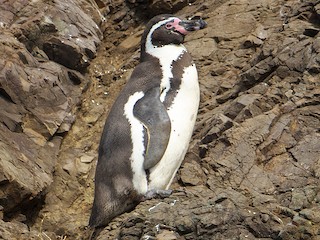
The Humboldt Penguin is a medium-sized penguin native to South America, named after the Humboldt Current, a cold ocean current that flows north along the west coast of South America, bringing nutrient-rich waters. It is characterized by a distinctive black band across its chest and a pinkish fleshy patch at the base of its bill.
Size & lifespan
- Length
- 56-70 cm (22-28 inches)
- Wingspan
- Approximately 80-90 cm (31-35 inches) flipper to flipper underwater
- Weight
- 3.3-5.0 kg (7.3-11.0 lbs)
- Lifespan
- Typically 15-20 years in the wild, up to 30 years in captivity.
- Diet
- Primarily consists of small to medium-sized schooling fish such as anchovies (Engraulis ringens), sardines (Sardinops sagax), and squid (e.g., Loligo gahi). They are pursuit predators, catching prey underwater.
Physical characteristics
- Plumage
- Adults have a black head with a white border that runs from the base of the bill, over the eye, and down the sides of the neck to meet the white underparts. A prominent black band crosses the chest. The dorsal side is dark slate-grey to black. The belly is white with black spots that vary individually.
- Beak shape
- Moderately long, robust, and slightly hooked at the tip. The bill is black with a distinctive pinkish fleshy patch at its base and around the eye.
- Eye color
- Dark brown, often surrounded by the pinkish fleshy patch that extends from the bill.
- Leg color
- Blackish-grey with webbing. Their feet are adapted for swimming, with strong claws.
- Distinguishing features
- The combination of the single black chest band, the extensive pink bare skin at the base of the bill and around the eye, and the general size differentiates it. The black spots on the white belly are unique to each individual, like a fingerprint.
- Juvenile appearance
- Juveniles are generally duller than adults, lacking the distinct white head stripe and chest band. Their dorsal plumage is more brownish-grey, and their underparts are greyish-white without the sharp demarcation or chest band of adults. The pink facial skin patch is less developed or absent.
- Seasonal changes
- Plumage does not change seasonally, but penguins undergo an annual catastrophic moult when they replace all their feathers. During this period (lasting approximately 2-3 weeks), they cannot enter the water to feed and rely on stored fat reserves, appearing dishevelled. The timing of moult can vary due to environmental factors or individual health.
- Sexual dimorphism
- Males are generally slightly larger than females in both weight and length, but plumage coloration is identical. This size difference is not always easily discernible in the field.
How to identify
- 1
Chest Band
Look for a single, prominent black band across the white chest, contrasting with the two bands of Magellanic Penguins.
- 2
Facial Markings
Note the extensive pinkish fleshy patch at the base of the bill and around the eye, which is a key differentiator from other Spheniscus penguins. The white stripe curves over the eye and around the side of the head, meeting the white underparts.
- 3
Belly Spots
Observe the variable black spotting on the white belly. While not always easily seen, it's a unique characteristic for individual identification.
- 4
Vocalization
Listen for their distinctive, loud braying calls, reminiscent of a donkey, especially within colonies.
- 5
Size and Proportion
Its medium size among the banded penguins helps narrow down identification when combined with plumage details.
Habitat & range
- Biomes
- Coastal marine environments, rocky shores, and arid coastal regions.
- Geographic range
- Found along the Pacific coast of South America, from approximately Isla Foca in northern Peru (5°S) south to Chiloé Island in southern Chile (43°S).
- Elevation range
- Primarily sea level, nesting on coastal cliffs and islands.
- Preferred environments
- Arid coastal areas, offshore islands, and rocky headlands where they can find suitable nesting sites (such as burrows in guano, rock crevices, or caves) and access to cold, nutrient-rich upwelling waters provided by the Humboldt Current.
Behavior
- Activity time
- Diurnal, with most foraging occurring during daylight hours. They return to colonies in the evenings.
- Feeding habits
- Diurnal, foraging at sea for schooling fish and cephalopods. They are excellent swimmers and divers, capable of diving to depths of up to 150 meters (490 feet) for several minutes, though most dives are much shallower and shorter. They use their strong flippers for propulsion underwater and their webbed feet for steering. They often feed in groups.
- Social behavior
- Colonial breeders, forming large breeding colonies on islands and coastal areas. They are generally social at sea and on land, though territoriality around nests can be observed during breeding season. They exhibit various social interactions, including allopreening and vocalizations.
- Flight pattern
- Flightless. They 'fly' underwater using their powerful flippers.
- Migration pattern
- Generally non-migratory but may undertake localized movements to follow prey or find suitable nesting/foraging grounds throughout their range.
- Territoriality
- Exhibit territorial behavior around their nest sites during the breeding season, often engaging in bill-jousting, aggressive postures, and vocalizations to defend their space from rivals.
Song & calls
- Song
- N/A. Penguins do not sing in the traditional sense.
- Call
- Their vocalizations are varied, including braying calls (often described as donkey-like), squawks, and trumpeting sounds. The braying calls are used for communication within the colony, particularly during breeding and to attract mates or identify individuals. They also have contact calls and alarm calls.
- When they vocalize
- Most vocal during the breeding season, especially at colonies, and when establishing or defending territories. They also vocalize when interacting with mates or chicks, and sometimes when foraging at sea.
Breeding & reproduction
- Breeding season
- Highly variable, influenced by local conditions and food availability. In Peru, breeding typically peaks from March to December; in Chile, it can be from April to January, with two peak periods, one in spring (September-October) and another in autumn (March-April). They can lay two clutches in a good year.
- Nesting habits
- Nests in burrows dug into guano deposits, rock crevices, or caves on offshore islands and protected coastal areas. They often return to the same nest sites year after year.
- Clutch size
- Usually two eggs.
- Egg description
- Typically lay two eggs, which are white or pale blue-green, oval-shaped, and relatively large for the bird's size.
- Incubation period
- Approximately 40-42 days, with both parents sharing incubation duties.
- Fledging period
- Chicks fledge around 70-90 days after hatching, once their waterproof plumage has developed.
- Parental care
- Both parents are actively involved in incubation and chick rearing, taking turns to forage and guard the nest. After fledging, parental care gradually diminishes.
Where to find
Offshore Islands
Many colonies are found on remote, protected offshore islands along the coasts of Peru and Chile, as these offer safety from terrestrial predators.
Rocky Coastal Areas
They also nest on mainland rocky headlands and cliffs with access to suitable nesting crevices or areas for digging burrows in guano deposits.
Marine Protected Areas
Within their range, marine protected areas and national reserves often harbor significant populations and offer the best chances for observation.
Field tips
- Visit Breeding Colonies. The best time to see Humboldt Penguins is during their breeding season at known colony sites in Peru and Chile. This is when they are most concentrated on land.
- Observe from a Distance. Always maintain a respectful distance to avoid disturbing the birds, especially during nesting. Binoculars or a spotting scope are essential for good views.
- Guided Tours. Consider joining a reputable birdwatching or ecotourism tour that specializes in coastal wildlife viewings in their range. Guides can often take you to the best observation points without disturbing the birds.
- Look for Basking. During warmer times of day, they may be seen standing with their flippers outstretched, a behavior known as 'flipper-spreading' or 'thermo-regulation', to cool down. The pink coloration on their face contributes to heat exchange.
Similar species
Magellanic Penguin
Spheniscus magellanicus
The Magellanic Penguin has two distinct black bands across its chest, whereas the Humboldt Penguin has only one. The Magellanic Penguin also has less extensive pink bare skin on its face and bill, and its white head stripe is broader and more continuous, often extending further down the throat.
African Penguin
Spheniscus demersus
The African Penguin also has a single black chest band like the Humboldt, but its facial markings differ. The white eyebrow stripe of the African Penguin forms an inverted 'U' shape, connecting with a black band around the chin. The extent of pink bare skin at the bill base is also less pronounced than in the Humboldt Penguin.
Galapagos Penguin
Spheniscus mendiculus
The Galapagos Penguin is considerably smaller than the Humboldt Penguin. While it also has a single chest band, its facial pattern is distinct, with a white stripe extending from the eye towards the throat, and a relatively smaller bill that lacks the prominent pink fleshy patch seen in the Humboldt.
Quick facts
- Average Length:
- 65 cm (26 inches)
- Clutch Size:
- 2 eggs
- Diet:
- Small schooling fish and squid
- Key Threat:
- Overfishing and climate change
- Unique Feature:
- Pink fleshy patch on face/bill, single chest band
Fun facts
- Humboldt Penguins can tolerate a relatively wide range of temperatures due to the cold Humboldt Current, thriving in quite arid and warm coastal environments.
- Each Humboldt Penguin has a unique pattern of black spots on its white belly, much like a human fingerprint.
- They use their prominent pink facial patches for thermoregulation. When they get hot, blood flow to these areas increases, allowing excess heat to be radiated away.
- They are one of the 'banded penguins' (genus Spheniscus) known for their distinctive black and white plumage patterns.
- Despite being flightless, their underwater 'flight' can achieve speeds of up to 48 km/h (30 mph).
Scientific classification
- Kingdom
- Animalia
- Phylum
- Chordata
- Class
- Aves
- Order
- Sphenisciformes
- Family
- Spheniscidae
- Genus
- Spheniscus
- Species
- S. humboldti
Explore the Humboldt Penguin
Identify birds anywhere
Free on iOS, Android, and Web. Photo & sound identification, full species database, and your personal life list.