
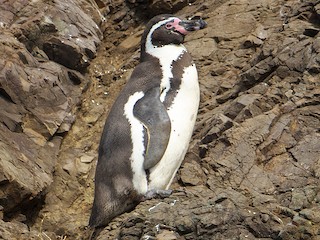
Where does the Humboldt Penguin live?
Spheniscus humboldti
Spotted a bird? Identify it instantly with the Birdby app
Open the appThe Humboldt Penguin lives in specific habitats and regions. Knowing where, and when, to look improves your chances of a successful sighting.
Biomes
Coastal marine environments, rocky shores, and arid coastal regions.
Geographic range
Found along the Pacific coast of South America, from approximately Isla Foca in northern Peru (5°S) south to Chiloé Island in southern Chile (43°S).
Preferred environments
Arid coastal areas, offshore islands, and rocky headlands where they can find suitable nesting sites (such as burrows in guano, rock crevices, or caves) and access to cold, nutrient-rich upwelling waters provided by the Humboldt Current.
Elevation range
Primarily sea level, nesting on coastal cliffs and islands.
Where to look
Offshore Islands
Many colonies are found on remote, protected offshore islands along the coasts of Peru and Chile, as these offer safety from terrestrial predators.
Rocky Coastal Areas
They also nest on mainland rocky headlands and cliffs with access to suitable nesting crevices or areas for digging burrows in guano deposits.
Marine Protected Areas
Within their range, marine protected areas and national reserves often harbor significant populations and offer the best chances for observation.
Field tips
- Visit Breeding Colonies. The best time to see Humboldt Penguins is during their breeding season at known colony sites in Peru and Chile. This is when they are most concentrated on land.
- Observe from a Distance. Always maintain a respectful distance to avoid disturbing the birds, especially during nesting. Binoculars or a spotting scope are essential for good views.
- Guided Tours. Consider joining a reputable birdwatching or ecotourism tour that specializes in coastal wildlife viewings in their range. Guides can often take you to the best observation points without disturbing the birds.
- Look for Basking. During warmer times of day, they may be seen standing with their flippers outstretched, a behavior known as 'flipper-spreading' or 'thermo-regulation', to cool down. The pink coloration on their face contributes to heat exchange.
Migration
Generally non-migratory but may undertake localized movements to follow prey or find suitable nesting/foraging grounds throughout their range.
Explore the Humboldt Penguin
Identify birds anywhere
Free on iOS, Android, and Web. Photo & sound identification, full species database, and your personal life list.