
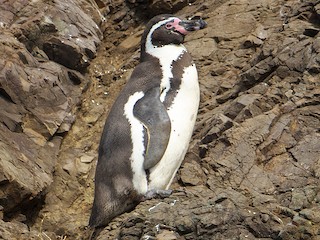
How to identify the Humboldt Penguin
Spheniscus humboldti
Spotted a bird? Identify it instantly with the Birdby app
Open the appTo correctly identify the Humboldt Penguin (Spheniscus humboldti), check each of these features. Birds can be tricky: habit, habitat, and call often confirm a sighting that a single photo cannot.
Size at a glance
- Length
- 56-70 cm (22-28 inches)
- Wingspan
- Approximately 80-90 cm (31-35 inches) flipper to flipper underwater
- Weight
- 3.3-5.0 kg (7.3-11.0 lbs)
Physical features to check
- 1
Plumage
Overall feather coloration and pattern.
Adults have a black head with a white border that runs from the base of the bill, over the eye, and down the sides of the neck to meet the white underparts. A prominent black band crosses the chest. The dorsal side is dark slate-grey to black. The belly is white with black spots that vary individually.
- 2
Beak shape
Shape and color of the bill: a key field mark.
Moderately long, robust, and slightly hooked at the tip. The bill is black with a distinctive pinkish fleshy patch at its base and around the eye.
- 3
Eye color
Iris color and any distinctive eye markings.
Dark brown, often surrounded by the pinkish fleshy patch that extends from the bill.
- 4
Leg color
Leg and foot color.
Blackish-grey with webbing. Their feet are adapted for swimming, with strong claws.
- 5
Distinguishing features
Standout features that separate this species.
The combination of the single black chest band, the extensive pink bare skin at the base of the bill and around the eye, and the general size differentiates it. The black spots on the white belly are unique to each individual, like a fingerprint.
- 6
Juvenile appearance
How young birds differ from adults.
Juveniles are generally duller than adults, lacking the distinct white head stripe and chest band. Their dorsal plumage is more brownish-grey, and their underparts are greyish-white without the sharp demarcation or chest band of adults. The pink facial skin patch is less developed or absent.
- 7
Seasonal changes
Plumage variation between breeding and non-breeding seasons.
Plumage does not change seasonally, but penguins undergo an annual catastrophic moult when they replace all their feathers. During this period (lasting approximately 2-3 weeks), they cannot enter the water to feed and rely on stored fat reserves, appearing dishevelled. The timing of moult can vary due to environmental factors or individual health.
- 8
Sexual dimorphism
How males and females differ.
Males are generally slightly larger than females in both weight and length, but plumage coloration is identical. This size difference is not always easily discernible in the field.
Key field marks
- Chest Band. Look for a single, prominent black band across the white chest, contrasting with the two bands of Magellanic Penguins.
- Facial Markings. Note the extensive pinkish fleshy patch at the base of the bill and around the eye, which is a key differentiator from other Spheniscus penguins. The white stripe curves over the eye and around the side of the head, meeting the white underparts.
- Belly Spots. Observe the variable black spotting on the white belly. While not always easily seen, it's a unique characteristic for individual identification.
- Vocalization. Listen for their distinctive, loud braying calls, reminiscent of a donkey, especially within colonies.
- Size and Proportion. Its medium size among the banded penguins helps narrow down identification when combined with plumage details.
Explore the Humboldt Penguin
Identify birds anywhere
Free on iOS, Android, and Web. Photo & sound identification, full species database, and your personal life list.