
Spotted a bird? Identify it instantly with the Birdby app
Open the appAbout
The Yellow-bellied Sapsucker is a medium-sized woodpecker native to North and Central America, known for its distinctive feeding behavior of drilling rows of sap wells in trees. It is one of four sapsucker species in North America and is easily identified by its unique plumage and characteristic drumming.
Size & lifespan
- Length
- 19-21 cm (7.5-8.3 in)
- Wingspan
- 34-40 cm (13.4-15.7 in)
- Weight
- 43-60 g (1.5-2.1 oz)
- Lifespan
- Typically 4-7 years in the wild, with records up to 10 years.
- Diet
- Omnivore, primarily tree sap, insects (especially ants), and some fruits and berries.
Physical characteristics
- Plumage
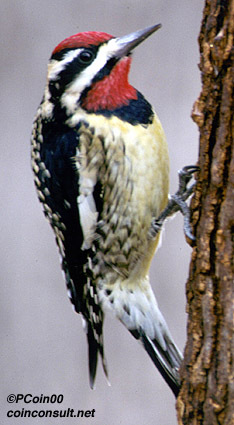
- Adults have a black and white barred back, white wing patch, and a black chest band. The belly is yellowish, though often subtle. Males have a red crown and a red throat, while females have a red crown and a white throat. Both sexes have a prominent white stripe behind the eye and a black malar stripe.
- Beak shape
- Short, chisel-tipped, and straight, adapted for drilling sap wells.
- Eye color
- Dark brown.
- Leg color
- Grayish-green to dark gray.
- Distinguishing features
- The most distinctive features are the white wing patch (visible in flight and at rest), the red crown (both sexes), red throat (male), white throat (female), and the characteristic rows of sap wells drilled into tree bark.
- Juvenile appearance
- Juveniles are duller and browner overall, with less distinct barring and a mottled brown head and breast. They lack the bright red crown and throat of adults, which develop during their first fall molt.
- Seasonal changes
- No significant seasonal plumage changes beyond the post-juvenile molt. Breeding and non-breeding plumages are essentially the same for adults.
- Sexual dimorphism
- Males have a red throat, while females have a white throat. Otherwise, plumage is very similar.
How to identify
- 1
White Wing Patch
Look for a prominent vertical white stripe on the folded wing, visible even when the bird is perched. This is a key field mark for all sapsucker species.
- 2
Facial Pattern
Note the black and white striped face, with a white stripe behind the eye and a black malar stripe. Males have a red throat, females a white throat, and both have a red crown.
- 3
Belly Color
Observe the yellowish wash on the belly, though this can be subtle and difficult to see in poor light or at a distance.
- 4
Feeding Behavior (Sap Wells)
Look for characteristic rows of small, neatly drilled holes (sap wells) in tree bark. These are often found on birch, maple, and pine trees. The bird will frequently return to these wells.
- 5
Drumming Pattern
Listen for its distinctive, irregular, 'stuttering' or 'Morse code' drumming, which is unique among North American woodpeckers.
- 6
Calls
Learn its nasal, whining 'queeah' or 'whee-ooh' calls, and its sharp 'kweek' call.
Habitat & range
- Biomes
- Temperate forests, boreal forests, mixed woodlands.
- Geographic range
- Breeds across Canada and the northeastern United States, extending south through the Appalachian Mountains. Winters in the southeastern United States, Mexico, Central America, and the Caribbean.
- Elevation range
- From sea level up to 2,000 meters (6,500 feet) in breeding grounds, and similar ranges in wintering areas.
- Preferred environments
- Deciduous or mixed deciduous-coniferous forests, particularly those with birch, maple, aspen, and pine trees. They prefer younger, regenerating forests or forest edges with a good mix of tree species for sap feeding and nesting.
Behavior
- Activity time
- Diurnal.
- Feeding habits
- Unique among woodpeckers for its primary reliance on tree sap. It drills small, shallow holes (sap wells) in horizontal or vertical rows, returning to feed on the flowing sap and any insects attracted to it. They also glean insects from bark and catch flying insects. Fruits and berries are consumed, especially in late summer and fall.
- Social behavior
- Generally solitary outside of the breeding season. During breeding, they form monogamous pairs. They can be territorial around their sap wells, defending them from other sapsuckers and even hummingbirds.
- Flight pattern
- Undulating, bouncy flight typical of woodpeckers, with rapid wing beats followed by a short glide on closed wings.
- Migration pattern
- Long-distance migrant. Most populations migrate south for the winter, with northern breeders moving to the southeastern U.S., Mexico, and Central America. Some southern Appalachian populations may be resident or undertake short-distance altitudinal migrations.
- Territoriality
- Highly territorial during the breeding season, defending nesting sites and sap-feeding trees. They also defend productive sap wells during migration and winter.
Song & calls
- Song
- A series of nasal, whining calls, often described as 'queeah' or 'whee-ooh', sometimes given in a rhythmic pattern. They also produce a distinctive, irregular drumming pattern, often described as a 'stuttering' or 'Morse code' drum, which is unique among North American woodpeckers.
- Call
- Common calls include a sharp 'kweek' or 'pee-er' call, often given when agitated or in flight. They also have a soft 'churr' call.
- When they vocalize
- Most vocal during the breeding season (spring and early summer) with drumming and calls. Calls can be heard year-round, especially when disturbed or interacting with other birds.
Breeding & reproduction
- Breeding season
- Late April to July, peaking in May and June.
- Nesting habits
- Nests in cavities excavated in live deciduous trees, often those with fungal heart rot that softens the wood. Aspen, birch, and maple are common choices. Both sexes participate in excavating the nest hole, which typically has a round entrance hole.
- Clutch size
- 3-7 eggs.
- Egg description
- 3-7 (usually 4-6) pure white, unmarked, oval eggs. Approximately 22 x 17 mm (0.87 x 0.67 in).
- Incubation period
- 10-13 days, shared by both parents.
- Fledging period
- 25-31 days after hatching. Young are fed by both parents.
- Parental care
- Both male and female incubate eggs and feed the nestlings and fledglings. They continue to feed young for several weeks after they leave the nest.
Where to find
Breeding Grounds (Summer)
Look in deciduous or mixed forests across Canada and the northeastern U.S., particularly areas with birch, maple, and aspen. Forest edges and clearings are also good spots.
Wintering Grounds (Winter)
Search in forests and woodlands in the southeastern U.S., Mexico, Central America, and the Caribbean. They can be found in a wider variety of wooded habitats during winter, including suburban areas with mature trees.
Migration Routes (Spring/Fall)
During migration, they can be found in almost any wooded habitat, including parks and suburban yards, as they move between breeding and wintering areas.
Field tips
- Look for Sap Wells. The most reliable way to find a Yellow-bellied Sapsucker is to locate trees with their characteristic rows of sap wells. Once found, wait patiently, as the bird will likely return to feed.
- Listen for Drumming. Learn its unique, irregular drumming pattern. This is often the first indication of its presence, especially during the breeding season.
- Scan Tree Trunks. Carefully scan the trunks and larger branches of trees, especially birch, maple, and aspen, for the bird itself or its feeding signs.
- Check for White Wing Patch. When you spot a woodpecker, immediately look for the prominent white wing patch. This is a definitive field mark for sapsuckers.
- Observe Behavior. Watch for birds actively drilling or feeding at sap wells, or gleaning insects from bark. Their feeding method is quite distinctive.
Similar species
Red-naped Sapsucker
Sphyrapicus nuchalis
The Red-naped Sapsucker, found in western North America, is very similar. The key difference is the presence of a red nape (back of the neck) in both sexes of the Red-naped Sapsucker, which is absent in the Yellow-bellied. The Red-naped also has more red on the face, with the white superciliary stripe often broken by red.
Red-breasted Sapsucker
Sphyrapicus ruber
Found along the Pacific coast, the Red-breasted Sapsucker has an entirely red head and breast, lacking the distinct black and white facial pattern and white throat of the Yellow-bellied Sapsucker. The white wing patch is still present.
Downy Woodpecker
Dryobates pubescens
Smaller than the Yellow-bellied Sapsucker, the Downy Woodpecker lacks the prominent white wing patch and the distinct facial pattern. It has a plain white belly and a smaller bill. Its drumming is a rapid, even roll, not the stuttering pattern of the sapsucker.
Hairy Woodpecker
Dryobates villosus
Larger than the Yellow-bellied Sapsucker, the Hairy Woodpecker also lacks the white wing patch and distinct facial pattern. It has a plain white belly and a longer, stouter bill. Its drumming is a rapid, even roll, similar to the Downy but louder.
Quick facts
- Primary Food Source:
- Tree sap
- Distinctive Mark:
- White wing patch
- Drumming Pattern:
- Irregular, 'stuttering' or 'Morse code'
- Nest Type:
- Cavity in live deciduous trees
- Migration:
- Long-distance migrant
Fun facts
- Yellow-bellied Sapsuckers are one of only four sapsucker species in North America, and the only one found in eastern North America.
- Their sap wells provide a vital food source for many other species, including hummingbirds, insects, and even other woodpeckers, making them a 'keystone' species in some ecosystems.
- They have a specialized brush-tipped tongue, adapted for lapping up sap, unlike the barbed tongues of most other woodpeckers used for extracting insects.
- The 'yellow belly' can be quite subtle and is often not the most obvious field mark, especially compared to the white wing patch and facial patterns.
- They prefer to drill sap wells on trees with thin bark, such as birch, maple, and aspen, as these trees tend to have higher sap flow.
Scientific classification
- Kingdom
- Animalia
- Phylum
- Chordata
- Class
- Aves
- Order
- Piciformes
- Family
- Picidae
- Genus
- Sphyrapicus
- Species
- Sphyrapicus varius
Explore the Yellow-bellied Sapsucker
Identify birds anywhere
Free on iOS, Android, and Web. Photo & sound identification, full species database, and your personal life list.