
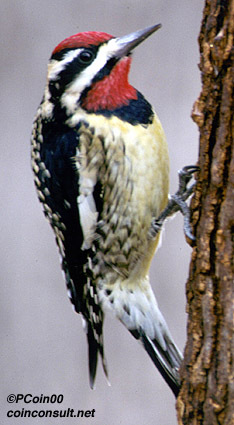
Where does the Yellow-bellied Sapsucker live?
Sphyrapicus varius
Spotted a bird? Identify it instantly with the Birdby app
Open the appThe Yellow-bellied Sapsucker lives in specific habitats and regions. Knowing where, and when, to look improves your chances of a successful sighting.
Biomes
Temperate forests, boreal forests, mixed woodlands.
Geographic range
Breeds across Canada and the northeastern United States, extending south through the Appalachian Mountains. Winters in the southeastern United States, Mexico, Central America, and the Caribbean.
Preferred environments
Deciduous or mixed deciduous-coniferous forests, particularly those with birch, maple, aspen, and pine trees. They prefer younger, regenerating forests or forest edges with a good mix of tree species for sap feeding and nesting.
Elevation range
From sea level up to 2,000 meters (6,500 feet) in breeding grounds, and similar ranges in wintering areas.
Where to look
Breeding Grounds (Summer)
Look in deciduous or mixed forests across Canada and the northeastern U.S., particularly areas with birch, maple, and aspen. Forest edges and clearings are also good spots.
Wintering Grounds (Winter)
Search in forests and woodlands in the southeastern U.S., Mexico, Central America, and the Caribbean. They can be found in a wider variety of wooded habitats during winter, including suburban areas with mature trees.
Migration Routes (Spring/Fall)
During migration, they can be found in almost any wooded habitat, including parks and suburban yards, as they move between breeding and wintering areas.
Field tips
- Look for Sap Wells. The most reliable way to find a Yellow-bellied Sapsucker is to locate trees with their characteristic rows of sap wells. Once found, wait patiently, as the bird will likely return to feed.
- Listen for Drumming. Learn its unique, irregular drumming pattern. This is often the first indication of its presence, especially during the breeding season.
- Scan Tree Trunks. Carefully scan the trunks and larger branches of trees, especially birch, maple, and aspen, for the bird itself or its feeding signs.
- Check for White Wing Patch. When you spot a woodpecker, immediately look for the prominent white wing patch. This is a definitive field mark for sapsuckers.
- Observe Behavior. Watch for birds actively drilling or feeding at sap wells, or gleaning insects from bark. Their feeding method is quite distinctive.
Migration
Long-distance migrant. Most populations migrate south for the winter, with northern breeders moving to the southeastern U.S., Mexico, and Central America. Some southern Appalachian populations may be resident or undertake short-distance altitudinal migrations.
Explore the Yellow-bellied Sapsucker
Identify birds anywhere
Free on iOS, Android, and Web. Photo & sound identification, full species database, and your personal life list.