
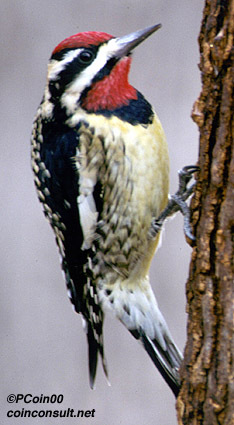
How to identify the Yellow-bellied Sapsucker
Sphyrapicus varius
Spotted a bird? Identify it instantly with the Birdby app
Open the appTo correctly identify the Yellow-bellied Sapsucker (Sphyrapicus varius), check each of these features. Birds can be tricky: habit, habitat, and call often confirm a sighting that a single photo cannot.
Size at a glance
- Length
- 19-21 cm (7.5-8.3 in)
- Wingspan
- 34-40 cm (13.4-15.7 in)
- Weight
- 43-60 g (1.5-2.1 oz)
Physical features to check
- 1
Plumage
Overall feather coloration and pattern.
Adults have a black and white barred back, white wing patch, and a black chest band. The belly is yellowish, though often subtle. Males have a red crown and a red throat, while females have a red crown and a white throat. Both sexes have a prominent white stripe behind the eye and a black malar stripe.
- 2
Beak shape
Shape and color of the bill: a key field mark.
Short, chisel-tipped, and straight, adapted for drilling sap wells.
- 3
Eye color
Iris color and any distinctive eye markings.
Dark brown.
- 4
Leg color
Leg and foot color.
Grayish-green to dark gray.
- 5
Distinguishing features
Standout features that separate this species.
The most distinctive features are the white wing patch (visible in flight and at rest), the red crown (both sexes), red throat (male), white throat (female), and the characteristic rows of sap wells drilled into tree bark.
- 6
Juvenile appearance
How young birds differ from adults.
Juveniles are duller and browner overall, with less distinct barring and a mottled brown head and breast. They lack the bright red crown and throat of adults, which develop during their first fall molt.
- 7
Seasonal changes
Plumage variation between breeding and non-breeding seasons.
No significant seasonal plumage changes beyond the post-juvenile molt. Breeding and non-breeding plumages are essentially the same for adults.
- 8
Sexual dimorphism
How males and females differ.
Males have a red throat, while females have a white throat. Otherwise, plumage is very similar.
Key field marks
- White Wing Patch. Look for a prominent vertical white stripe on the folded wing, visible even when the bird is perched. This is a key field mark for all sapsucker species.
- Facial Pattern. Note the black and white striped face, with a white stripe behind the eye and a black malar stripe. Males have a red throat, females a white throat, and both have a red crown.
- Belly Color. Observe the yellowish wash on the belly, though this can be subtle and difficult to see in poor light or at a distance.
- Feeding Behavior (Sap Wells). Look for characteristic rows of small, neatly drilled holes (sap wells) in tree bark. These are often found on birch, maple, and pine trees. The bird will frequently return to these wells.
- Drumming Pattern. Listen for its distinctive, irregular, 'stuttering' or 'Morse code' drumming, which is unique among North American woodpeckers.
- Calls. Learn its nasal, whining 'queeah' or 'whee-ooh' calls, and its sharp 'kweek' call.
Explore the Yellow-bellied Sapsucker
Identify birds anywhere
Free on iOS, Android, and Web. Photo & sound identification, full species database, and your personal life list.