
Spotted a bird? Identify it instantly with the Birdby app
Open the appAbout
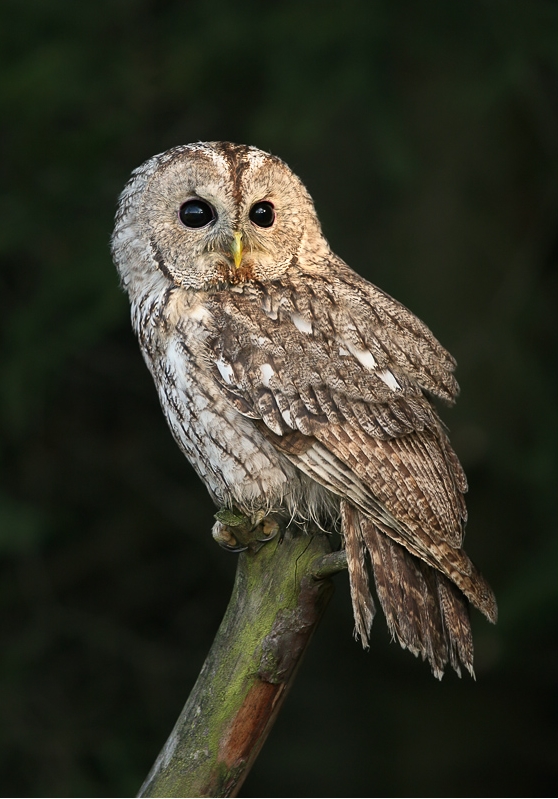
The Tawny Owl (Strix aluco) is a medium-sized, robust owl with a large, rounded head, no ear tufts, and large dark eyes. It is one of the most common and widespread owl species in Europe and is well-known for its distinctive hooting call. Primarily nocturnal, it is a highly effective predator of small mammals and birds.
Size & lifespan
- Length
- 37-43 cm
- Wingspan
- 81-96 cm
- Weight
- 380-800 g (females typically larger and heavier than males)
- Lifespan
- Up to 18 years in the wild, though typically 4-5 years
- Diet
- Carnivore, primarily feeding on small mammals (voles, mice, shrews, young rabbits) and small to medium-sized birds. Also takes insects, amphibians, and fish, especially in urban areas.
Physical characteristics
- Plumage
- Tawny Owls exhibit significant plumage variation, primarily falling into two main morphs: rufous (reddish-brown) and grey-brown. Both morphs have dark streaking on the underparts and a mottled pattern on the upperparts, providing excellent camouflage against tree bark. The facial disc is prominent, pale, and bordered by darker feathers, with a distinct dark V-shape between the eyes. The upperparts are barred and streaked, while the underparts are paler with dark streaks.
- Beak shape
- Short, strongly hooked, and dark yellowish to horn-colored.
- Eye color
- Large, dark brown to black eyes, giving a 'soft' or 'gentle' expression.
- Leg color
- Feathered legs and feet, typically pale greyish-brown.
- Distinguishing features
- Lack of ear tufts, large dark eyes, rounded head, and mottled plumage. The facial disc is less defined than in some other owl species. The two main color morphs (rufous and grey-brown) are important to note.
- Juvenile appearance
- Juveniles are similar to adults but have a softer, fluffier plumage with more uniform barring and less distinct streaking. They often appear more 'fluffy' and less compact than adults.
- Seasonal changes
- No significant seasonal changes in plumage. Plumage remains consistent year-round.
- Sexual dimorphism
- Females are generally larger and heavier than males, but plumage is identical. This size difference is not always obvious in the field.
How to identify
- 1
Size and Shape
Medium-sized, stocky owl with a large, rounded head and no ear tufts. Appears robust.
- 2
Eyes
Large, dark brown to black eyes, giving a 'gentle' expression. This contrasts with the yellow eyes of many other owl species.
- 3
Plumage Color
Look for either a rufous (reddish-brown) or grey-brown overall coloration, with dark streaking on the underparts and mottled upperparts. Excellent camouflage.
- 4
Facial Disc
Prominent, pale facial disc bordered by darker feathers, with a distinct dark V-shape between the eyes.
- 5
Calls
The male's classic 'hoo-hoo-hoooooo' hoot and the female's sharp 'kewick' call are highly distinctive and often the first indication of their presence.
- 6
Habitat
Found in woodlands, parks, and gardens with mature trees. Less likely to be seen in open country.
- 7
Activity
Strictly nocturnal. If seen during the day, it will likely be roosting silently, often close to a tree trunk or in dense cover.
Habitat & range
- Biomes
- Temperate forests, woodlands, parks, large gardens, and urban areas with mature trees.
- Geographic range
- Widespread across Europe, from the Iberian Peninsula to Western Siberia, and south to North Africa and parts of the Middle East and Central Asia. Absent from Ireland and some northern parts of Scandinavia.
- Elevation range
- Sea level up to approximately 2,000 meters, depending on local conditions and availability of suitable habitat.
- Preferred environments
- Deciduous and mixed woodlands, mature coniferous plantations, suburban parks, and large gardens with old trees for nesting and roosting. Requires dense canopy cover and open understory for hunting.
Behavior
- Activity time
- Strictly nocturnal, becoming active at dusk and hunting throughout the night. Roosts silently during the day, often close to the tree trunk or in dense foliage.
- Feeding habits
- Primarily a nocturnal ambush predator. It hunts from a perch, swooping down silently on unsuspecting prey. Excellent hearing and vision in low light are crucial for its hunting success. Prey is typically swallowed whole or torn into manageable pieces.
- Social behavior
- Monogamous and highly territorial, typically forming pair bonds for life. Pairs defend their territory year-round. Generally solitary outside the breeding season, though pairs remain in their territory.
- Flight pattern
- Silent, buoyant flight with deep, powerful wing beats. Often flies low through woodland, weaving between trees. Can be surprisingly agile in dense cover.
- Migration pattern
- Sedentary and non-migratory throughout its range. Young birds disperse from their natal territories in autumn to establish their own territories.
- Territoriality
- Highly territorial, with pairs defending their breeding and hunting grounds year-round. Territory size varies depending on habitat quality and prey availability, typically 10-50 hectares. Calls are often used to proclaim territory.
Song & calls
- Song
- The classic 'hoo-hoo-hoo-hooo' hooting call of the male, often described as 'too-wit, too-woo' (though this is a misinterpretation of the male's hoot and the female's 'kewick' call). The male's hoot is a long, drawn-out, wavering 'hoo-hoo-hoooooo'.
- Call
- The female's primary call is a sharp, short, and often repeated 'kewick' or 'ke-wick'. When agitated or in contact with its mate, it may emit a 'kewick-kewick-kewick' call. Young birds have a persistent, high-pitched 'squeak' or 'chitter' call when begging for food.
- When they vocalize
- Most vocal during the breeding season (late winter to early spring) and in autumn when young birds are dispersing and establishing territories. Calls are primarily heard at dusk, throughout the night, and at dawn.
Breeding & reproduction
- Breeding season
- Late winter to early spring (February to April), though can vary with latitude and food availability.
- Nesting habits
- Does not build a nest. Typically nests in tree hollows, old crow or raptor nests, disused buildings, or large nest boxes. Prefers sites with good cover and proximity to hunting grounds.
- Clutch size
- 2-5 eggs
- Egg description
- 2-5 (typically 3-4) pure white, smooth, and slightly glossy eggs. Roughly spherical in shape.
- Incubation period
- 28-30 days, primarily by the female.
- Fledging period
- 30-35 days. Young leave the nest before they can fly properly, often 'branching' out onto nearby limbs, and are fed by parents for several weeks thereafter.
- Parental care
- Both parents care for the young. The female incubates and broods, while the male provides food. Once young fledge, both parents continue to feed them for several weeks until they become independent.
Where to find
Mature Woodlands
Deciduous and mixed woodlands with old, hollow trees are prime habitats.
Urban Parks and Gardens
Large parks and gardens with mature trees, especially those with some undisturbed areas, can host Tawny Owls.
Cemeteries
Old cemeteries with large, established trees often provide suitable nesting and roosting sites.
Rural Areas with Tree Cover
Farmsteads with copses, hedgerows, and scattered mature trees can also support populations.
Field tips
- Listen at Dusk and Dawn. The best way to detect Tawny Owls is by listening for their calls, particularly the male's hoot, during the twilight hours or throughout the night.
- Look for Pellets. Check the base of large trees or potential roosting sites for owl pellets (regurgitated indigestible prey remains). These indicate owl presence.
- Scan Tree Trunks. During the day, Tawny Owls often roost pressed against tree trunks or in dense ivy, using their camouflage. Look for their distinctive shape and dark eyes.
- Use a Red-Light Torch. If searching at night, a red-light torch can help you see without disturbing the owl's natural behavior or vision.
- Be Patient and Quiet. Tawny Owls are shy and well-camouflaged. Patience and minimal disturbance are key to observing them.
Similar species
Long-eared Owl
Asio otus
Long-eared Owls have prominent ear tufts (though not always visible), orange eyes, and a more slender build. Their facial disc is more elongated, and their plumage is more finely mottled with vertical streaking. They are also typically smaller.
Short-eared Owl
Asio flammeus
Short-eared Owls have very short ear tufts (often not visible), yellow eyes, and a more open country habitat preference. They are often active during the day (crepuscular) and have a distinctive buoyant, moth-like flight. Their plumage is paler and more streaked.
Little Owl
Athene noctua
Little Owls are much smaller, have bright yellow eyes, a flattened head, and a more upright posture. They are often seen perching conspicuously during the day and have a distinctive undulating flight. Their plumage is more spotted than streaked.
Quick facts
- Primary Diet:
- Small mammals and birds
- Activity:
- Nocturnal
- Key Identification Feature:
- Dark eyes, no ear tufts, distinctive hoot
- Habitat Preference:
- Woodlands, parks, gardens with mature trees
- Migration Status:
- Resident (non-migratory)
Fun facts
- The 'too-wit, too-woo' call often attributed to the Tawny Owl is actually a duet between the male's hoot ('hoo-hoo-hooo') and the female's sharp 'kewick'.
- Tawny Owls have asymmetrical ear openings, which helps them pinpoint the exact location of prey in complete darkness.
- They are highly territorial and will fiercely defend their nesting and roosting sites, even against much larger predators or humans.
- Despite their commonality, they are rarely seen due to their nocturnal habits and excellent camouflage.
- In some urban areas, Tawny Owls have adapted to hunt pigeons and other urban birds, showcasing their adaptability.
Scientific classification
- Kingdom
- Animalia
- Phylum
- Chordata
- Class
- Aves
- Order
- Strigiformes
- Family
- Strigidae
- Genus
- Strix
- Species
- Strix aluco
Explore the Tawny Owl
Identify birds anywhere
Free on iOS, Android, and Web. Photo & sound identification, full species database, and your personal life list.