
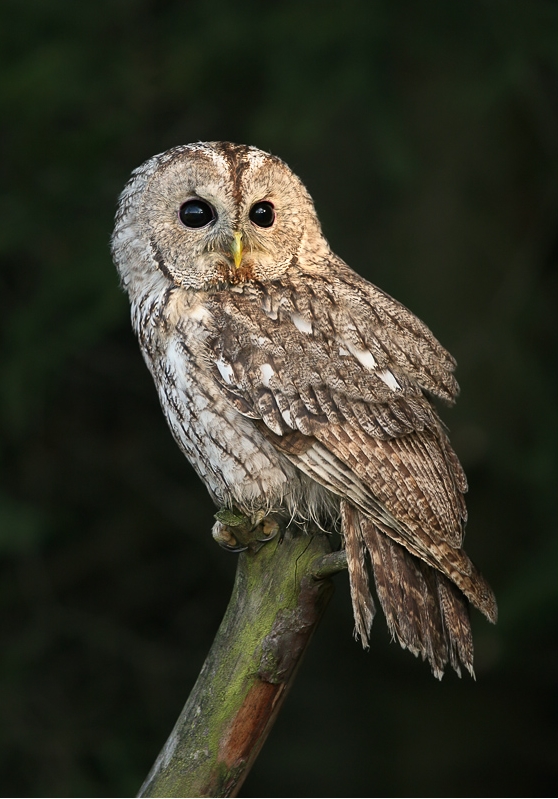
How to identify the Tawny Owl
Strix aluco
Spotted a bird? Identify it instantly with the Birdby app
Open the appTo correctly identify the Tawny Owl (Strix aluco), check each of these features. Birds can be tricky: habit, habitat, and call often confirm a sighting that a single photo cannot.
Size at a glance
- Length
- 37-43 cm
- Wingspan
- 81-96 cm
- Weight
- 380-800 g (females typically larger and heavier than males)
Physical features to check
- 1
Plumage
Overall feather coloration and pattern.
Tawny Owls exhibit significant plumage variation, primarily falling into two main morphs: rufous (reddish-brown) and grey-brown. Both morphs have dark streaking on the underparts and a mottled pattern on the upperparts, providing excellent camouflage against tree bark. The facial disc is prominent, pale, and bordered by darker feathers, with a distinct dark V-shape between the eyes. The upperparts are barred and streaked, while the underparts are paler with dark streaks.
- 2
Beak shape
Shape and color of the bill: a key field mark.
Short, strongly hooked, and dark yellowish to horn-colored.
- 3
Eye color
Iris color and any distinctive eye markings.
Large, dark brown to black eyes, giving a 'soft' or 'gentle' expression.
- 4
Leg color
Leg and foot color.
Feathered legs and feet, typically pale greyish-brown.
- 5
Distinguishing features
Standout features that separate this species.
Lack of ear tufts, large dark eyes, rounded head, and mottled plumage. The facial disc is less defined than in some other owl species. The two main color morphs (rufous and grey-brown) are important to note.
- 6
Juvenile appearance
How young birds differ from adults.
Juveniles are similar to adults but have a softer, fluffier plumage with more uniform barring and less distinct streaking. They often appear more 'fluffy' and less compact than adults.
- 7
Seasonal changes
Plumage variation between breeding and non-breeding seasons.
No significant seasonal changes in plumage. Plumage remains consistent year-round.
- 8
Sexual dimorphism
How males and females differ.
Females are generally larger and heavier than males, but plumage is identical. This size difference is not always obvious in the field.
Key field marks
- Size and Shape. Medium-sized, stocky owl with a large, rounded head and no ear tufts. Appears robust.
- Eyes. Large, dark brown to black eyes, giving a 'gentle' expression. This contrasts with the yellow eyes of many other owl species.
- Plumage Color. Look for either a rufous (reddish-brown) or grey-brown overall coloration, with dark streaking on the underparts and mottled upperparts. Excellent camouflage.
- Facial Disc. Prominent, pale facial disc bordered by darker feathers, with a distinct dark V-shape between the eyes.
- Calls. The male's classic 'hoo-hoo-hoooooo' hoot and the female's sharp 'kewick' call are highly distinctive and often the first indication of their presence.
- Habitat. Found in woodlands, parks, and gardens with mature trees. Less likely to be seen in open country.
- Activity. Strictly nocturnal. If seen during the day, it will likely be roosting silently, often close to a tree trunk or in dense cover.
Explore the Tawny Owl
Identify birds anywhere
Free on iOS, Android, and Web. Photo & sound identification, full species database, and your personal life list.