
Visto un uccello? Identificalo all'istante con l'app Birdby
Apri l'appInformazioni
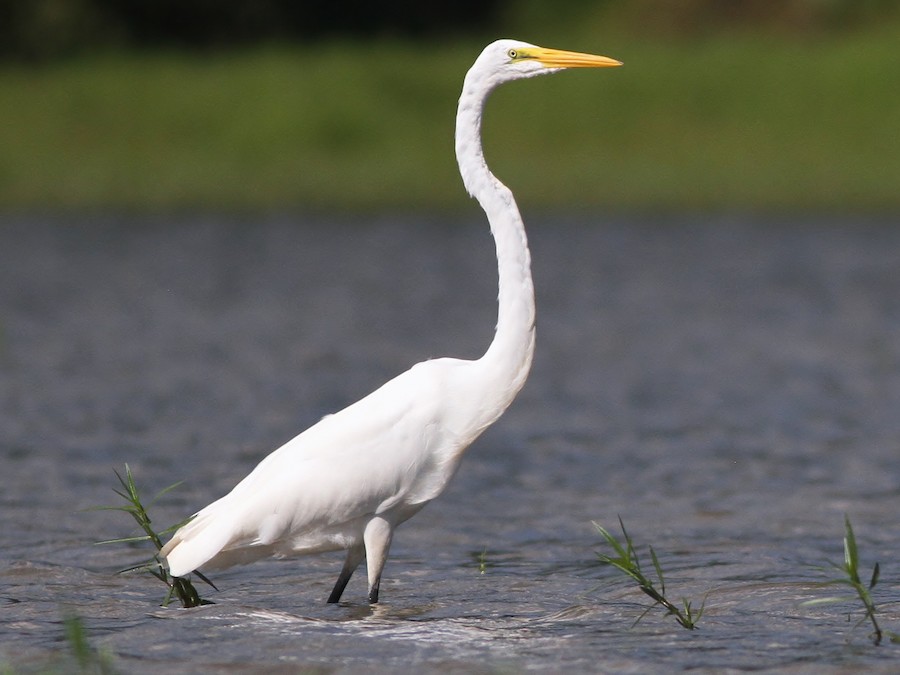
The Great Egret, also known as the Common Egret or Great White Heron, is a large, widely distributed heron with entirely white plumage. It is a graceful and elegant bird, often seen wading in shallow waters, patiently stalking its prey. Its striking appearance, especially during breeding season with its long, delicate plumes, makes it a highly recognizable species.
Dimensioni e longevità
- Lunghezza
- 80-104 cm (31-41 in)
- Apertura alare
- 131-170 cm (52-67 in)
- Peso
- 700-1500 g (1.5-3.3 lbs)
- Longevità
- Up to 22 years in the wild, typically 15 years
- Dieta
- Carnivore (primarily piscivorous)
Caratteristiche fisiche
- Piumaggio
- Entirely pure white plumage throughout the year. During the breeding season, adults develop long, delicate, lacy scapular plumes (aigrettes) that extend beyond the tail.
- Forma del becco
- Long, dagger-like, and pointed. Non-breeding adults have a yellow-orange bill, which turns black or dark grey with a yellow base during the breeding season. Juveniles have a yellow bill.
- Colore degli occhi
- Yellow iris, surrounded by a patch of greenish-yellow skin (lores) that turns bright green during the breeding season.
- Colore delle zampe
- Long, slender legs and feet are typically black. During breeding, the upper legs (tibia) may show a reddish or yellowish tinge.
- Caratteristiche distintive
- Large size, all-white plumage, long S-curved neck, and a distinctive slow, deliberate gait when wading. The combination of a yellow bill (non-breeding) or black bill (breeding) and black legs is key.
- Aspetto giovanile
- Similar to non-breeding adults, with all-white plumage, yellow bill, and black legs. They lack the elaborate breeding plumes.
- Cambiamenti stagionali
- Non-breeding adults have a yellow-orange bill and greenish-yellow lores. During the breeding season, the bill darkens to black (or dark grey with a yellow base), the lores turn bright emerald green, and long, delicate scapular plumes (aigrettes) develop on the back, extending beyond the tail.
- Dimorfismo sessuale
- Males and females are outwardly similar in plumage and size, though males may be slightly larger on average. Breeding plumes are present in both sexes.
Come identificare
- 1
Size and Shape
Look for a very large, slender, all-white heron with a long, S-curved neck and long legs. It stands taller than most other white egrets.
- 2
Bill Color
In non-breeding plumage, the bill is yellow-orange. In breeding plumage, the bill turns black or dark grey with a yellow base. This is a key differentiator from Little Egrets (black bill, yellow feet) and Snowy Egrets (black bill, yellow feet).
- 3
Leg and Foot Color
Legs and feet are entirely black in all plumages. This distinguishes it from Little Egrets and Snowy Egrets, which have yellow feet.
- 4
Lores Color
The skin between the eye and the bill (lores) is greenish-yellow in non-breeding birds, turning bright emerald green during the breeding season. This green patch is very distinctive in breeding birds.
- 5
Breeding Plumes
During breeding season, look for long, delicate, lacy plumes (aigrettes) on its back that extend beyond the tail. These are absent in non-breeding birds and juveniles.
- 6
Flight Profile
Observe its flight: slow, powerful wingbeats with the neck retracted into an S-shape and legs trailing straight behind.
Habitat e areale
- Biomi
- Wetlands, marshes, swamps, estuaries, lakes, rivers, ponds, coastal lagoons, flooded fields, and rice paddies.
- Areale geografico
- Nearly cosmopolitan, found across most of the tropical and warm temperate regions of the world. Present in North and South America, Europe, Africa, Asia, and Australia. In Europe, it is widespread, particularly in southern and eastern regions, expanding its range northward.
- Fascia altitudinale
- Primarily found in lowlands, from sea level up to approximately 2,000 meters (6,500 feet), though typically below 1,000 meters.
- Ambienti preferiti
- Shallow freshwater or brackish wetlands with abundant fish and amphibian populations, often with emergent vegetation for nesting and roosting. Requires undisturbed areas for breeding colonies.
Comportamento
- Periodo di attività
- Diurnal, primarily active during daylight hours, especially at dawn and dusk for foraging.
- Abitudini alimentari
- A patient and stealthy hunter. It typically wades slowly in shallow water, often standing motionless, waiting for prey to come within striking distance. It then uses its long neck and dagger-like bill to spear or snatch fish, amphibians, insects, and small reptiles or mammals. Occasionally, it will run or shuffle its feet to stir up prey.
- Comportamento sociale
- Generally solitary when foraging, but highly colonial during the breeding season, nesting in large mixed-species heronries. Roosts communally in trees or dense vegetation.
- Tipo di volo
- Flies with slow, powerful wingbeats, with its neck retracted into an S-shape and its long legs trailing straight behind. Appears graceful and deliberate in flight.
- Migrazione
- Varies geographically. Northern populations are migratory, moving south for the winter. Southern populations are resident or undertake short-distance dispersal. European populations are partially migratory, with many birds moving to southern Europe and Africa, while some remain in milder coastal areas.
- Territorialità
- Defends a small foraging territory around itself when feeding, but is colonial during nesting, with pairs defending only their immediate nest site within the heronry.
Canto e richiami
- Canto
- Not known for a complex song. Vocalizations are generally limited to harsh calls.
- Richiamo
- Typically silent away from the breeding colony. At the nest, it produces a variety of harsh, guttural croaks, squawks, and grunts, often described as 'kraak' or 'karrr'. Alarm calls are louder and more abrupt.
- Quando vocalizza
- Most vocal during the breeding season, especially within the colony, and when disturbed or interacting with conspecifics.
Riproduzione
- Stagione riproduttiva
- Varies geographically, typically spring and early summer. In temperate regions, from March to July; in tropical regions, often coinciding with rainy seasons.
- Abitudini di nidificazione
- Nests colonially, often in large mixed-species heronries, usually in trees or tall shrubs over water or in dense reedbeds. Nests are bulky platforms made of sticks, reeds, and other vegetation, lined with finer material. Both parents contribute to nest building.
- Dimensione della covata
- Usually 3-5 eggs, occasionally 1-6.
- Descrizione dell'uovo
- Typically 3-5 eggs, pale blue-green, oval-shaped, and unspotted. Dimensions average about 56 x 40 mm.
- Periodo di incubazione
- 23-26 days, incubated by both parents.
- Periodo di involo
- Young fledge (leave the nest) at about 42-49 days old, but remain dependent on parents for several weeks thereafter.
- Cure parentali
- Both parents share incubation duties and care for the young, feeding them regurgitated food. Chicks are altricial (helpless at birth).
Dove trovarlo
Freshwater Wetlands
Lakes, rivers, ponds, and marshes with shallow water and emergent vegetation are prime locations.
Coastal Areas
Estuaries, tidal flats, salt marshes, and coastal lagoons are also frequently used habitats.
Agricultural Lands
Flooded fields, especially rice paddies, can attract Great Egrets for foraging.
Protected Areas
National parks, wildlife refuges, and nature reserves with suitable wetland habitats are excellent places to find them, particularly during breeding season in heronries.
Consigli sul campo
- Look for still hunters. Great Egrets often stand motionless for long periods, patiently waiting for prey. Scan the edges of water bodies carefully.
- Observe at dawn and dusk. These are often peak foraging times. They may also be seen flying to and from communal roosts.
- Visit breeding colonies. During the breeding season, locate known heronries (often shared with other heron species) for spectacular views of multiple birds with their breeding plumes.
- Use optics. Binoculars or a spotting scope are essential for observing details like bill and lores color, especially to distinguish from similar species.
- Check for movement. While often still, they also wade slowly. Look for subtle movements in shallow water.
Specie simili
Little Egret
Egretta garzetta
Significantly smaller (55-65 cm length). Has a black bill and yellow feet ('yellow slippers') in all plumages, whereas the Great Egret has black legs and a yellow or black bill depending on season. The Great Egret also lacks the two long head plumes of the breeding Little Egret.
Cattle Egret
Bubulcus ibis
Much smaller (48-56 cm length) and stockier. Non-breeding adults are all white with a yellow bill and yellowish-grey legs. Breeding adults develop buffy-orange plumes on the head, neck, and back. Often found in drier habitats, associating with livestock, unlike the Great Egret's preference for open water.
Snowy Egret
Egretta thula
Found only in the Americas. Smaller than the Great Egret (56-66 cm length). Has a black bill and bright yellow feet (like the Little Egret), but with black legs. The Great Egret has black legs and a yellow or black bill, never a black bill with yellow feet.
Fatti rapidi
- Global Distribution:
- Nearly cosmopolitan
- Primary Diet:
- Fish
- Nesting Type:
- Colonial tree/shrub nester
- Breeding Plumage Feature:
- Long, delicate scapular plumes (aigrettes)
- Bill Color (Breeding):
- Black
- Bill Color (Non-breeding):
- Yellow-orange
- Leg Color:
- Black
Curiosità
- The Great Egret was nearly hunted to extinction in the late 19th and early 20th centuries for its beautiful breeding plumes, which were highly prized for women's hats. Its recovery is a conservation success story and led to the formation of early conservation organizations like the National Audubon Society.
- It is the symbol of the National Audubon Society, a prominent American non-profit environmental organization dedicated to bird conservation.
- Despite its large size, the Great Egret is incredibly agile when striking prey, capable of extending its neck and bill with remarkable speed and precision.
- The scientific name 'Ardea alba' literally means 'white heron', a straightforward description of its most prominent feature.
- There are four recognized subspecies of Ardea alba, though they are often treated as a single species due to their similar appearance and behavior across their vast range.
Classificazione scientifica
- Regno
- Animalia
- Phylum
- Chordata
- Classe
- Aves
- Ordine
- Pelecaniformes
- Famiglia
- Ardeidae
- Genere
- Ardea
- Specie
- Ardea alba
Esplora Great Egret
Identifica uccelli ovunque
Gratis su iOS, Android e Web. Identificazione per foto e suono, database completo e la tua lista personale.