
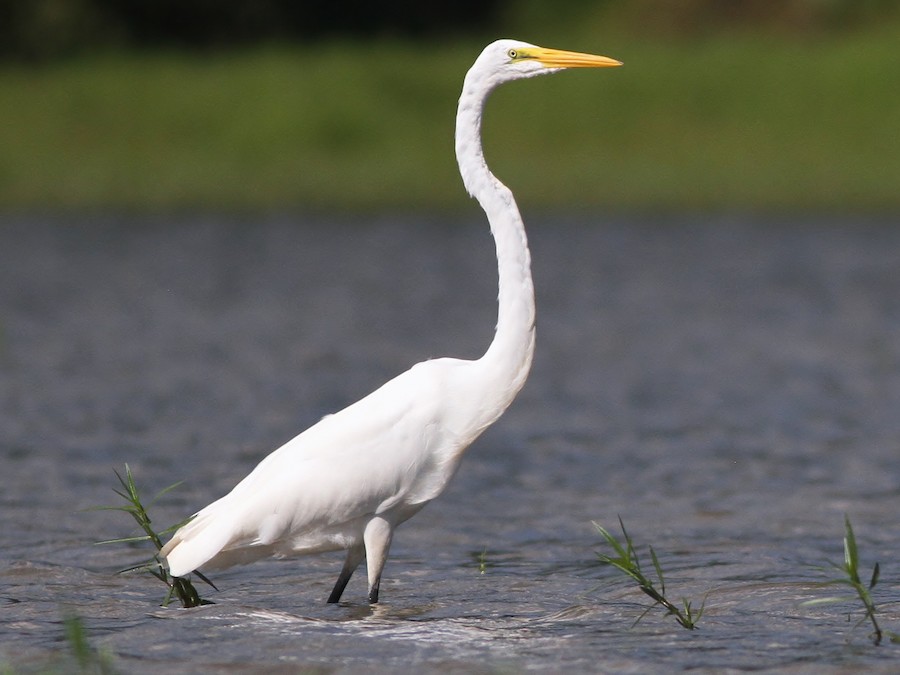
Come identificare Great Egret
Ardea alba
Visto un uccello? Identificalo all'istante con l'app Birdby
Apri l'appPer identificare correttamente Great Egret (Ardea alba), controlla ciascuna di queste caratteristiche. Gli uccelli possono essere complicati da riconoscere, perché comportamento, habitat e canto spesso confermano ciò che una sola foto non può.
Dimensioni a colpo d'occhio
- Lunghezza
- 80-104 cm (31-41 in)
- Apertura alare
- 131-170 cm (52-67 in)
- Peso
- 700-1500 g (1.5-3.3 lbs)
Caratteristiche fisiche da controllare
- 1
Piumaggio
Colorazione e disegno generale del piumaggio.
Entirely pure white plumage throughout the year. During the breeding season, adults develop long, delicate, lacy scapular plumes (aigrettes) that extend beyond the tail.
- 2
Forma del becco
Forma e colore del becco, un segno di campo chiave.
Long, dagger-like, and pointed. Non-breeding adults have a yellow-orange bill, which turns black or dark grey with a yellow base during the breeding season. Juveniles have a yellow bill.
- 3
Colore degli occhi
Colore dell'iride e segni distintivi sugli occhi.
Yellow iris, surrounded by a patch of greenish-yellow skin (lores) that turns bright green during the breeding season.
- 4
Colore delle zampe
Colore di zampe e piedi.
Long, slender legs and feet are typically black. During breeding, the upper legs (tibia) may show a reddish or yellowish tinge.
- 5
Caratteristiche distintive
Tratti distintivi che separano questa specie.
Large size, all-white plumage, long S-curved neck, and a distinctive slow, deliberate gait when wading. The combination of a yellow bill (non-breeding) or black bill (breeding) and black legs is key.
- 6
Aspetto giovanile
Come i giovani si differenziano dagli adulti.
Similar to non-breeding adults, with all-white plumage, yellow bill, and black legs. They lack the elaborate breeding plumes.
- 7
Cambiamenti stagionali
Variazione del piumaggio tra stagione riproduttiva e non.
Non-breeding adults have a yellow-orange bill and greenish-yellow lores. During the breeding season, the bill darkens to black (or dark grey with a yellow base), the lores turn bright emerald green, and long, delicate scapular plumes (aigrettes) develop on the back, extending beyond the tail.
- 8
Dimorfismo sessuale
Differenze tra maschi e femmine.
Males and females are outwardly similar in plumage and size, though males may be slightly larger on average. Breeding plumes are present in both sexes.
Segni di campo chiave
- Size and Shape. Look for a very large, slender, all-white heron with a long, S-curved neck and long legs. It stands taller than most other white egrets.
- Bill Color. In non-breeding plumage, the bill is yellow-orange. In breeding plumage, the bill turns black or dark grey with a yellow base. This is a key differentiator from Little Egrets (black bill, yellow feet) and Snowy Egrets (black bill, yellow feet).
- Leg and Foot Color. Legs and feet are entirely black in all plumages. This distinguishes it from Little Egrets and Snowy Egrets, which have yellow feet.
- Lores Color. The skin between the eye and the bill (lores) is greenish-yellow in non-breeding birds, turning bright emerald green during the breeding season. This green patch is very distinctive in breeding birds.
- Breeding Plumes. During breeding season, look for long, delicate, lacy plumes (aigrettes) on its back that extend beyond the tail. These are absent in non-breeding birds and juveniles.
- Flight Profile. Observe its flight: slow, powerful wingbeats with the neck retracted into an S-shape and legs trailing straight behind.
Esplora Great Egret
Identifica uccelli ovunque
Gratis su iOS, Android e Web. Identificazione per foto e suono, database completo e la tua lista personale.