
Visto un uccello? Identificalo all'istante con l'app Birdby
Apri l'appInformazioni
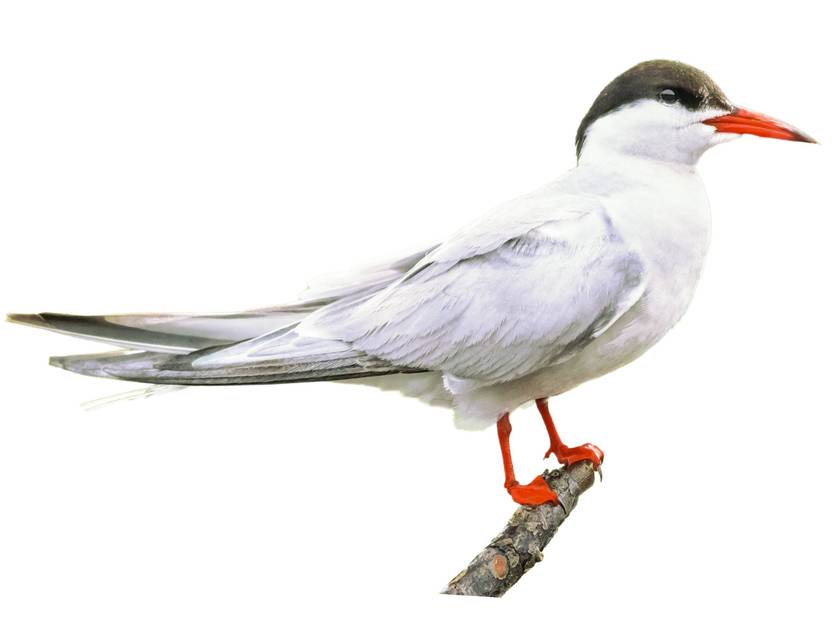
The Common Tern (Sterna hirundo) is a medium-sized seabird, widely distributed across the Northern Hemisphere. It is known for its graceful, buoyant flight and characteristic plunge-diving feeding technique. Often found in coastal and freshwater environments, it is a migratory species, undertaking long-distance journeys between breeding and wintering grounds.
Dimensioni e longevità
- Lunghezza
- 31-35 cm (including tail streamers)
- Apertura alare
- 72-82 cm
- Peso
- 90-170 g
- Longevità
- Up to 23 years in the wild, typically 10-15 years
- Dieta
- Carnivore (primarily piscivorous)
Caratteristiche fisiche
- Piumaggio
- Adult breeding plumage features a black cap, white underparts, and pale grey upperparts. The primary flight feathers have dark tips, forming a dark trailing edge to the wing. Non-breeding adults have a reduced black cap, often streaked with white, and a dark carpal bar on the underwing. Juveniles are mottled brown and grey on the back, with a dark carpal bar and a less defined black cap.
- Forma del becco
- Slender, pointed bill. In breeding adults, it is bright red with a black tip. In non-breeding adults and juveniles, it is typically black or dark red with a black tip.
- Colore degli occhi
- Dark brown
- Colore delle zampe
- Bright red in breeding adults, duller red or blackish in non-breeding adults and juveniles.
- Caratteristiche distintive
- Long, deeply forked tail streamers (especially in breeding plumage), slender body, buoyant flight, and characteristic plunge-diving. The red bill with a black tip in breeding adults is a key feature.
- Aspetto giovanile
- Juveniles have a scaly, mottled brown and grey back, a dark carpal bar on the upperwing, and a less extensive black cap that is often streaked with white. Their bill is dark, and legs are duller.
- Cambiamenti stagionali
- Breeding adults develop a full black cap, bright red bill with a black tip, and bright red legs. Non-breeding adults lose the full black cap, which becomes streaked with white, the bill darkens (often entirely black or dark red with a black tip), and legs become duller red or blackish. The dark carpal bar on the underwing becomes more prominent in non-breeding plumage.
- Dimorfismo sessuale
- Males and females are generally monomorphic in plumage, though males may be slightly larger on average. No obvious visual differences in the field.
Come identificare
- 1
Size and Shape
Medium-sized tern, slender body, long pointed wings, and a deeply forked tail with long streamers, especially in breeding plumage.
- 2
Plumage (Breeding Adult)
Look for the solid black cap, white underparts, pale grey back, and the bright red bill with a distinct black tip. The dark trailing edge on the primaries is also a good indicator.
- 3
Plumage (Non-breeding Adult/Juvenile)
Note the streaky black and white cap, darker bill (often all black or dark red with black tip), and duller legs. Juveniles have a mottled brown back and a prominent dark carpal bar on the upperwing.
- 4
Bill and Leg Color
The red bill with a black tip and red legs in breeding adults are key. Arctic Terns have an all-red bill, and Roseate Terns have a mostly black bill.
- 5
Flight Style
Observe its graceful, buoyant flight, often hovering before plunge-diving for fish. This behavior is characteristic of many terns but helps distinguish them from gulls.
- 6
Vocalizations
Listen for the sharp, screaming 'kee-arr' or 'kier-ick' call, which is a reliable identification cue, especially in colonies.
Habitat e areale
- Biomi
- Coastal areas, estuaries, large freshwater lakes, rivers, and wetlands.
- Areale geografico
- Breeds across temperate and subarctic regions of North America, Europe, and Asia. Winters in tropical and subtropical coastal regions of the Southern Hemisphere, including South America, Africa, and Australia.
- Fascia altitudinale
- Primarily found at sea level, but can be found inland along large freshwater bodies.
- Ambienti preferiti
- Prefers open water with nearby sandy beaches, shingle banks, rocky islets, or artificial structures (e.g., jetties, dikes) for nesting. Requires clear water for foraging.
Comportamento
- Periodo di attività
- Diurnal, actively foraging during daylight hours.
- Abitudini alimentari
- Primarily piscivorous, feeding on small fish (e.g., sand eels, herring, sprats, gobies). They hunt by hovering over the water and then plunge-diving headfirst to catch prey just below the surface. They also consume crustaceans and insects, especially in freshwater habitats.
- Comportamento sociale
- Highly colonial breeders, forming dense colonies that can number in the thousands. Gregarious outside the breeding season, often forming large roosts. They are vocal and territorial within their breeding colonies.
- Tipo di volo
- Graceful, buoyant, and agile flight with deep, elastic wingbeats. Often hovers before plunge-diving. When migrating, they fly in loose flocks with steady, direct flight.
- Migrazione
- Long-distance migratory species. Northern Hemisphere breeders migrate south to wintering grounds in the Southern Hemisphere, often covering thousands of kilometers. Migration occurs in large flocks, typically along coastlines.
- Territorialità
- Highly territorial within breeding colonies, defending a small area around their nest from conspecifics and predators. They will aggressively mob intruders.
Canto e richiami
- Canto
- The Common Tern does not have a complex song. Its vocalizations are primarily calls.
- Richiamo
- A distinctive, sharp, and often repeated 'kee-arr' or 'kier-ick' call, often described as a 'screaming' sound. Also a shorter, sharper 'kit-kit-kit' alarm call when disturbed or mobbing predators. During courtship, a softer 'kew-kew-kew' may be heard.
- Quando vocalizza
- Most vocal during the breeding season, especially within colonies, and when foraging or migrating.
Riproduzione
- Stagione riproduttiva
- Typically May to July in the Northern Hemisphere.
- Abitudini di nidificazione
- Nests in dense colonies on open ground, often on sandy beaches, shingle banks, rocky islets, or artificial islands. The nest is a shallow scrape in the ground, sometimes lined with sparse vegetation, shells, or pebbles.
- Dimensione della covata
- 2-3 eggs
- Descrizione dell'uovo
- Typically 2-3 eggs (range 1-4), oval to pyriform in shape. Color varies from pale buff to olive-brown, heavily spotted and blotched with dark brown, black, or purplish-grey markings, often concentrated at the broader end.
- Periodo di incubazione
- 21-26 days, incubated by both parents.
- Periodo di involo
- 22-28 days. Young are semi-precocial, leaving the nest scrape within a few days but remaining in the vicinity and dependent on parents for food for several weeks after fledging.
- Cure parentali
- Both parents share incubation duties and care for the chicks, bringing them fish. Parental care continues for several weeks after fledging, with young often following adults to learn foraging techniques.
Dove trovarlo
Coastal Beaches and Shingle Banks
Look for them nesting or roosting on undisturbed stretches of sandy or pebbly coastlines, especially on islands or spits.
Estuaries and Lagoons
Common in brackish water environments where small fish are abundant, often seen foraging or resting on mudflats at low tide.
Large Freshwater Lakes and Rivers
Inland populations can be found on large bodies of freshwater, particularly those with suitable nesting islands or shorelines.
Artificial Structures
They may utilize jetties, breakwaters, or artificial nesting platforms in harbors and coastal areas.
Consigli sul campo
- Scan for hovering birds. Look for birds hovering gracefully over the water, often pausing before executing a swift plunge-dive. This is a classic foraging behavior.
- Listen for calls. Their distinctive 'kee-arr' call is often heard before the bird is seen, especially near breeding colonies or foraging areas.
- Observe bill color carefully. Pay close attention to the bill color and pattern, particularly the presence or absence of a black tip on a red bill, which is crucial for distinguishing from Arctic Tern.
- Check tail streamers. In breeding plumage, the long, deeply forked tail streamers are a good feature, though Arctic Terns also have long streamers.
- Visit breeding colonies. During the breeding season, visiting known tern colonies (from a respectful distance) offers excellent viewing opportunities.
Specie simili
Arctic Tern
Sterna paradisaea
The Arctic Tern has a shorter neck, longer tail streamers, and a completely red bill (lacking the black tip of the Common Tern in breeding plumage). Its flight is often described as more buoyant and 'lighter'. The trailing edge of the primary flight feathers is less distinctly dark than in the Common Tern. Calls are also distinct: Arctic Tern's 'kee-yah' is often harsher and more drawn out.
Roseate Tern
Sterna dougallii
The Roseate Tern is paler overall, with a longer, thinner black bill (often with a red base in breeding plumage, but never a full red bill with black tip like Common Tern). It has very long tail streamers, extending well beyond the wingtips at rest. The underparts can show a faint pinkish flush in breeding plumage. Its call is a distinctive 'chiv-ik'.
Forster's Tern
Sterna forsteri
Primarily a North American species. In breeding plumage, Forster's Tern has a more extensive black cap that extends further down the nape, and its bill is orange with a black tip. The most reliable field mark is the white primary flight feathers on the upperwing, which contrast with the grey mantle, giving a 'white wedge' appearance, unlike the Common Tern's darker primaries. Its call is a nasal 'zraaa'.
Fatti rapidi
- Diet:
- Small fish, crustaceans, insects
- Habitat:
- Coasts, estuaries, large freshwater bodies
- Migration:
- Long-distance migrant
- Nesting:
- Colonial ground nesters
- Conservation Status:
- Least Concern
Curiosità
- The Common Tern is one of the most widespread tern species globally, breeding across three continents.
- They are known for their impressive migratory journeys, with some individuals traveling over 10,000 km between breeding and wintering grounds.
- Common Terns are highly aggressive in defending their nests, often mobbing much larger predators, including humans, with dive-bombing attacks and loud calls.
- Their scientific name 'hirundo' means 'swallow' in Latin, referring to their graceful, swallow-like flight.
- They can live for over two decades, with the oldest recorded individual living for 33 years.
Classificazione scientifica
- Regno
- Animalia
- Phylum
- Chordata
- Classe
- Aves
- Ordine
- Charadriiformes
- Famiglia
- Laridae
- Genere
- Sterna
- Specie
- Sterna hirundo
Esplora Common Tern
Identifica uccelli ovunque
Gratis su iOS, Android e Web. Identificazione per foto e suono, database completo e la tua lista personale.