
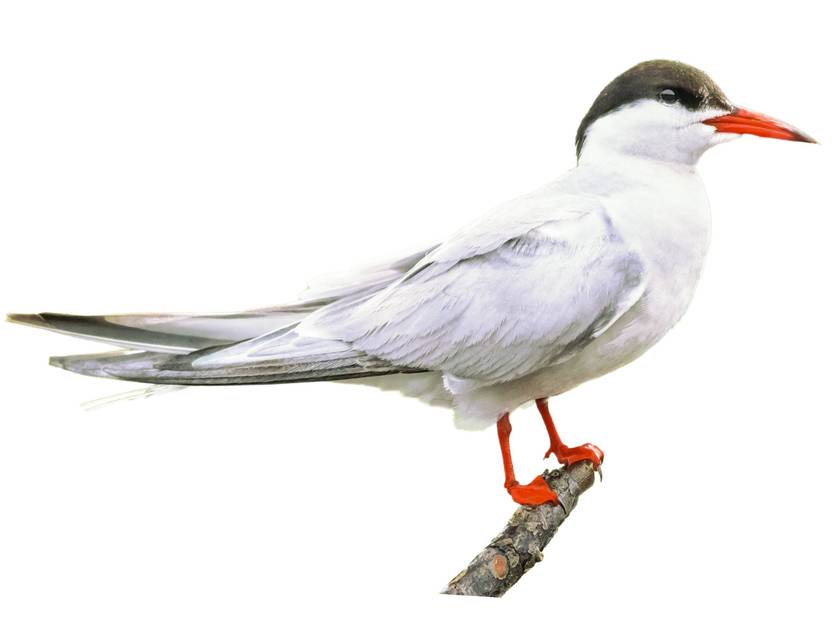
Come identificare Common Tern
Sterna hirundo
Visto un uccello? Identificalo all'istante con l'app Birdby
Apri l'appPer identificare correttamente Common Tern (Sterna hirundo), controlla ciascuna di queste caratteristiche. Gli uccelli possono essere complicati da riconoscere, perché comportamento, habitat e canto spesso confermano ciò che una sola foto non può.
Dimensioni a colpo d'occhio
- Lunghezza
- 31-35 cm (including tail streamers)
- Apertura alare
- 72-82 cm
- Peso
- 90-170 g
Caratteristiche fisiche da controllare
- 1
Piumaggio
Colorazione e disegno generale del piumaggio.
Adult breeding plumage features a black cap, white underparts, and pale grey upperparts. The primary flight feathers have dark tips, forming a dark trailing edge to the wing. Non-breeding adults have a reduced black cap, often streaked with white, and a dark carpal bar on the underwing. Juveniles are mottled brown and grey on the back, with a dark carpal bar and a less defined black cap.
- 2
Forma del becco
Forma e colore del becco, un segno di campo chiave.
Slender, pointed bill. In breeding adults, it is bright red with a black tip. In non-breeding adults and juveniles, it is typically black or dark red with a black tip.
- 3
Colore degli occhi
Colore dell'iride e segni distintivi sugli occhi.
Dark brown
- 4
Colore delle zampe
Colore di zampe e piedi.
Bright red in breeding adults, duller red or blackish in non-breeding adults and juveniles.
- 5
Caratteristiche distintive
Tratti distintivi che separano questa specie.
Long, deeply forked tail streamers (especially in breeding plumage), slender body, buoyant flight, and characteristic plunge-diving. The red bill with a black tip in breeding adults is a key feature.
- 6
Aspetto giovanile
Come i giovani si differenziano dagli adulti.
Juveniles have a scaly, mottled brown and grey back, a dark carpal bar on the upperwing, and a less extensive black cap that is often streaked with white. Their bill is dark, and legs are duller.
- 7
Cambiamenti stagionali
Variazione del piumaggio tra stagione riproduttiva e non.
Breeding adults develop a full black cap, bright red bill with a black tip, and bright red legs. Non-breeding adults lose the full black cap, which becomes streaked with white, the bill darkens (often entirely black or dark red with a black tip), and legs become duller red or blackish. The dark carpal bar on the underwing becomes more prominent in non-breeding plumage.
- 8
Dimorfismo sessuale
Differenze tra maschi e femmine.
Males and females are generally monomorphic in plumage, though males may be slightly larger on average. No obvious visual differences in the field.
Segni di campo chiave
- Size and Shape. Medium-sized tern, slender body, long pointed wings, and a deeply forked tail with long streamers, especially in breeding plumage.
- Plumage (Breeding Adult). Look for the solid black cap, white underparts, pale grey back, and the bright red bill with a distinct black tip. The dark trailing edge on the primaries is also a good indicator.
- Plumage (Non-breeding Adult/Juvenile). Note the streaky black and white cap, darker bill (often all black or dark red with black tip), and duller legs. Juveniles have a mottled brown back and a prominent dark carpal bar on the upperwing.
- Bill and Leg Color. The red bill with a black tip and red legs in breeding adults are key. Arctic Terns have an all-red bill, and Roseate Terns have a mostly black bill.
- Flight Style. Observe its graceful, buoyant flight, often hovering before plunge-diving for fish. This behavior is characteristic of many terns but helps distinguish them from gulls.
- Vocalizations. Listen for the sharp, screaming 'kee-arr' or 'kier-ick' call, which is a reliable identification cue, especially in colonies.
Esplora Common Tern
Identifica uccelli ovunque
Gratis su iOS, Android e Web. Identificazione per foto e suono, database completo e la tua lista personale.